How to Write in Spanish: A Practical Guide to Fluency
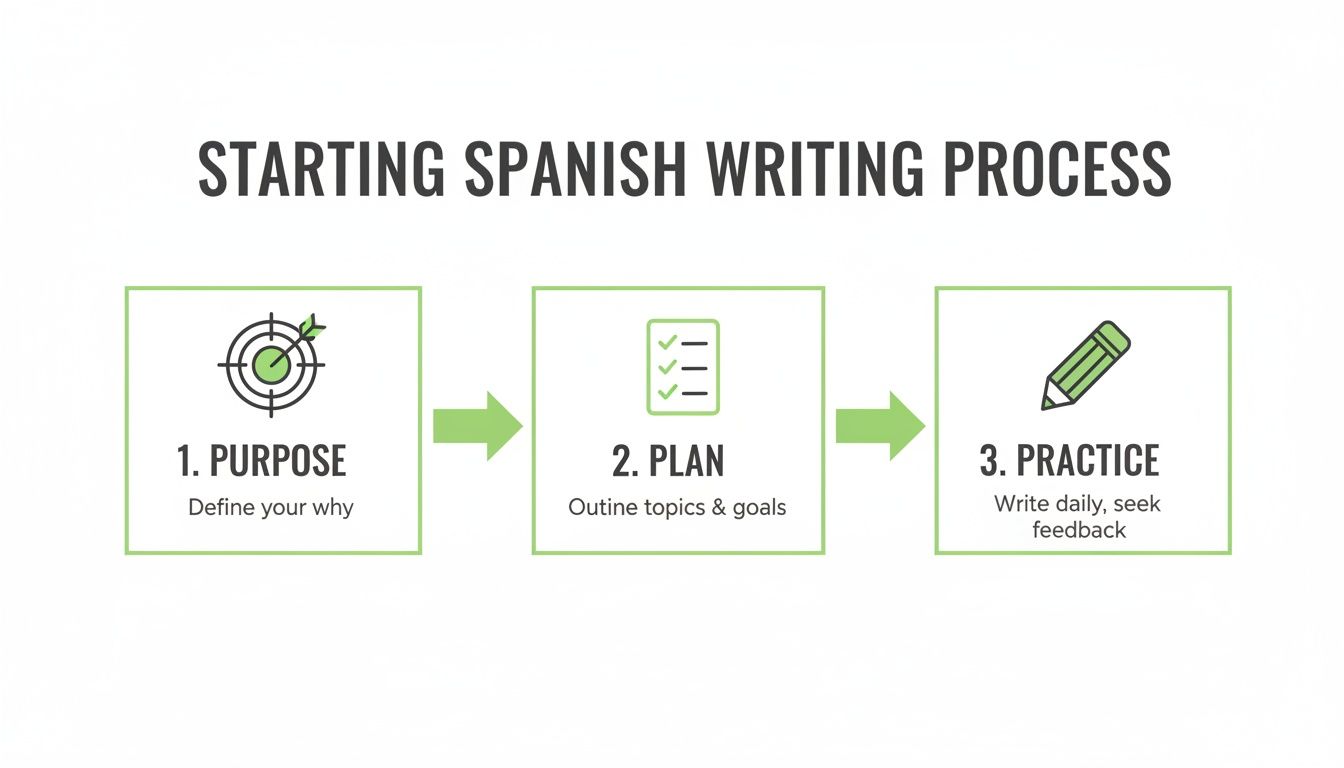
Learning to write in Spanish is all about turning passive knowledge into an active, usable skill. It's the bridge between input (reading and listening) and output (speaking and writing). The process boils down to three steps: setting a clear purpose, making a realistic plan, and practicing consistently.
Build Your Foundation for Spanish Writing
Many language learners get stuck in the "consumption trap." You can follow a podcast, understand a news article or TV show. But the moment you try to create something original, like a simple email or converstion, your mind goes blank.
If this sounds familiar, don't worry. This gap between understanding and producing is normal. Bridging it is what separates learners from fluent speakers, and writing is one of the best tools for the job.
It forces you to actively pull vocabulary from memory, wrestle with grammar, and organize your thoughts logically in Spanish. Writing solidifies everything you've picked up from listening and reading, turning fuzzy concepts into concrete skills. The goal is not perfection but building clarity and confidence, one sentence at a time. Writing is less anxiety-inducing than speaking which makes it a great starting point.
Define Your Personal Writing Goals
Before you start, ask yourself one simple question: Why do I want to write in Spanish? Your answer will guide your learning journey. A vague goal like "I want to get better at writing" is not effective. You need specific, personal objectives that mean something to you.
Consider these practical goals:
Professional Communication: Write clear, concise emails to Spanish-speaking colleagues or clients.
Social Connection: Comment on social media posts or message friends from Spanish-speaking countries naturally.
Personal Expression: Keep a daily journal to untangle your thoughts and track your progress.
Creative Pursuits: Craft short stories, poems, or blog posts to share your ideas with a new audience.
When you have a clear "why," staying motivated and focused is much easier. If professional emails are your goal, you'll concentrate on formal language and business vocabulary. If it's journaling, you'll need descriptive words and past tenses to talk about your day.
Connect With a Global Community
Learning to write in Spanish is more than an academic exercise; it's a key to a massive, interconnected world. The Instituto Cervantes reports there are nearly 600 million Spanish speakers worldwide, making it a powerhouse in global business and culture.
For a learner who knows 1,000–5,000 words, moving from understanding to writing is a significant leap. It opens a direct line of communication to this enormous community.
Your ability to write a simple, clear message in Spanish does more than practice a skill. It builds a bridge to hundreds of millions of people, allowing you to participate, not just observe.
This active participation makes writing powerful. It reinforces what you learn through methods like Comprehensible Input, where you absorb language naturally through reading and listening. You can learn more in our guide on what is Comprehensible Input.
Master Core Grammar for Clear Writing
Grammar can feel like the biggest obstacle when you start writing in Spanish, but it doesn't have to be. The secret is not to memorize every rule from day one. Instead, focus on high-impact concepts that do most of the heavy lifting in real-world communication.
If you can get a solid handle on a few core areas and combine this with lots of input, the clarity and flow of your sentences will improve dramatically. This isn't about staring at endless conjugation charts. It's about understanding how the pieces fit together unconsciously to create meaning.
Prioritize High-Frequency Verbs and Tenses
Your first target should be the verbs and tenses that appear constantly. You don't need to know every tense to write effectively. Focus your energy on the present and the two main past tenses: the preterite and the imperfect.
Understanding the difference between preterite and imperfect is a game-changer. The preterite narrates a story's main events, while the imperfect provides background details and context.
The goal isn't just to memorize rules but to develop an intuitive feel for them. One of the best ways to do this is through consistent exposure and practice. That's why we created our guide on how to learn grammar without studying rules. It's all about absorbing patterns naturally.
By zeroing in on these three tenses, you'll be able to express a huge range of ideas without feeling overwhelmed. This focused approach makes the process much more manageable.
Nail Noun and Adjective Agreement
One of the quickest ways to spot a non-native writer is incorrect agreement. In Spanish, every noun has a gender (masculine or feminine), and any articles or adjectives describing it must match it in both gender and number. There are no exceptions.
Here’s a quick look at what that means in practice:
| English Example | Incorrect Spanish | Correct Spanish | Explanation |
|---|---|---|---|
| The red house | La casa rojo | La casa roja | Casa is feminine, so the adjective rojo must be roja. |
| Some interesting books | Unos libros interesante | Unos libros interesantes | Libros is plural, so interesante must be interesantes. |
| The tall boys | Los chico altos | Los chicos altos | Both noun and adjective must be masculine and plural. |
This might seem fiddly at first, but with practice, it becomes second nature. Pay close attention to these details when you read, and make a conscious effort to double-check them when you write.
Build Your Connector Vocabulary
Smooth writing isn't just about correct grammar; it's also about linking ideas logically. Without transition words, your sentences can feel choppy and disconnected, like a list of facts instead of a flowing text.
Start with a small, versatile set of these "connector" words to link your thoughts:
To add information: y (and), también (also), además (furthermore)
To show contrast: pero (but), sin embargo (however)
To show cause/effect: porque (because), así que (so), por eso (that's why)
To sequence ideas: primero (first), luego (then), finalmente (finally)
A useful trick is to keep a list of these connectors handy while you write. Try to use a different one each time to add variety to your sentences. This simple habit will make your writing more sophisticated and easier for a native speaker to follow.
Develop a Consistent Spanish Writing Habit
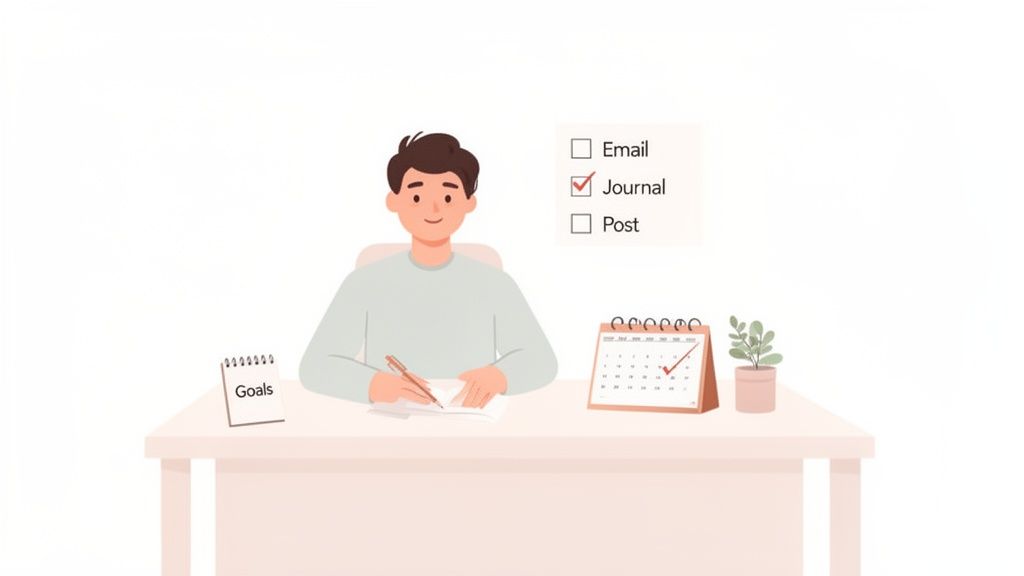
You can memorize every grammar rule, but that knowledge is useless if you don't actually write. Real, tangible progress in your Spanish writing comes from one thing: consistency. It's not about multi-hour cram sessions. It's about small, sustainable efforts woven into your daily life.
The goal is to make writing a few sentences in Spanish feel as normal as checking your email. This subtle shift transforms writing from a chore into a habit.
When you focus on showing up consistently, you remove the pressure. You give yourself permission to be imperfect, to experiment, and to simply get the words out. That’s where the real learning happens.
Embrace Low-Stakes Writing
One of the biggest hurdles to building a habit is the fear of making mistakes. This is where low-stakes writing becomes your secret weapon. The concept is simple: write for the sake of writing, without any concern for perfection.
Think quantity over quality, at least in the beginning. This approach builds fluency and confidence because you're not constantly second-guessing every word.
Here are a few ways to start:
Daily Journaling: Write three to five sentences about your day in Spanish. What did you do? How did you feel? It doesn't have to be poetry.
Brain Dumping: Set a timer for five minutes and just write. Don't stop to fix typos or look up words. Let your thoughts flow in Spanish, no matter how messy.
Simple Descriptions: Pick an object in your room. Describe it in a short paragraph using only the vocabulary you already know.
This kind of practice is like weight training for your brain. It strengthens the mental muscles needed to produce Spanish without hesitation, making more complex writing feel much easier later.
Turn Reading into Writing Practice
Here's a powerful technique: connect your writing directly to your reading. By linking your writing to comprehensible input, you naturally absorb authentic sentence structures and vocabulary that you can immediately use.
First, pick a short, level-appropriate text. It could be a news blurb, a blog post, or one of the simplified stories on a platform like Lenguia. Read it until you understand the main ideas.
Now, put the original text away and summarize it in your own words. The key here is not to copy sentences. You need to process the information and then reconstruct it using your own Spanish. This forces you to actively recall words and build your own sentences, using the original as a mental model.
By summarizing what you read, you actively turn passive knowledge into an active skill. You're not just consuming the language; you're creating with it, which is the fastest way to solidify what you've learned.
This method also solves the "what should I write about?" problem. The topic is already there for you, so you can focus entirely on the act of writing.
Learn From Your Mistakes and Self-Correct
Mistakes are not just part of the process; they're the most valuable resource you have. Every error you make writing in Spanish is a signpost, pointing you exactly where you need to focus next. When you learn to spot, understand, and fix your own mistakes, you become an active editor of your own work.
Leverage Feedback Loops for Faster Growth
Consistency gets you far, but consistent practice combined with immediate feedback puts your progress on the fast track. You need to know what you're doing right and, more importantly, why you're making certain mistakes.
Use AI Tools to Deepen Understanding
AI-powered writing assistants, like the one built into Lenguia’s writing journal, are fantastic for instant feedback. You get to write freely or with some guidance and then above every sentence you see the corrections. From there you can create a multi-media flashcard of the correction with just a couple of clicks.
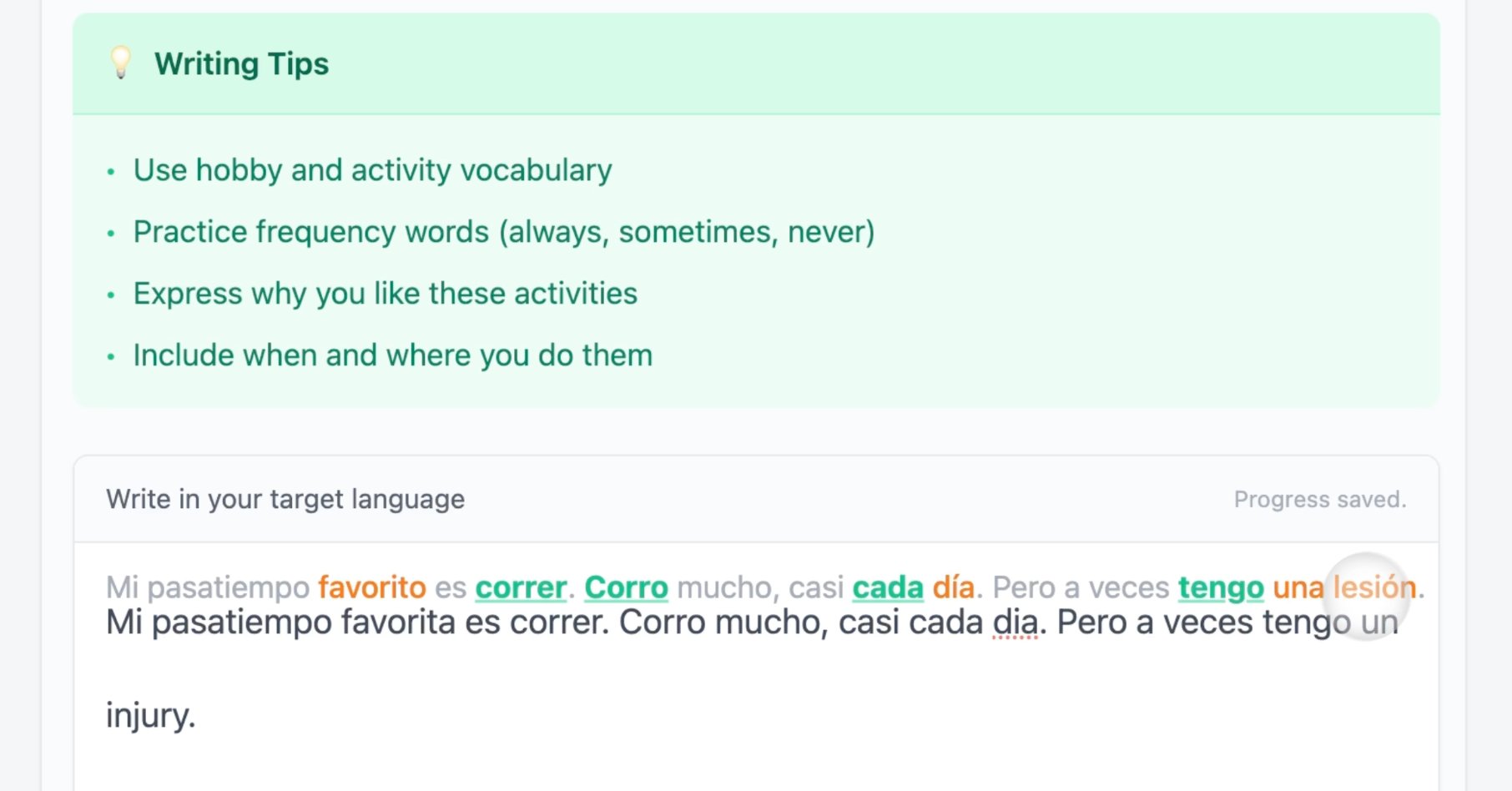
Treat the AI like a 24/7 tutor. When it suggests a correction, ask it: "Why is this the correct way to say this?" or "Can you explain the grammar rule here?" This turns a simple fix into a mini-lesson.
This kind of interaction makes the knowledge stick. It’s one thing to be told that "estoy feliz" is right, but understanding that happiness is a temporary state (estar) is what cements the rule in your brain.
Use Model Texts to Write More Naturally
Staring at a blank page is one of the most paralyzing parts of learning to write in Spanish. But you don't have to reinvent the wheel every time. Using model texts and simple templates is a powerful way to guide your writing, learn authentic phrasing, and build confidence.
By seeing how native speakers put sentences together, you’ll start to absorb the natural rhythm and flow of the language. It demystifies the process and gives you a clear path to writing Spanish that sounds natural.
Deconstruct and Rebuild
The real magic isn't just copying. It's about breaking down texts to understand how they work, then using those pieces to build your own original sentences. This is a much more active and effective way to learn than just passively reading.
Start with something short and simple, like a brief news blurb, a product description, or a comment on a YouTube video. Your job is to become a language detective.
Look for these key elements:
Key Phrases: Spot useful, repeatable chunks of language. Think of common greetings like "Espero que estés bien" (I hope you are well) or transition phrases like "Por otro lado" (On the other hand).
Sentence Structures: Pay attention to how sentences are built. Where does the adjective go? How do they connect two ideas? Make a note of these patterns.
Verb Tenses: Notice which tenses are used and try to figure out why. Is the writer describing a past event with the preterite or setting a scene with the imperfect?
Vocabulary in Context: Underline new words and see how they’re used in a real sentence. This is much more powerful than memorizing a word from a list.
Once you’ve gathered these building blocks, the next step is to use them. Try writing your own sentences by swapping out nouns and verbs but keeping the core structure. This "deconstruct and rebuild" method is a fantastic way to internalize Spanish grammar and style without getting lost in abstract rules.
Model texts provide a scaffold for your writing. They show you what’s possible and give you the structural support you need to express your own ideas clearly and correctly.
How Much Should I Write Each Day?
Consistency always wins over intensity. It's far more powerful to write for just 10 minutes every single day than to cram in a two-hour session on a Saturday. That could be as simple as jotting down a few sentences in a journal or writing a quick summary of a podcast you just heard.
This small daily habit is your best defense against burnout. It keeps Spanish active in your brain and constantly reinforces your vocabulary and grammar, which is essential for building long-term fluency.
Ready to put this advice into practice? The interactive writing journal from Lenguia is the perfect place to build that daily habit, offering instant AI corrections to guide you. Start making real, measurable progress today at https://www.lenguia.com.