The Best Way to Learn French: A Practical Roadmap
What is the secret to learning French? It is not about finding one perfect method. It is about building a simple, repeatable system that combines consistent exposure, active practice, and smart review until it becomes a daily habit.
The key is focusing on comprehensible input, listening to and reading things you can mostly understand, and then trying to use what you are learning.
Finding Your Blueprint for French Fluency
Forget the myth that there is a single magic bullet for becoming fluent. An effective learning plan is built on a few core principles that all work together. It is less about cramming vocabulary and grammar rules and more about creating a situation where French becomes a natural part of your life.
The goal is to move from rote memorization toward a more intuitive way of learning. You want to build a solid foundation that lets you understand, speak, and eventually think in French with real confidence all while enjoying the process. The most successful learners integrate these key pillars into their daily routine.
The Core Pillars of Language Acquisition
The modern way of learning French comes down to three powerful ideas you can start using today. Getting these right will shape every other learning decision you make.
Let's break down these foundational pillars.
| Principle | What It Means | Why It Works |
|---|---|---|
| Consistent Exposure | Surrounding yourself with French by listening and reading things you find interesting. | This builds your intuition for the language’s natural rhythm and structure without having to memorize rules. You will learn grammar inductively and see vocabulary in action. |
| Active Practice | Producing the language by speaking and writing, even for just a few minutes a day. | It forces you to actively recall what you have learned, cementing it in your memory and showing you where your gaps are. Start with writing and then move to speaking gradually (which is harder and often more anxiety-inducing) |
| Smart Review | Using a system to review vocabulary at the perfect moment, just before you are about to forget it. | This moves words from your short term memory to your reliable long term memory, so they stick for good. |
Mastering this cycle is what truly separates learners who make consistent progress from those who get stuck.
Here is a closer look at how these principles play out.
Consistent Exposure (Comprehensible Input)
This is all about surrounding yourself with French through listening and reading. The trick is to use materials you find genuinely interesting and can mostly understand. This idea, known as comprehensible input, is the most critical piece for developing an intuitive feel for the language. You can search for "comprehensible input french" on YouTube, read our free French stories and listen to easy French podcasts.
Active Practice (Output)
Input is only half the battle. You have to produce the language by speaking and writing, even if it is just for yourself for a few minutes each day. This process of active recall is what solidifies what you have learned and shines a light on the areas where you still need more work. Don't overdo this in the beginning as it might be discouraging to see how little you know and how often you will get stuck. You can also practice shadowing, where you watch a French video on YouTube and pause after every sentence. You then try to mimic the sentence - say it out loud for yourself and practice pronunciation that way without the need to construct the sentence yourself.
Smart Review (Spaced Repetition)
To stop vocabulary from going in one ear and out the other, you need a system. This is where tools using Spaced Repetition Systems (SRS) are a game changer. They prompt you to review words at the exact moment you are about to forget them, making your review sessions incredibly efficient.
The most effective way to master French is by combining small parts of formal study with daily immersion through media, and conversational practice. This blended approach addresses all facets of language acquisition, from grammar and vocabulary to real world communication skills.
A Global Language with Practical Benefits
French is one of the most popular second languages. It's an official language in 29 countries and a major player in global diplomacy, which gives learners plenty of motivation.
Thanks to modern tools, it is more accessible than ever. Digital apps make it easier for learners to stay consistent. This shows that combining app based learning with other methods is a powerful strategy for mastering the language.
Building Your Daily French Learning Habit
Consistency is your single greatest asset when it comes to learning French. It is not about marathon study sessions once a week. It is about small, repeatable actions that become as natural as brewing your morning coffee (this is how you should train for a marathon too!).
The goal is to weave French into your life so seamlessly it never feels like a chore. Let's focus on creating a simple, sustainable 30 minute routine that you can stick with even on your busiest days. It is this small daily commitment that builds incredible momentum over time.
Crafting Your 60-Minute Daily French Routine
A powerful daily habit does not require hours of grinding away at a textbook. A balanced 60 minute routine, segmented into different parts of the day, can cover all the essentials, ensuring you make steady progress in listening, vocabulary, and understanding new material. The trick is to link these activities to habits you already have.
Here is a simple but effective framework you can adapt:
30 Minutes of Consumption: Start and end your day with immersion. While your coffee brews or during your commute, put on a French podcast. This tunes your ear to the sounds and rhythms of the language. At night you can read a French text or again listen to more material. This block is the most important and the more time you have, the more you should focus on this. It builds the base of everything.
20 Minutes of Vocabulary Review: Use a Spaced Repetition System (SRS) like Anki or a built-in tool to review your flashcards during lunch time or even on toilet breaks instead of scrolling through social media feeds. This is the perfect activity for moments of downtime like waiting in line or on a quick break.
10 Minutes with New Material & Output: Dedicate the final block to something fresh. This could be reading a short news story, watching a five minute YouTube video in French, working through a grammar lesson in a language learning app, writing a short journal or recording a voice note for yourself.
This structure keeps you reinforcing what you already know while gently pushing your boundaries each day.
From Daily Actions to Weekly Wins
Once your daily habit is locked in, you can start thinking bigger. Scale that routine into a weekly plan with clear, achievable goals. This is where you connect your small daily efforts to larger, more motivating milestones. Instead of a vague goal like "get better at French," you create specific targets you can measure.
Successful learners focus on process over perfection. They know that a small, consistent daily effort is far more effective than sporadic bursts of intense study. This method builds not just knowledge, but confidence.
A solid weekly plan might include goals like these:
Learn 50 new high frequency words and use at least five of them in a sentence.
Have one 15-minute conversation with a language partner or tutor.
Watch one 20-minute episode of a French series with subtitles.
Write a short journal entry (5-7 sentences) about your day in French.
These goals are concrete and satisfying to check off. They create a positive feedback loop that keeps you engaged and transforms your learning from a passive activity into an active pursuit.
Your Roadmap From Beginner to Intermediate
Going from basic greetings to holding a conversation needs a solid plan. Think of this as a phased roadmap for your first few crucial months, designed to turn the goal of "learning French" into concrete, daily actions. The key is to build a strong foundation layer by layer, focusing on high impact activities.
This initial period is not about perfection. It is about building momentum. We will concentrate on the core pieces of the language, get you into a consistent habit of taking in French, and gently start producing simple sentences. Each phase has a distinct focus to keep you from getting overwhelmed.
Month One: Focus on the Core Foundations
Your first month is all about getting the essential building blocks in place. Before you can string together complex thoughts, you need a handle on how French sounds and the words people actually use. Many learners rush this part, which leads to frustration later.
Start by tackling French pronunciation. Pay close attention to the sounds that do not exist in English, like the nasal vowels (an, in, on) and the French 'r'. One effective strategy is to watch videos of native speakers and mimic their mouth movements.
At the same time, start building your vocabulary with the 500 most frequent French words. These are the words that form the backbone of everyday conversation. Getting them down early will give your comprehension a massive boost.
Pronunciation Drills: Spend 10 minutes a day practicing tricky sounds. Use online tools or apps with audio examples where you can record yourself and compare.
Vocabulary Building: Get a set of flashcards (digital or physical) for those top 500 words. The goal is active recall, forcing your brain to pull the word out of memory, not just passively recognizing it.
Simple Sentences: Start putting your new words together in basic sentences like "J'ai un chien" (I have a dog).
Months Two and Three: Build Your Input Engine
With some basic vocabulary and a better feel for pronunciation, it is time to immerse yourself. The main goal here is to make listening and reading French a consistent, enjoyable habit. This is where you flood your brain with comprehensible input.
Look for content made for learners at the A1-A2 level. The trick is to find stuff that is genuinely interesting to you, because that is what will keep you coming back. This could be podcasts with slow, clear speech, YouTube channels for beginners, or graded readers.
Lenguia is the perfect tool here, because it can turn any text, web article or book into a simplified version that suits your level. Additionally it creates daily texts for you based on your interests and vocabulary, so that you can naturally immerse with content you enjoy. It also helps by giving you interactive transcripts for podcasts and audio files so you can listen and read at the same time and get translations and flashcards with a single click.
This is also the perfect time to dip your toes into some simple, low pressure output. The idea is to start using the language without the fear of messing up in a live conversation.
The journey from beginner to intermediate is powered by a consistent diet of comprehensible input. When you listen to and read things you mostly understand, your brain naturally acquires grammar and sentence structures without tedious memorization.
Here is a great way to visualize how these habits stack up over time.
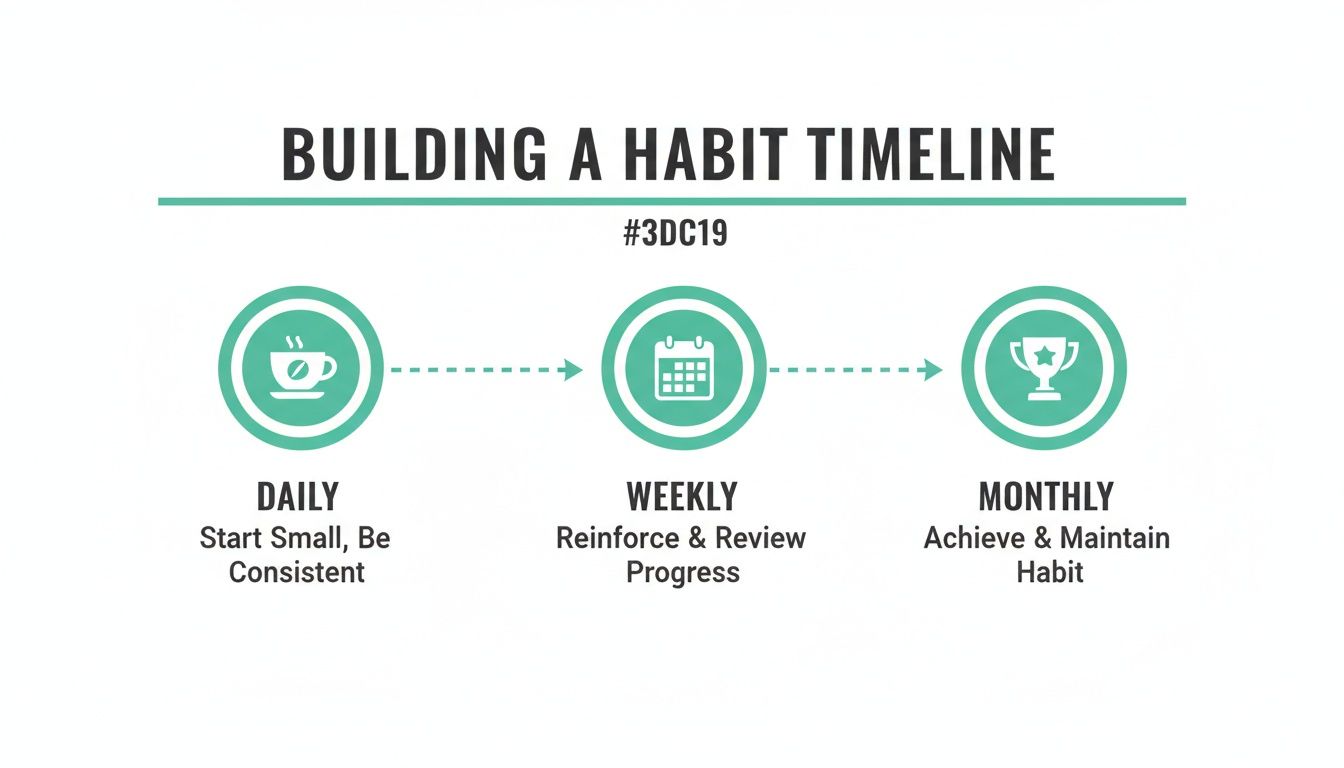
This shows how small daily actions, like listening to a podcast with your morning coffee, build into weekly wins and, eventually, major monthly breakthroughs
Integrating the Right Tools and Resources
The right tools can speed things up, but the wrong ones lead to frustration. The best way to learn French is not about downloading dozens of apps. It is about building a small, effective digital toolkit where each piece has a clear job.
Think of it as your own personal learning ecosystem. Instead of bouncing between random apps, you will have a smart workflow where each tool feeds into the next. This makes your study time more productive.
Building Your Core Learning Workflow
A smart workflow connects your activities in a logical loop. You might start with some input, move to practice, and finish with review. This creates a powerful cycle where new information gets locked in.
For example, imagine you are using an AI powered tool like Lenguia to read a news article. You stumble on a new phrase, get an instant translation, and immediately save it as a flashcard. Later, you use that same phrase while practicing in your AI writing journal and get instant corrections.
That is a smart workflow. It connects your input (reading), review (flashcards), and output (writing) into one seamless process.
Transforming Passive Consumption into Active Learning
One of the biggest game changers for modern learners is turning passive activities, like watching TV or browsing the web, into active French lessons. This is where a few key tools make all the difference.
Browser extensions are fantastic for this. They can overlay dual language subtitles on streaming services, making it easy to follow along. Others let you click any word on a webpage for an instant translation, turning the internet into your classroom.
This approach lets you soak up authentic French content you actually enjoy. It stops feeling like a chore and starts feeling like entertainment with a purpose.
Effective digital toolkits are small and focused. It is better to master two or three tools that work well together than to dabble in ten different apps that do not connect. A streamlined workflow reduces decision fatigue and keeps you focused on learning.
Finding and Maximizing Language Partnerships
Sooner or later, you have to talk to real people. This is non negotiable if you want to get conversationally fluent. Luckily, you do not need to live in France to find native speakers who are happy to chat.
Language exchange platforms are built to connect you with people who want to learn your native language. This sets up a partnership where you both get to practice and improve.
Popular Platforms for Language Exchange:
Tandem: This app works like a social network for language learners, letting you find partners for text, audio, or video chat.
HelloTalk: Similar to Tandem, it comes with helpful built-in tools like translation and correction features to make conversations flow better.
Once you find a partner, the key is making your chats productive. A little structure goes a long way in making sure you both get real value from the exchange.
Tips for Productive Language Exchanges
To get the most out of your conversations, it helps to have a game plan. This keeps you from defaulting back to English and ensures you are actively practicing new things.
Set a Time Split: Agree to spend half the time speaking French and the other half in your partner's language. A timer helps keep everyone honest.
Come Prepared: Think of a simple topic or a few questions beforehand. This kills awkward silences and gives your chat some direction.
Focus on Correction: Ask your partner to gently correct your major mistakes. You can agree on a system, like sending corrections in the chat after you finish speaking.
Keep a Notebook: Jot down new words or corrected phrases you pick up during the chat. These are pure gold for your next flashcard session.
By piecing together these tools and strategies, you create a powerful, personalized learning system. Your tools for input, review, and practice all work in concert, making sure every minute you spend on French is as effective as possible.
Avoiding Common French Learning Pitfalls
Sooner or later, every language learner hits a wall. The road to fluency is paved with common challenges that can stall your progress and drain your enthusiasm if you are not ready for them.
The good news? These roadblocks are predictable. Because they are predictable, we have proven ways to get around them. Let's break down the most common hurdles you will face and how to clear them.
Breaking Through the Intermediate Plateau
The dreaded "intermediate plateau" is that frustrating stage where you feel like you are putting in the hours, but your French is not getting any better. The initial buzz has worn off, but true fluency still feels miles away.
This usually happens when your learning methods have gone stale. The things that got you to the intermediate level, like beginner apps and simplified podcasts, are often the same things holding you back.
The Fix: Intentionally shake up your routine. If you have been glued to one app, add another to the mix. If you have only been listening to slow, clear podcasts for learners, it is time to find one with native speakers talking at their natural speed.
This kind of deliberate variety is what your brain needs. It introduces new accents, slang, and sentence structures, forcing it out of its comfort zone and back into growth mode.
Overcoming the Fear of Speaking
For many, the fear of making a mistake in front of a native speaker is paralyzing. You can spend months consuming French content, only to freeze when it is your turn to speak. It is a classic case of perfectionism getting in the way.
The longer you put off speaking, the bigger this mental hurdle becomes. You have to break the cycle. The key is to start small in a place where you feel safe.
Find low stakes environments to get your mouth moving without the pressure of a real conversation. This could be practicing with an AI coach, a patient tutor, or even just another learner.
Actionable Steps to Build Speaking Confidence:
Talk to yourself. Narrate your day in French. Describe what you are doing or thinking. It is zero pressure, high reward practice.
Hire a tutor. Platforms like italki or Preply connect you with tutors who are paid to be patient and encouraging.
Join a group. Find a small, friendly conversation group where everyone is learning. Knowing you are all in the same boat makes the fear of judgment melt away.
Escaping the Grammar Trap
Many learners, especially those from traditional schooling, get bogged down in grammar. They try to memorize every verb conjugation before they have a feel for how the language flows. This leads to slow, robotic speech because your brain is trying to be a calculator instead of a communicator.
Grammar is important, but it is the polish, not the foundation. Fluency comes from internalizing the natural patterns of a language by listening and reading a lot.
The Fix: Use grammar as a reference guide, not a textbook. When you are reading or listening and come across a structure you do not recognize, then you look it up.
This "just in time" approach is far more effective. It connects a rule to a real world context you have already seen, making it stick. Your brain absorbs the natural rhythm first, and the grammar rules simply clarify what you are already starting to notice.
Avoid the Translation Habit
Leaning too heavily on translation is another common crutch. If you are constantly translating words back and forth in your head, you are exhausting your brain and slowing everything down. The goal is to start thinking in French, even at a simple level.
This is a tough habit to break, but it is non negotiable for reaching advanced fluency. You need to create direct links between French words and the concepts they represent, cutting English out of the equation.
Practical Ways to Stop Translating:
Use a French-to-French dictionary. Once you have a decent vocabulary base, make the switch. It forces you to stay inside the language.
Visualize. When you learn a new word like courir (to run), do not just memorize the English. Picture someone running.
Every learner runs into these issues. The difference between those who succeed and those who get stuck is having a clear strategy to push through. Here is a quick summary to help you spot and solve these challenges.
Common French Learning Challenges and Solutions
| Common Pitfall | Why It Happens | Actionable Solution |
|---|---|---|
| Intermediate Plateau | Your routine has become too comfortable and is no longer challenging enough to stimulate growth. | Intentionally diversify your learning materials. Add new podcasts, watch different shows, or read about new topics. |
| Fear of Speaking | Perfectionism and the worry of being judged by native speakers create anxiety and hesitation. | Start speaking in low pressure environments. Talk to yourself, use an AI coach, or find a patient tutor. |
| The Grammar Trap | Over focusing on memorizing rules before developing an intuitive feel for the language. | Treat grammar as a reference. Look up patterns as you encounter them in your listening and reading, not before. |
| Translation Habit | Relying on your native language as an intermediary, which slows down comprehension and speech. | Create direct associations. Use a French-only dictionary, label objects in your home, and visualize new vocabulary. |
By being aware of these common traps and knowing how to climb out of them, you can keep your journey to French fluency smooth and moving forward.
Your French Learning Questions Answered
Even the best roadmaps have bumps, and questions are a natural part of the journey. Let's tackle some of the most common ones that pop up for anyone serious about learning French. Getting clear, practical answers helps you set the right expectations and stay focused on what actually works.
How Long Does It Really Take to Become Fluent in French?
The honest answer is that fluency is not a single destination; it is a spectrum. But we can still get a solid estimate. For a native English speaker aiming for a solid conversational level (B1/B2), you are looking at somewhere between 600 to 750 hours of focused learning.
If you put in about an hour of quality practice every day, that pencils out to roughly 1.5 to 2 years. You can speed this up with more intensity or by immersing yourself, but the real drivers are always consistency and the quality of your methods.
Should I Focus on Grammar or Vocabulary First?
In the very beginning, pour your energy into high frequency vocabulary. Learning the 500-1,000 most common French words unlocks a large amount of everyday language, often estimated around 80% of typical conversations. This gives you a massive head start on understanding what you hear and read.
Grammar is best learned in context. As you consume more French content, you will start to internalize the patterns. When you come across a sentence structure that trips you up, that is the perfect moment to look it up. This "just in time" approach makes the rules stick because they are connected to something real.
Treat grammar as a helpful guide for polishing your skills, not the foundation. The real foundation is a strong core vocabulary and tons of comprehensible input. This helps you build an intuitive feel for French, instead of trying to piece sentences together like a math problem.
What Is the Best Way to Practice Speaking Without Native Speakers?
You do not need to live in a French speaking country to get great speaking practice. Thanks to some fantastic tools, you have plenty of options. The goal is to get your mouth moving and build muscle memory and confidence.
Here are a few strategies that actually work:
Language Exchange Apps: Platforms like Tandem or HelloTalk are brilliant. They connect you with native French speakers who want to learn English. You can text, send voice notes, or do video calls.
Online Tutors: Services like italki or Preply offer affordable one on one sessions. This gives you a safe, structured space to talk with a guide who can offer instant, personalized feedback without judgment.
AI Language Coaches: Many platforms now have AI powered conversation partners. It is a game changer. You can practice speaking about anything, anytime, without the fear of making mistakes in front of another person.
Shadowing: This one is simple but powerful. You listen to a native speaker and repeat exactly what they say, trying to mimic their pronunciation, rhythm, and intonation. It is a fantastic way to train your mouth to produce French sounds naturally.
Ready to transform your learning with a tool built around these principles? Lenguia turns content you love into effective French lessons. Get daily, level-appropriate stories and podcasts, create flashcards with one click, and practice writing with an AI-powered journal that gives you immediate corrections.