How to Improve Reading Comprehension Skills: A Practical Guide
Improving your reading comprehension (especially in a foreign language) is more than just recognizing words on a page. It is about shifting from passively seeing text to actively understanding, questioning, and remembering what you read.
Why Strong Reading Comprehension Is Your Learning Superpower
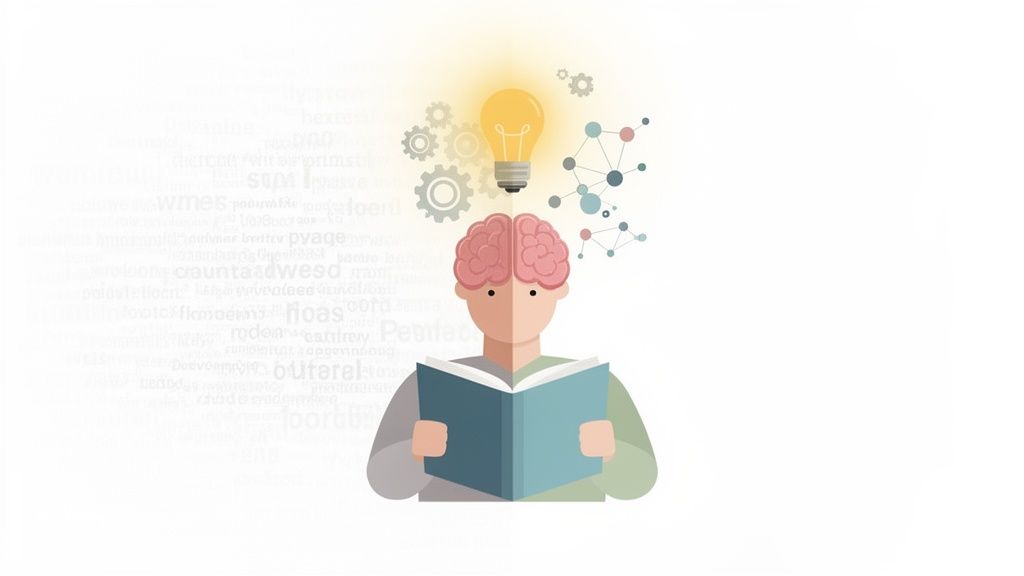
We have all been there. You get to the bottom of a page and realize you have no idea what you just read. Nothing stuck. That frustrating moment is the perfect example of the gap between simply seeing words and truly grasping their meaning. For any language learner, this is a huge and often discouraging roadblock.
Getting past this stage is everything. Good reading comprehension is not just a skill for passing tests; it is the engine that drives your fluency. It is what lets you connect new ideas to what you already know, creating a rich network of knowledge that actually sticks. Without it, you are just skimming the surface.
The Real-World Impact of Deeper Understanding
The payoff for boosting your comprehension skills goes way beyond the classroom. It is about building practical, real-world abilities that will shape your personal and professional life. When you can read and genuinely understand, you unlock some serious advantages.
Suddenly, you can follow complex instructions for a new task at work without getting flustered. You can analyze news articles and form your own opinions, instead of just taking someone else's word for it. You can even get lost in a novel in another language without feeling lost.
This ability to process and hold onto information is a game-changer in so many areas:
Academic Success: You will absorb key concepts from textbooks way more efficiently, which means better grades on assignments and exams.
Career Growth: Strong comprehension is crucial for everything from reading dense reports and staying on top of industry trends to just communicating clearly with your team.
Personal Enrichment: You can dive into new hobbies, learn complex skills from online guides, and connect more deeply with other cultures through their stories and writing.
True comprehension is not about pulling out a few facts. It is about building a mental model of what you are reading, which lets you debate its ideas, question its assumptions, and connect it all back to your own life.
Moving from Passive to Active Reading
So, how do you make that jump from passively scanning words to actively engaging with them? It all starts with a mindset shift. Stop seeing a text as a one-way street where information is just dumped on you. Instead, think of it as a conversation. You are not just a receiver; you are an active participant.
This guide will walk you through the practical strategies to make that happen. The goal is to give you a toolkit that turns every reading session into a powerful learning opportunity.
Mastering the Core Skills for Deeper Understanding
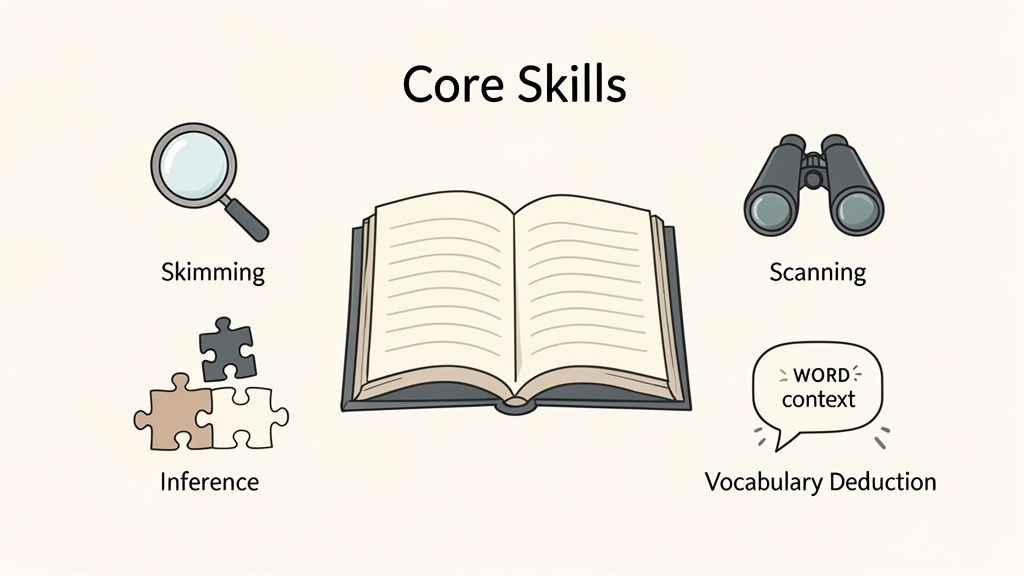
If you want to move from just getting the gist of a text to truly understanding it, you need to master a few foundational techniques.
Strategic Skimming and Scanning
A lot of people think skimming and scanning are just lazy reading. They are not. When used right, they are precision instruments that help you get oriented before you dive deep.
Skimming is your first pass, like glancing at a map before a road trip. You read the headings, subheadings, the first sentence of each paragraph, and any bold text. This gives you the layout and the main points in a flash.
Scanning is different. It is about finding a specific piece of information, like a name, a date, or a key statistic. Your eyes sweep across the page, ignoring everything else until you lock onto the target.
Let's make this practical. Imagine you are looking at a news article about a new scientific study:
Skim First (60 seconds): Read the headline, subheadings, and the first sentence of the intro and conclusion. You will instantly know the main finding, like "New study finds daily walks improve memory."
Scan Next (30 seconds): Now, you hunt for specifics. Scan for numbers or keywords like "participants," "percentage," or the research institution's name. You'll quickly spot details like "5% improvement" or "University of Knowledge."
This quick two-step process primes your brain. It gives you a framework to hang the details on when you start reading more closely.
Reading Between the Lines With Inference
Real understanding goes beyond what is written on the page. You have to make inferences, which are educated guesses based on the text and your own knowledge. It is the art of figuring out what the author implies without saying it directly.
Think about it: you read a story where a character walks in with soaked shoes and a dripping umbrella, shivering. The author never says, "It's raining," but you know it is. You inferred it from the clues.
To get better at this, constantly ask yourself "why" as you read. Why did the author use that specific word? Why did that character do that? This mindset forces you to dig for hidden meanings and deeper connections.
You can also practice by making predictions. Pause every so often and ask, "What do I think will happen next?" This keeps you actively engaged and trains your brain to spot subtle hints.
Unlocking Vocabulary From Context
Stopping to look up every new word in the dictionary is a surefire way to kill your momentum and motivation. A much better skill is learning to figure out a word's meaning from its context. The sentences around an unfamiliar word are packed with clues.
Take this sentence for example: "The project was a fiasco; the budget was blown, the deadline was missed, and the final product did not even work."
Even if you have never seen the word "fiasco," you know exactly what it means. The list of complete failures tells you it was a disaster. This skill is crucial for keeping your reading flow, especially with tough material. Plus, learning words this way helps you remember them because you are linking them to a real situation.
Building these skills is not just about learning techniques; it is about adopting a more systematic way of reading. Ultimately, mastering these skills means you get more out of every single thing you read. For language learners, this approach is especially powerful because it aligns with how we acquire languages most effectively. You can learn more about this in our guide on what is comprehensible input.
Building a Reading Routine That Actually Sticks
Understanding the core skills of comprehension is one thing; putting them into practice consistently is where the real growth happens. We have all had great intentions that fade without a solid routine. The secret is not cramming for hours, but building a sustainable habit that actually fits into your life.
When it comes to improving your reading comprehension, consistency is so much more powerful than intensity. A short, focused session every day builds momentum and keeps your new skills sharp. It is about making reading an automatic part of your day, just like brewing your morning coffee.
The Power of the 20-Minute Daily Session
Twenty minutes might not sound like a lot, but it is the sweet spot. It's long enough to engage deeply with a text but short enough that you can squeeze it in on even your most chaotic days. Think of this daily practice as your gym session for your comprehension muscles.
The goal here is not to finish a book, it is to actively practice. During this time, you should be applying the strategies we have discussed, like making inferences or spotting main ideas, with a text that is just challenging enough to stretch you.
This whole approach is built on the idea of comprehensible input. This is the theory that we learn most effectively when we understand most of what we are reading but are still exposed to new words and structures. Finding the right material is everything. To get started, you can find a selection of texts at just the right level in our library of Spanish stories, which are designed for exactly this kind of practice.
Designing Your Weekly Deep Dive
While daily sessions are for consistency, a weekly deep dive is where you cement your understanding. Once a week, set aside a bigger chunk of time, perhaps 45 to 60 minutes, to tackle something more substantial. This could be a long-form news article, a full book chapter, or a detailed report on a topic you find interesting.
This longer session serves two key purposes:
Sustained Focus: It trains your brain to maintain concentration over a longer period.
Active Recall: This is the most crucial part. After reading, you need to reinforce what you have just learned.
Once you finish your deep-dive reading, take ten minutes to write a quick summary of the text in your own words. This simple act forces you to process the information, pull out the most important points, and structure them logically. It is an immediate gut-check on your comprehension and instantly shows you where the gaps are.
Making It Stick with a Flexible Schedule
Let's be real: a rigid schedule is a fragile one. The best routine is one you can adapt to your life. Below is a sample weekly plan, but think of it as a flexible template. The key is to find what works for you and stick with it.
And remember, the goal is progress, not perfection. If you miss a day, do not worry about it. Just get back to it the next day. International assessments back this up, showing that enjoyment and consistency are huge drivers of success. For example, the PIRLS 2021 study found that students who liked reading scored significantly higher.
Here is a look at what a balanced week could look like. It is designed to be effective without leading to burnout.
Sample Weekly Reading Comprehension Routine
| Day | Activity (15-25 minutes) | Goal |
|---|---|---|
| Mon-Thu | Read a short, level-appropriate article or story. Focus on one active reading strategy each day. | Build consistency and reinforce core skills. |
| Friday | Review new vocabulary from the week. Use flashcards or write sentences with the new words. | Solidify vocabulary retention. |
| Saturday | Deep Dive (45-60 min): Read a longer article and write a one-paragraph summary. | Improve focus and practice synthesis. |
| Sunday | Rest or read purely for pleasure with no specific goal. | Maintain motivation and enjoy the language. |
This structured approach transforms the vague goal of "improving comprehension" into a series of small, achievable daily actions. By combining short, regular practice with a weekly deep dive, you create a powerful system for steady, noticeable growth.
Using Smart Technology to Accelerate Your Progress
While consistent practice and solid strategies are your foundation, smart technology can seriously speed things up. The right tools can knock down the most common roadblocks, making the journey to better reading comprehension a whole lot smoother and, frankly, more fun.
This is not just about adding another app to your phone. It is about integrating technology into your core learning system. Platforms designed for language learners, like Lenguia, build these tools right into the reading experience. This means you can stay focused on the story without constantly stopping to look up words. The goal is to make learning feel less like a chore and more like a natural discovery.
Getting Daily Doses of Comprehensible Input
One of the toughest parts of learning any language is finding a steady supply of material to read that is both interesting and just right for your level. This is where AI-powered platforms are a huge help. They can serve up daily, level-appropriate stories and articles based on what you actually like, ensuring you always have fresh content that provides perfect comprehensible input.
This is huge for motivation. You are reading about things you genuinely care about, not some boring textbook chapter. More importantly, it keeps you in that sweet spot of being challenged enough to grow without feeling totally lost. That consistent exposure is how you start to internalize vocabulary and grammar without even trying.
Making Authentic Content Accessible
Ever get excited to read a real news article or a book in your target language, only to find it is way too hard? It is a common wall to hit, and it is where technology offers a brilliant workaround. Lenguia offers text simplification features, so you can grab any authentic web article or book and simplify the vocabulary and sentence structure to fit your reading level.
This feature is a total game-changer. It means you can dive into current, relevant, and interesting topics early on, instead of waiting until you are "advanced" enough. You get all the benefits of real-world content without the usual frustration.
By making challenging texts accessible, these tools bridge the gap between learner materials and the real world. You are not just practicing reading; you are actively participating in the language as it is used today.
Overcoming Common Reading Comprehension Hurdles
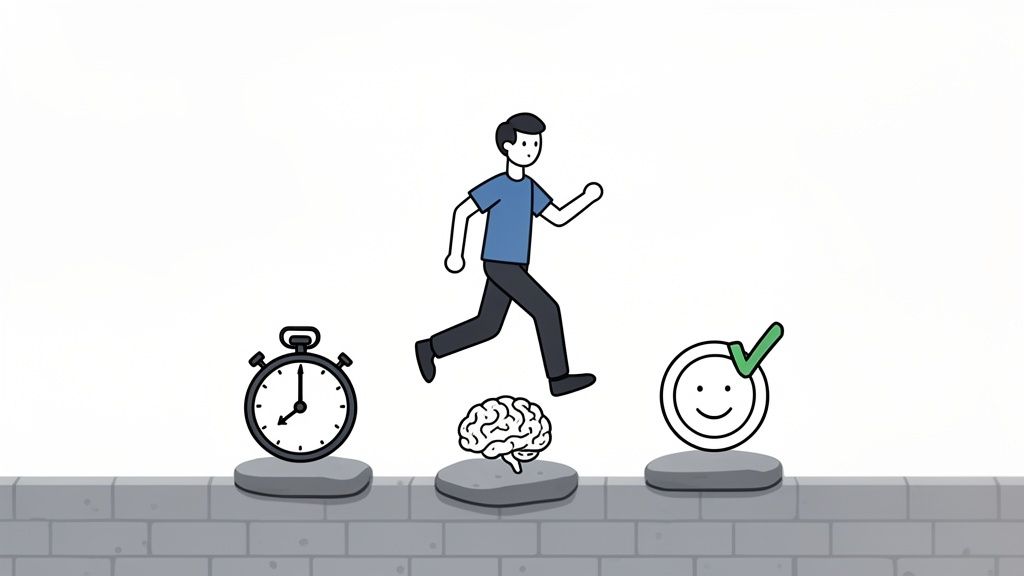
Every language learner hits a wall eventually. You feel like you are putting in the effort, but the words just are not sticking. Do not worry, this is a completely normal part of the journey, not a sign that you are failing.
The trick is figuring out what is tripping you up and hitting it with the right strategy. Let's dig into the most common obstacles and give you some battle-tested ways to blow right past them.
Regaining Focus When Your Mind Wanders
Sound familiar? You start reading, and two paragraphs later, you are mentally making a grocery list or planning your weekend. Losing focus is probably the most common struggle, and it is usually a sign of mental fatigue or just plain passive reading.
The fix is to turn reading into a short, focused game. Forget trying to read for an hour straight. Instead, try short, timed bursts.
Set a timer for just 10 minutes.
During that window, your only job is to read with total concentration.
When the timer dings, take a two-minute break. Seriously, get up, stretch, then dive back in.
This approach, a variation of the Pomodoro Technique, trains your brain to sustain attention. It makes the whole task feel less intimidating and builds your mental stamina over time.
Decoding Intimidating Sentences
Long, complex sentences with a bunch of clauses can feel like hitting a brick wall. When you run into one, it is easy to get overwhelmed and completely lose the author's point. The strategy here is to play detective and break the sentence down into smaller, digestible chunks.
Instead of trying to swallow it whole, dissect it piece by piece:
Find the main subject and verb. This is the sentence's simple skeleton.
Identify the supporting clauses. Look for connecting words like "which," "that," "because," and "although."
Restate each part in your own words. Then, put the simplified pieces back together to grasp the full idea.
This methodical approach turns a complex puzzle into a series of simple, manageable steps.
Of course, some reading challenges are more deeply rooted. For learners facing specific difficulties, our guide on dyslexia and learning a second language offers more targeted insights.
Ultimately, pushing past these hurdles comes down to having the right strategies and getting consistent exposure to your target language. International assessments back this up. For instance, the 2022 PISA results from the OECD show a clear link between targeted support and reading success. While scores vary globally, students who regularly engage with meaningful texts at their level consistently perform much better.
Got Questions About Reading Comprehension? Let's Get Them Answered.
As you start digging into improving your reading, a lot of questions pop up. It is totally normal. Getting clear, practical answers is the best way to keep your practice on track and set expectations that will not leave you feeling frustrated.
Let us tackle some of the most common questions from learners.
How Long Does It Take to See Improvement?
This is the big one, isn't it? The honest answer is: it depends on where you are starting from and how consistent you are. But the good news is, most learners start to feel a real difference within just a few weeks of dedicated practice.
If you can carve out 20 to 30 minutes a day for focused reading, your brain will start to form new pathways. You will begin to spot main ideas faster, and that wall of unfamiliar vocabulary will not feel quite so intimidating.
But true, lasting improvement? That is a marathon, not a sprint. We are talking several months of consistent effort. The quality of your practice is way more important than the hours you log. This is where using level-appropriate content really shines, it makes sure every single session is productive and keeps you locked in.
Is It Better to Read Fast or Slowly?
The only correct speed is the one that matches your goal for that specific text. There is no magic number here. It is all about adapting your pace to your purpose.
Think of it like driving. You do not use the same speed for a wide-open highway as you do for navigating a tight parking garage.
Go Fast (Skimming): Perfect for getting the gist of something. You might skim a news article just to catch the main points without getting bogged down in the details.
Slow Down (Studying): When you need to really understand and absorb information, hitting the brakes is crucial. A slower pace gives your brain time to connect ideas, process new words, and actually learn.
Ultimately, the goal is to develop reading fluency, a comfortable, efficient pace that lets you focus your mental energy on understanding the meaning, not just decoding the words. A good habit is to skim a text first for a quick preview, then circle back for a slower, more detailed read.
Can I Improve by Only Reading What I Enjoy?
Yes, absolutely. In fact, it is one of the most powerful strategies you can use. Reading for pleasure is the ultimate motivator, and motivation is what builds the consistency you need for real, long-term progress.
When you are hooked on a story or fascinated by a topic, you are naturally more willing to wrestle with tricky sentences or look up a new word. Your brain is just more open to learning when the experience is rewarding. It turns what could feel like a chore into something you actually look forward to.
Reading what you love is the secret to building a habit that sticks. It transforms practice into a hobby, and that is a game-changer for long-term consistency.
While it is a good idea to eventually branch out into different genres to build a more well-rounded skill set, starting with materials you genuinely can't put down is the best foundation you can build.
What Role Does Writing Play in Improving Reading?
Think of writing as the ultimate comprehension check. It is the bridge between passively taking in information and actively understanding it. When you have to summarize an article or jot down your thoughts on a chapter, you are forced to organize the information in your own words.
This act of "output" immediately shines a spotlight on any gaps in your understanding. You might finish reading an article and think you have got it all figured out, but the moment you try to explain its main argument, you will instantly discover which parts are still a bit fuzzy.
Try this: After each reading session, take five minutes to write a short, one-paragraph summary in a journal. It is a simple, powerful exercise in active recall that cements what you have learned and delivers tangible gains.
Ready to put these ideas into practice? Lenguia gives you daily, level-appropriate stories and smart tools that make improving your reading feel less like work and more like fun. Stop hunting for the right materials and start enjoying the path to fluency. See how our platform can speed up your progress at https://www.lenguia.com.