10 Authentic Conversation Starters in Spanish for 2026
Moving from textbook Spanish to real, flowing conversations is a significant leap for any learner. The right question can instantly turn a simple greeting into a meaningful exchange, but many students get stuck relying on the same basic phrases they learned on day one. This hesitation often stems not from a lack of vocabulary, but from a lack of confidence in using authentic, natural-sounding openers. This guide is designed to bridge that gap by providing a toolkit of practical and effective conversation starters in Spanish.
You will learn not just what to ask, but how and why it works in specific social settings. Forget robotic translations and awkward silences. By the end of this article, you will have a clear framework for starting conversations that are more interesting, authentic, and rewarding, helping you transform your Spanish skills into real-world connections.
1. ¿De dónde eres?
As one of the most fundamental and universally useful conversation starters in Spanish, ¿De dónde eres? (Where are you from?) is an essential tool for any learner. This simple question does more than just ask for a location; it opens a gateway to discussing personal history, cultural background, and regional identity. For learners, it’s a high-impact opener that immediately establishes context and invites a narrative response.
This question is perfect for initial interactions, whether you're meeting a new language exchange partner, joining a group conversation, or simply breaking the ice. The answer almost always provides rich, comprehensible input filled with new vocabulary related to cities, countries, and cultural specifics. It is the natural starting point from which deeper, more meaningful conversations can grow.
How to Deepen the Conversation
Asking the question is just the beginning. The real learning happens in the follow-up. Once your conversation partner tells you where they're from, use these strategies to keep the dialogue flowing:
Ask for details: Use questions like ¿Y cómo es tu ciudad/país? (And what is your city/country like?) or ¿Qué es lo más famoso de allí? (What is the most famous thing from there?).
Share your own experience: Connect their answer to your own knowledge or experiences. For example, ¡Ah, Colombia! He oído que el café de allí es increíble. (Ah, Colombia! I've heard the coffee there is incredible.)
Inquire about their connection: Ask ¿Toda tu familia es de allí? (Is all of your family from there?) to learn more about their personal history.
2. ¿Qué te apasiona?
Diving deeper than surface-level questions, ¿Qué te apasiona? (What are you passionate about?) is one of the most powerful conversation starters in Spanish. It bypasses simple facts and goes straight to the heart of what motivates a person. This question invites an emotional, detailed response, creating an immediate opportunity for a meaningful connection and exposing you to rich, specialized vocabulary.
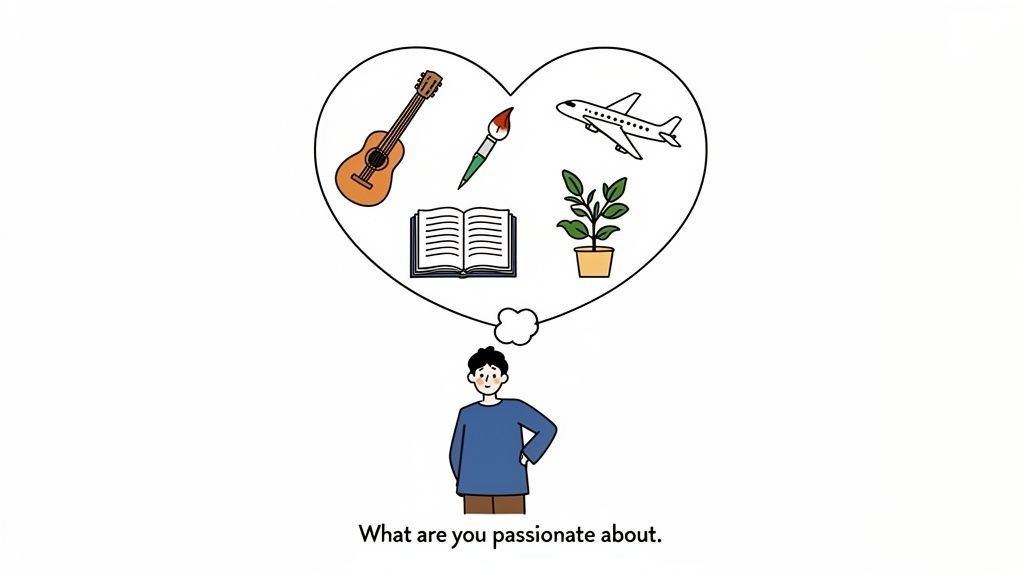
Using this opener shows genuine curiosity and respect for your conversation partner's inner world. The answers you receive will be packed with descriptive language, personal stories, and the specific terms people use when talking about their hobbies and interests. It is an ideal way to move beyond rehearsed small talk and engage in authentic, memorable dialogue.
How to Deepen the Conversation
The initial answer is a goldmine of topics. To keep the momentum going, build upon what they share with you. Here are some effective follow-up strategies:
Explore the "why": Ask questions like ¿Qué es lo que más te gusta de [su pasión]? (What do you like most about [their passion]?) or ¿Cómo descubriste que te gustaba? (How did you discover you liked it?).
Show active interest: Relate to their passion by saying something like, ¡Qué interesante! Siempre he querido aprender a tocar la guitarra. (How interesting! I've always wanted to learn to play the guitar.)
Inquire about their journey: Use prompts like ¿Desde cuándo lo haces? (How long have you been doing it?) to learn more about their dedication and experience.
3. ¿Cuál es tu comida favorita?
As one of the most universally enjoyable and culturally significant conversation starters in Spanish, ¿Cuál es tu comida favorita? (What is your favorite food?) is a fantastic tool for any learner. This question taps into the central role that food plays in family, celebration, and identity across the Spanish-speaking world. It's a simple, friendly opener that invites personal stories and a rich exchange of vocabulary.
This question is highly effective because it’s both personal and universal, making it suitable for almost any informal social setting. The answers often lead to discussions about recipes, family traditions, and regional specialties, providing you with authentic, context-rich language. For learners, it’s an accessible way to talk about something tangible and sensory, connecting language directly to culture and experience.
How to Deepen the Conversation
The initial question is just an appetizer. The main course of the conversation comes from your follow-up questions. Once you know their favorite dish, use these strategies to explore the topic further:
Ask about preparation: Inquire about the process with questions like ¿Cómo se prepara? (How is it prepared?) or ¿Qué ingredientes lleva? (What ingredients does it have?). This is a great way to learn cooking verbs and food vocabulary.
Connect to culture and family: Ask about the dish's significance, such as ¿Es un plato típico de tu región? (Is it a typical dish from your region?) or ¿Hay alguna historia familiar con esa comida? (Is there a family story with that food?).
Share your own favorites: Reciprocate by sharing your favorite food and why you like it. For instance, A mí me encanta la paella. La probé por primera vez en Valencia y fue inolvidable. (I love paella. I tried it for the first time in Valencia and it was unforgettable.)
4. ¿Qué hiciste el fin de semana pasado?
For intermediate learners aiming to break free from present-tense conversations, ¿Qué hiciste el fin de semana pasado? (What did you do last weekend?) is an indispensable tool. This question is one of the most effective conversation starters in Spanish for practicing past tenses, specifically the preterite and imperfect, which are crucial for storytelling. It shifts the dialogue from simple facts to personal narratives, a cornerstone of genuine human connection.
Using this question encourages your conversation partner to recount events, providing you with a natural story filled with rich vocabulary and grammatical structures. It’s perfect for Monday or Tuesday chats, making it a timely and relevant opener. For learners, it’s a direct invitation to practice narrating experiences, moving beyond theoretical grammar exercises into practical, real-world application.
How to Deepen the Conversation
A good story deserves an engaged audience. Once they share their weekend activities, use these follow-up questions to explore the narrative further:
Ask about feelings and impressions: ¿Y qué tal? ¿Te divertiste? (And how was it? Did you have fun?) or ¿Cómo estuvo la comida en ese restaurante? (How was the food at that restaurant?).
Request more details: If they mention a movie or a book, ask ¿De qué se trataba? (What was it about?). If they went hiking, ask ¿El paisaje era bonito? (Was the scenery pretty?).
Connect it to future plans: Turn the past into the future with questions like ¿Volverías a ir a ese lugar? (Would you go back to that place?) or ¿Me lo recomiendas? (Do you recommend it to me?).
5. ¿Cuáles son tus metas personales?
As a forward-looking and deeply personal opener, ¿Cuáles son tus metas personales? (What are your personal goals?) is one of the most powerful conversation starters in Spanish for forging a genuine connection. This question moves beyond surface-level topics to explore aspirations, motivations, and future plans. It’s particularly effective for adult learners as it taps into the very reason many of us learn a new language: personal growth and achieving new goals.
This question is ideal for conversations where you want to build rapport and show you are interested in the other person's ambitions. The responses naturally prompt the use of advanced grammar, including the future tense ("viajaré a Perú"), conditional structures ("me gustaría empezar mi propio negocio"), and even the subjunctive mood ("espero que pueda aprender a tocar la guitarra"). This creates a rich learning environment within a single, meaningful exchange.
How to Deepen the Conversation
The initial answer is a fantastic starting point. To build on it and encourage a more profound discussion, use these follow-up strategies:
Ask about the "why": Inquire about the motivation behind their goals with ¿Por qué es importante para ti? (Why is that important to you?) or ¿Qué te inspiró a tener esa meta? (What inspired you to have that goal?).
Discuss the process: Show interest in their plan by asking ¿Y qué pasos estás tomando para lograrlo? (And what steps are you taking to achieve it?). This invites them to share their strategy and progress.
Share your own goals: Reciprocate by sharing your own aspirations. For example, ¡Qué interesante! Una de mis metas es llegar a un nivel C1 en español este año. (How interesting! One of my goals is to reach a C1 level in Spanish this year.)
Key Insight: Asking about personal goals transforms a simple chat into a motivational exchange. It allows both speakers to practice advanced grammar related to future possibilities while building a connection based on shared ambition.
6. ¿Cuál es tu libro/película favorita?
Diving into cultural tastes, ¿Cuál es tu libro/película favorita? (What is your favorite book/movie?) is one of the most effective conversation starters in Spanish. This question goes beyond simple preferences, opening doors to discussions about art, storytelling, cultural values, and personal identity. It's a fantastic way to generate rich, detailed dialogue and discover shared interests.
Using this opener is ideal when you want to move past superficial topics and into more substantive territory. The answers reveal a person’s narrative preferences, emotional responses, and often introduce you to important cultural works, from Gabriel García Márquez's novels to the latest Almodóvar film. The ensuing discussion naturally brings up complex vocabulary and grammatical structures, particularly the subjunctive mood for expressing opinions and recommendations.
How to Deepen the Conversation
A simple answer is just the beginning. The real value lies in exploring the "why" behind their choice. Use these follow-up strategies to build a more engaging dialogue:
Explore the themes: Ask questions like ¿De qué se trata? (What is it about?) or ¿Cuál es el mensaje principal para ti? (What is the main message for you?).
Discuss characters and plot: Use prompts such as ¿Quién es tu personaje favorito y por qué? (Who is your favorite character and why?) or ¿Qué parte te sorprendió más? (Which part surprised you the most?).
Share your own perspective: Connect their favorite to something you enjoy. For instance, ¡Me encanta esa película también! No creo que el final fuera justo. (I love that movie too! I don't think the ending was fair.) This is a perfect opportunity to practice the subjunctive.
7. ¿Cómo pasas tu tiempo libre?
Moving beyond initial introductions, ¿Cómo pasas tu tiempo libre? (How do you spend your free time?) is a practical, lifestyle-focused conversation starter. It shifts the dialogue toward personal interests, daily habits, and passions, creating an immediate connection. For intermediate learners, this question is a goldmine for comprehensible input, as the answers are packed with vocabulary and grammatical structures directly related to real-life activities.
This question is ideal for building rapport once basic introductions are complete. It allows learners to practice describing routines using the present tense and introduces vocabulary specific to their own hobbies. Discussing leisure activities naturally aligns language practice with authentic lifestyle integration, making the conversation both meaningful and memorable. It helps you find common ground with your conversation partner.
How to Deepen the Conversation
A simple answer is good, but a detailed discussion is better. Use these follow-up questions to explore their interests and share your own:
Ask about frequency and history: Use questions like ¿Desde cuándo te gusta [la pintura]? (How long have you liked [painting]?) or ¿Con qué frecuencia [vas al gimnasio]? (How often do you [go to the gym]?).
Share your related interests: Create a connection by sharing your own hobbies. For example, A mí también me encanta la música. ¿Qué tipo de música escuchas? (I love music too. What kind of music do you listen to?).
Inquire about specifics: Dig deeper into their passion. If they like to read, ask ¿Cuál fue el último libro que leíste? (What was the last book you read?).
8. ¿Qué opinas sobre...? (What do you think about...?)
As you move into more advanced levels of Spanish, your goal shifts from exchanging basic information to sharing complex ideas. The phrase ¿Qué opinas sobre...? (What do you think about...?) is one of the most powerful conversation starters in Spanish for achieving this. It's a versatile framework that invites opinion, debate, and critical thinking, pushing you beyond simple facts and into the realm of abstract thought and personal perspective.
This opener is perfect for any context where a deeper discussion is welcome, from a one-on-one language exchange to a group dinner. By asking for an opinion, you signal that you value the other person's viewpoint, which is an excellent way to build rapport. The resulting conversation naturally generates advanced vocabulary and grammatical structures, particularly the subjunctive mood, which is essential for expressing desires, doubts, and opinions.
How to Deepen the Conversation
Simply asking for an opinion is just the start; the real magic is in the ensuing discussion. Once your partner shares their thoughts, use these strategies to explore the topic further:
Ask for justification: Follow up with ¿Por qué piensas así? (Why do you think that?) to understand the reasoning behind their opinion.
Introduce a counterpoint politely: To practice disagreement, you can say, Entiendo tu punto, pero yo creo que... (I understand your point, but I believe that...) or Es interesante, aunque yo lo veo de otra manera. (That's interesting, although I see it differently.)
Expand the topic: Connect their opinion to a broader theme with questions like ¿Crees que esa situación va a cambiar en el futuro? (Do you think that situation will change in the future?).
9. ¿Cuáles son tus desafíos en el aprendizaje del español?
As a meta-question perfect for the language learning community, ¿Cuáles son tus desafíos en el aprendizaje del español? (What are your challenges in learning Spanish?) is one of the most effective conversation starters in Spanish for building camaraderie. This question shifts the focus to the shared experience of learning, acknowledging struggles and creating a space for authentic peer support, empathy, and resource sharing. It’s a powerful tool for connecting with fellow learners on a deeper level.
This opener is ideal for language exchanges, study groups, or online forums. It moves beyond superficial small talk and gets to the heart of the learning journey. The resulting discussion is often rich with specific vocabulary related to grammar (like the subjunctive mood or verb conjugations), pronunciation difficulties, and learning strategies, making it a valuable learning opportunity in itself.
How to Deepen the Conversation
The initial question is a great starting point, but the real value comes from the collaborative problem-solving that follows. Use these follow-up strategies to foster a supportive and productive dialogue:
Offer specific help: If someone mentions a challenge you've overcome, share your strategy. For example, El subjuntivo también fue difícil para mí. ¿Has probado escuchar podcasts que lo usan mucho? (The subjunctive was hard for me too. Have you tried listening to podcasts that use it a lot?).
Ask about their methods: Inquire about what they've tried so far with a question like ¿Qué métodos has intentado para mejorar tu pronunciación? (What methods have you tried to improve your pronunciation?).
Share your own challenges: Be vulnerable and share your own struggles. This builds trust and encourages reciprocity. For example, Entiendo perfectamente. A mí me cuesta mucho entender cuando hablan rápido. (I completely understand. I find it very hard to understand when they speak fast.)
10. ¿Qué te gustaría aprender o explorar en español?
As one of the most learner-centric conversation starters in Spanish, ¿Qué te gustaría aprender o explorar en español? (What would you like to learn or explore in Spanish?) is an incredibly powerful tool for intermediate learners. This forward-looking question moves beyond small talk and taps directly into a person's motivations, goals, and passions related to the language itself. It’s an ideal opener for study groups, language exchanges, or conversations with tutors, as it frames the interaction around mutual growth and discovery.
Using this question shows a genuine interest in your partner's learning journey and immediately creates a collaborative atmosphere. The answers can reveal fascinating insights into what drives someone to learn Spanish, whether it's for business, travel, or a love for literature. This creates a strong foundation for a supportive and highly relevant conversation that is both engaging and educational.
How to Deepen the Conversation
The initial response to this question is a launchpad for a tailored and meaningful dialogue. Use these strategies to build upon their answer and keep the conversation rich with detail:
Be specific in your follow-up: If they say they want to read more, ask ¿Hay algún autor o género que te interese? (Is there an author or genre that interests you?). If they mention business, ask ¿En qué industria trabajas? (What industry do you work in?).
Share your own goals: Reciprocate by sharing your learning ambitions. For example, ¡Qué interesante! A mí me encantaría poder entender las letras de las canciones de cumbia. (How interesting! I would love to be able to understand the lyrics of cumbia songs.)
Offer resources or suggestions: If you have relevant knowledge, share it. You could say, Si te gusta la historia, he oído que hay unos podcasts geniales sobre la historia de América Latina. (If you like history, I've heard there are some great podcasts about Latin American history.)
Comparison of 10 Spanish Conversation Starters
| Item | Implementation complexity 🔄 | Resource requirements ⚡ | Expected outcomes 📊 | Ideal use cases | Key advantages ⭐💡 |
|---|---|---|---|---|---|
| ¿De dónde eres? | Low — simple question, easy prompts | Low — basic vocab & cultural notes | Moderate — place vocabulary, cultural context | A2–B1 icebreakers, intro cultural lessons | ⭐⭐⭐ Establishes rapport and regional vocab; 💡 follow up with "¿Cómo es tu ciudad?" |
| ¿Qué te apasiona? | Medium — needs richer prompts and probing | Moderate — personalization tools, topic content | High — motivated, specialized vocabulary & narratives | B1–B2 personalization, interest-based lessons | ⭐⭐⭐⭐ Drives engagement and tailored materials; 💡 use passions to generate custom content |
| ¿Cuál es tu comida favorita? | Low — straightforward, sensory prompts | Low–Moderate — recipes, regional resources | High — culinary vocab, cultural insights | A2–B1 cultural lessons, food-based comprehension | ⭐⭐⭐ Highly relatable; 💡 ask "¿Cómo se prepara?" to expand vocabulary |
| ¿Qué hiciste el fin de semana pasado? | Medium — requires past-tense scaffolding | Moderate — grammar models, example narratives | High — narrative competence, past-tense practice | B1–B2 past-tense instruction, storytelling | ⭐⭐⭐⭐ Builds narrative skills with preterite/imperfect; 💡 review irregular verbs first |
| ¿Cuáles son tus metas personales? | Medium — prompts for future/conditional use | Moderate — goal-tracking & personalized content | High — goal alignment, advanced grammar use | B1–B2+ adult learners, course planning | ⭐⭐⭐⭐ Aligns learning to goals and motivation; 💡 use for personalized study plans |
| ¿Cuál es tu libro/película favorita? | Medium — needs media integration and prompts | Moderate — transcripts, adapted texts | High — opinion language, narrative analysis | B1–B2+ media-based learning, literary modules | ⭐⭐⭐⭐ Connects to authentic texts; 💡 use transcript transformation for comprehension |
| ¿Cómo pasas tu tiempo libre? | Low — everyday vocabulary prompts | Low — hobby-specific resources possible | Moderate — habitual present, hobby lexicon | A2–B1 lifestyle integration, practical vocab | ⭐⭐⭐ Practical and directly usable; 💡 answer with specifics to unlock richer content |
| ¿Qué opinas sobre...? | Medium–High — requires topical framing | Moderate — topical materials & debate prompts | High — argumentative language, subjunctive use | B1–B2+ discussions, current events, debates | ⭐⭐⭐⭐ Encourages critical language and subjunctive; 💡 start with moderate topics |
| ¿Cuáles son tus desafíos en el aprendizaje del español? | Low — reflective prompts, supportive framing | Low — community tools, diagnostic content | High — identifies gaps, enables targeted support | A2–B2+ community forums, teacher diagnostics | ⭐⭐⭐ Normalizes challenges and guides remediation; 💡 frame as opportunities, not failures |
| ¿Qué te gustaría aprender o explorar en español? | Low–Medium — needs goal elicitation prompts | Moderate — personalization engine & resources | High — targeted content, higher motivation | A2–B2+ curriculum planning, learner-driven paths | ⭐⭐⭐⭐ Drives personalization and relevance; 💡 be specific and revisit goals regularly |
Your Next Step: Start the Conversation
Pick one question from this list that resonates with you today. Perhaps it's “¿Cuál es tu libro favorito?” or “¿Qué te gustaría explorar en español?”. Think about how you would answer it yourself. Then, find an opportunity this week to ask it to someone else. It could be a friend, a teacher, or a language partner. Listen to their answer, ask a follow up, and see where the conversation takes you. This is how you turn static knowledge into a dynamic, living skill. You are not just learning a language; you are learning to connect with millions of people on a more profound level.
Ready to turn these questions into confident conversations? Lenguia provides the tools you need to practice and apply what you’ve learned. Use our features to find engaging content based on your interests, practice your answers with our AI coach and interactive journal, and build the fluency you need for real world interactions. Start your journey with Lenguia today.