Top 10 Essential Action Words in Spanish for Everyday Fluency
Learning a new language is like building a house. Nouns are the bricks, but verbs (the action words) are the mortar and framework that give it structure and life.
This guide focuses on the 10 most essential action words in Spanish, providing practical insights and strategies to help you not just memorize them, but truly master them. Each entry is packed with contextual examples, key conjugation patterns, and actionable tips to help you internalize their use.
1. Hablar (To Speak)
As one of the most fundamental Spanish action words, hablar is the gateway to communication and a cornerstone for every learner. It is a regular -AR verb, meaning its conjugation pattern is a template for thousands of other verbs. Mastering hablar not only equips you to express the act of speaking but also builds a solid foundation for understanding the core mechanics of the Spanish language.
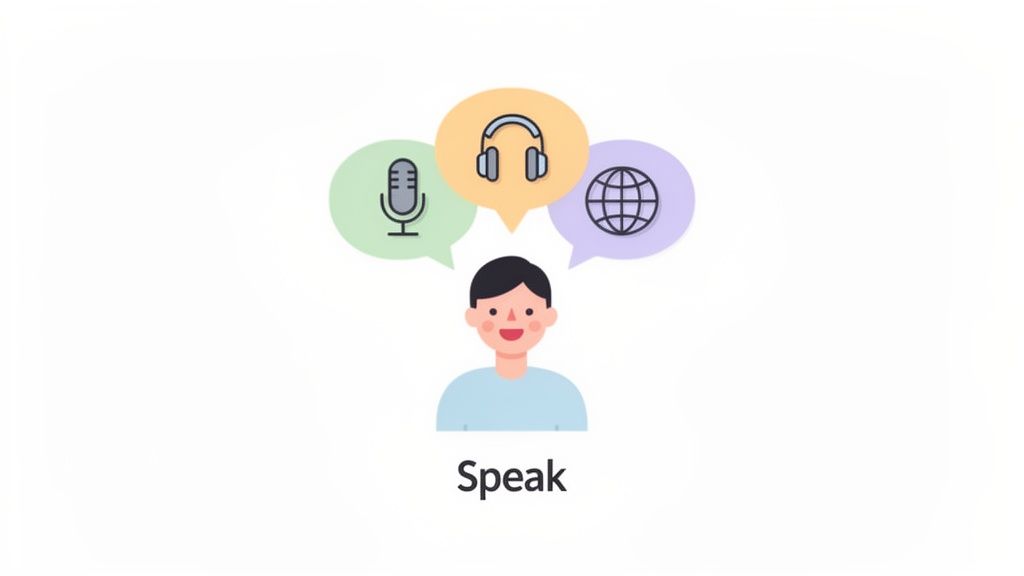
Because speaking is often the primary goal of language acquisition, you will encounter hablar constantly. Its high frequency makes it an ideal verb to study through comprehensible input, allowing you to absorb its usage naturally across different contexts.
Contextual Examples
Present Tense: Yo hablo español con mis amigos cada día. (I speak Spanish with my friends every day.)
Question Form: *¿*Hablas inglés? (Do you speak English?)
Descriptive Use: Ella habla muy rápido en las reuniones. (She speaks very quickly in meetings.)
Actionable Learning Strategies
To move beyond basic recognition, focus on how hablar functions within narratives. As you engage with stories, pay attention to shifts in tense that signal changes in time. A character might say, "Ayer hablé con mi jefe" (Yesterday I spoke with my boss), and later, "Mañana hablaré sobre el proyecto" (Tomorrow I will speak about the project). This contextual exposure is key to internalizing verb tenses. For a deeper understanding of verb functions and other grammatical roles, you can explore how to effectively practice parts of speech.
Furthermore, you can use an AI coach to clarify nuances. For example, you could ask, "What is the difference between hablar, decir, and contar?" to grasp subtle distinctions that elevate your fluency. Reinforce this knowledge by creating original sentences with hablar in Lenguia's writing journal to receive instant feedback and corrections.
2. Ser (To Be - Identity/Characteristics)
As one of the two "to be" verbs in Spanish, ser is indispensable for establishing identity and describing inherent characteristics. It is a highly irregular verb, meaning its conjugations do not follow a predictable pattern. Mastering its forms (soy, eres, es, somos, son) is a crucial milestone, as it is one of the most frequently used action words in Spanish, fundamental for describing who and what things are.
Unlike regular verbs, ser requires memorization, but its constant appearance in authentic content makes it a prime candidate for acquisition through comprehensible input. You will use it to talk about professions, nationalities, relationships, and permanent traits, making it central to nearly any conversation.
Contextual Examples
Identity: Yo soy ingeniero y ella es doctora. (I am an engineer and she is a doctor.)
Origin: *¿*Eres de México? (Are you from Mexico?)
Characteristics: Los datos son importantes para el análisis. (The data is important for the analysis.)
Actionable Learning Strategies
The main challenge with ser is distinguishing it from estar. As you read stories, actively track how each is used. Pay attention to context: is the author describing a permanent quality (ser) or a temporary state (estar)? This comparative analysis is far more effective than rote memorization of rules. For a comprehensive overview of verbs like this one, you can review a detailed list of irregular verbs in Spanish.
3. Estar (To Be - Location/Temporary State)
One of the most essential Spanish action words, estar, is the counterpart to ser. While both translate to "to be," estar is used to describe location, temporary conditions, and ongoing actions. Mastering the distinction between ser and estar is a significant milestone for learners, and repeated exposure through context is the most effective way to internalize its proper use.
The verb estar is fundamental for describing where you are, how you feel, and what you are doing right now. Because of its irregular conjugation, especially in the yo form (estoy), absorbing its patterns through comprehensible input helps learners move past rote memorization and toward intuitive, natural usage.
Contextual Examples
Location: ¿Dónde estás? Estoy en la biblioteca. (Where are you? I'm in the library.)
Temporary State: Estamos muy cansados después del viaje. (We are very tired after the trip.)
Present Progressive: Ella está estudiando para su examen final. (She is studying for her final exam.)
Actionable Learning Strategies
To grasp the nuances of estar, focus on its core functions separately. Start with location, as it is the most straightforward use. As you read stories, highlight every sentence that uses estar to describe where a person or object is. This reinforces the "how you feel and where you are, that is when you use estar" rule.
Next, compare sentences using ser and estar side by side to see the contrast in action. Pay close attention to how native speakers describe emotions and temporary conditions in podcasts. You might hear "estoy feliz" (I am happy right now) versus "soy feliz" (I am a happy person). Finally, practice forming present progressive sentences (estar + gerund) in your writing journal to describe ongoing activities, which will help solidify this key grammatical structure.
4. Hacer (To Do/Make)
As one of the most versatile and essential Spanish action words, hacer is a powerhouse for expressing a wide range of concepts. Its core meanings of "to do" and "to make" cover countless daily activities, but its true utility shines through its use in time expressions, weather descriptions, and dozens of idiomatic phrases. As an irregular verb, its conjugation patterns require focused attention, but mastering them unlocks a new level of expressive fluency.
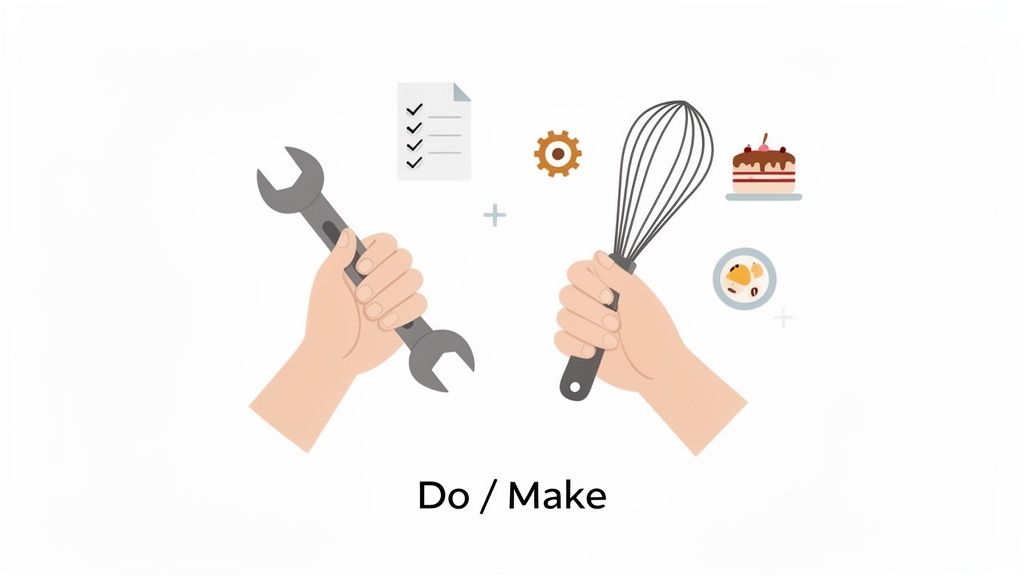
Because of its high frequency and multiple meanings, you will encounter hacer constantly in authentic Spanish content. Its irregular forms, like hago (I do/make) in the present and hice (I did/made) in the preterite, are best learned through repeated exposure in meaningful contexts rather than rote memorization.
Contextual Examples
Action/Creation: Ella hace un pastel delicioso para la fiesta. (She makes a delicious cake for the party.)
Question Form: ¿Qué haces los fines de semana? (What do you do on weekends?)
Time Expression: Hace tres años que vivo aquí. (I have been living here for three years.)
Weather Description: Hace mucho calor hoy. (It's very hot today.)
Actionable Learning Strategies
When you encounter hacer in stories, actively categorize its function. Ask yourself: is it describing an action, an act of creation, weather, or the passage of time? This mental exercise reinforces its different meanings. Create a personal list in your journal of idiomatic phrases with hacer that you find, such as hacer falta (to be needed) or hacer caso (to pay attention).
5. Ir (To Go)
As one of the most indispensable Spanish action words, ir is the key to expressing movement, direction, and future plans. It is a highly irregular verb, meaning its conjugation (voy, vas, va, vamos, van) does not follow a standard pattern. However, its constant use in everyday speech makes its forms easy to memorize through consistent exposure. Learning ir is crucial not only for talking about physical movement but also for mastering one of the most common ways to discuss the future.
The verb ir frequently combines with the preposition a and an infinitive verb to create the "near future" tense. This construction, ir a + infinitive, is equivalent to "going to + verb" in English and is used constantly in conversation to describe intentions and upcoming events. Its dual function makes it a high-impact verb for any learner.
Contextual Examples
Present Tense: Yo voy al mercado cada martes. (I go to the market every Tuesday.)
Question Form: ¿Adónde van ustedes? Vamos al cine. (Where are you all going? We're going to the cinema.)
Future Intentions: Ella va a viajar a España el próximo mes. (She is going to travel to Spain next month.)
Actionable Learning Strategies
To truly master ir, focus on its role in character movement and planning within stories. Pay close attention to how narratives use the ir a + infinitive structure to signal future actions. A character might think, *"*Voy a llamar a mi amigo más tarde" (I'm going to call my friend later), revealing their intentions naturally. This narrative context makes the grammar point feel intuitive rather than abstract.
6. Tener (To Have)
As one of the most versatile and high-frequency Spanish action words, tener is a powerhouse verb that extends far beyond simple possession. It is an essential irregular verb, meaning its conjugations deviate from standard patterns, particularly in the present tense (yo tengo). Mastering tener is crucial for expressing not only ownership but also physical states, obligations, and a wide array of idiomatic phrases that are fundamental to natural, everyday Spanish.
Because tener is used to describe everything from age and physical sensations to necessity, you will encounter it in nearly every conversation. Its unique role in common expressions like tener hambre (to be hungry) or tener que (to have to) makes it a priority for learners aiming for conversational fluency.
Contextual Examples
Possession: Yo tengo un hermano y dos hermanas. (I have a brother and two sisters.)
Obligation: Tengo que terminar este proyecto hoy. (I have to finish this project today.)
Physical/Emotional States: *¿*Tienes hambre? Sí, tengo mucha hambre. (Are you hungry? Yes, I'm very hungry.)
Description: Ella tiene los ojos verdes. (She has green eyes.)
Actionable Learning Strategies
To effectively learn tener, focus first on its most common idiomatic uses. In stories and podcasts, listen for phrases like tener sueño (to be sleepy), tener miedo (to be afraid), and tener razón (to be right). Notice how these are used in natural dialogue where English would use the verb "to be." This contextual listening is key to internalizing these non-literal structures.
Pay special attention to the "tener que + infinitive" construction for expressing obligation. As you read, highlight every instance of this structure to see how it drives the narrative forward by explaining a character's duties or motivations. Then, use a writing journal to practice. Describe your own obligations (Tengo que estudiar español), your physical state (Tengo frío), and your possessions (Tengo un coche azul).
7. Querer (To Want/Love)
The verb querer is one of the most versatile and emotionally expressive action words in Spanish. It is essential for conveying desire, preference, and even affection. Querer is an irregular stem-changing verb (e→ie), which means its conjugation pattern offers a crucial lesson for many other important verbs that follow the same logic. Mastering it unlocks the ability to express core human motivations and feelings.
As a high-frequency verb, querer appears constantly in dialogue and narration, making it ideal for acquisition through story-based learning. Understanding a character’s wants is key to understanding their actions, so you will see this verb used to drive plots forward in countless scenarios. Its dual meaning of "to want" and "to love" (in certain contexts) makes it a fascinating verb to explore.
Contextual Examples
Expressing Desire: Yo quiero aprender español porque amo la cultura. (I want to learn Spanish because I love the culture.)
Question Form: ¿Qué quieres hacer este fin de semana? (What do you want to do this weekend?)
Future Aspiration: Ella quiere ser ingeniera cuando sea mayor. (She wants to be an engineer when she grows up.)
Polite Offer: *¿*Quieres un café? (Do you want a coffee?)
Actionable Learning Strategies
Focus on mastering the e→ie stem change in the present tense (yo quiero, tú quieres, él quiere, ellos quieren), as this pattern applies to verbs like preferir and entender. Notice that the nosotros and vosotros forms do not change (queremos, queréis), a common exception in this verb group.
As you engage with learning materials, pay attention to how context distinguishes between "want" and "love." A character might say, *"*Quiero un helado" (I want an ice cream), but later tell a family member, "Te quiero mucho" (I love you very much). Use an AI coach to deepen this understanding by asking, "What is the difference between querer, gustar, and amar?" This will help you grasp the nuanced emotional spectrum of Spanish and apply these powerful action words accurately in your own conversations.
8. Poder (To Be Able To/Can)
The verb poder is one of the most powerful and frequent action words in Spanish, expressing ability, permission, and possibility. As a stem-changing irregular verb (o → ue), it presents a common conjugation pattern that, once mastered, unlocks a host of other important verbs. Its versatility makes it indispensable for everything from simple requests to complex hypothetical scenarios.
Because poder communicates capability and potential, you will find it woven into the fabric of daily conversations and narratives. It is fundamental for expressing what characters can and cannot do, making it a high-utility verb for learners aiming for natural, fluent communication.
Contextual Examples
Ability: No puedo ir al concierto porque tengo que trabajar. (I can't go to the concert because I have to work.)
Permission (Question): *¿*Puedo usar tu teléfono? (Can I use your phone?)
Polite Request: Podríamos viajar juntos en verano. (We could travel together in summer.)
Possibility: Esa idea puede funcionar muy bien. (That idea can work very well.)
Actionable Learning Strategies
To internalize poder, focus on its crucial o→ue stem change in the present tense (yo puedo, tú puedes, él puede). As you listen to podcasts, pay close attention to this shift in pronunciation and how it contrasts with forms that do not change, like nosotros podemos. This auditory reinforcement is key to making the pattern automatic.
A significant step towards advanced fluency is mastering the conditional form, podría, for polite requests. Explore the difference in tone between "¿Puedes ayudarme?" (Can you help me?) and "¿Podrías ayudarme?" (Could you help me?). Practice this nuance by writing sentences in your journal that make polite suggestions or ask for favors, allowing the AI to refine your usage and help you sound more natural. This distinction between directness and politeness is a subtle but critical aspect of Spanish communication.
9. Decir (To Say/Tell)
As one of the most common Spanish action words, decir is crucial for reporting speech, conveying information, and expressing opinions. Unlike regular verbs, decir is highly irregular, presenting a unique challenge with its stem changes in the present tense (digo, dices) and a completely different stem in the preterite (dij-). Mastering this verb is a significant milestone for learners aiming to handle dialogue and narrative.
Because it is central to all forms of communication, you will find decir everywhere, from character speech in stories to everyday conversation. Its high frequency makes it an excellent verb to learn through immersion, as repeated exposure in meaningful contexts helps solidify its tricky conjugations much more effectively than rote memorization alone.
Contextual Examples
Present Tense: ¿Qué dice el profesor sobre la tarea? (What does the professor say about the homework?)
Past Tense (Preterite): Ella dijo que no puede venir a la reunión. (She said that she can't come to the meeting.)
Plural Use: Me dijeron que la película era excelente. (They told me that the movie was excellent.)
Impersonal Use: Dicen que va a llover mañana. (They say that it's going to rain tomorrow.)
Actionable Learning Strategies
To master decir, focus first on its most common present tense forms, like digo, dices, and dice. When listening to podcasts and stories, pay close attention to dialogue and how characters report information. You will naturally absorb these high-frequency patterns. For the past tense, recognize the distinct dij- stem (dije, dijo, dijeron), which will help you identify it instantly.
A powerful way to practice is by using indirect speech. After reading a story, use your writing journal to summarize what a character said. For example, write sentences like, "El personaje dijo que tenía miedo" (The character said that he was scared). This directly reinforces the verb's structure for reporting information.
10. Dar (To Give)
The verb dar, meaning "to give," is one of the most versatile and high-frequency action words in Spanish. Its brevity hides a significant challenge: it is highly irregular. Mastering its unique conjugations, especially the "yo" form doy in the present and the preterite forms like di and dio, is a major step toward fluency. Its importance extends beyond the literal act of giving, as it anchors countless idiomatic expressions.

Because dar appears in both literal and figurative contexts, encountering it in stories and podcasts is an excellent way to absorb its varied meanings. You will see characters dar un regalo (give a gift) or find situations that dan miedo (are scary), helping you internalize its usage naturally through context rather than rote memorization.
Contextual Examples
Present Tense with Indirect Object: Le doy un regalo a mi madre para su cumpleaños. (I give my mother a gift for her birthday.)
Request Form: ¿Me das tu número de teléfono? (Will you give me your phone number?)
Idiomatic Use: Esa película da mucho miedo. (That movie is very scary.)
Preterite Tense: Me dieron la noticia el viernes pasado. (They gave me the news last Friday.)
Actionable Learning Strategies
Focus on learning common phrases with dar as complete vocabulary chunks. Idioms like dar la bienvenida (to welcome), dar importancia (to give importance), and dar tiempo (to give time) are best learned as a single unit. As you read stories, highlight these phrases to see how they function within a sentence.
Pay close attention to how dar partners with indirect object pronouns (me, te, le, nos, os, les). In character dialogues, notice how "le doy" signifies giving "to him/her/you (formal)."
Comparison of 10 Spanish Action Verbs
| Verb (Translation) | 🔄 Complexity | ⚡ Resource requirements | ⭐ Expected outcomes | 📊 Ideal use cases | 💡 Key tip |
|---|---|---|---|---|---|
| Hablar (To speak) | Low — regular -AR patterns | Low — high frequency in dialogue | ⭐⭐⭐⭐ — rapid speaking confidence | Beginner conversation, listening practice | Use dialogue-rich stories to practice real utterances |
| Ser (To be — identity) | High — highly irregular forms | High — frequent exposure + targeted review | ⭐⭐⭐⭐⭐ — essential for descriptions/identity | Self-introductions, descriptions, telling time | Compare examples of ser vs. estar across stories |
| Estar (To be — location/state) | Medium — -AR with present irregularities | High — needs contrast practice with ser | ⭐⭐⭐⭐ — clarity on states/locations | Location, temporary states, progressives | Search side-by-side ser/estar sentences in stories |
| Hacer (To do/make) | Medium — irregular first person + many uses | High — varied contexts (time/weather/idioms) | ⭐⭐⭐⭐ — versatile for many expressions | Actions, time/weather phrases, idioms | Note context (action vs. time/weather) when reviewing |
| Ir (To go) | High — completely irregular conjugation | High — memorize forms + practice near-future | ⭐⭐⭐⭐ — essential for movement and future plans | Movement, directions, near-future (ir a + inf.) | Practice "ir a + infinitive" for expressing plans |
| Tener (To have) | High — irregular + many idioms | High — learn conjugations and idiomatic uses | ⭐⭐⭐⭐⭐ — critical for possession/obligation | Possession, obligations (tener que), physical states | Learn common tener idioms as chunks (tener hambre, etc.) |
| Querer (To want/love) | Medium — stem-change e→ie | Moderate — pattern transferable to other verbs | ⭐⭐⭐⭐ — expresses desire and polite requests | Desires, preferences, motivations, conditional politeness | Master e→ie pattern; contrast with gustar/amar |
| Poder (To be able/can) | Medium — stem-change o→ue | Moderate — practice ability/possibility/permission | ⭐⭐⭐⭐ — useful for capability & hypotheticals | Ability, permission, conditional requests (podría) | Focus on o→ue pattern and conditional "podría" uses |
| Decir (To say/tell) | High — irregular present + irregular preterite | High — frequent in dialogue; practice tenses | ⭐⭐⭐⭐ — key for reported speech and dialogue | Reporting speech, instructions, narrative dialogue | Learn present forms first, then -ij- preterite (dije) |
| Dar (To give) | Medium — short but irregular forms | Moderate — idiomatic combos + pronouns | ⭐⭐⭐⭐ — common in idioms and interactions | Giving, idioms (dar miedo, dar importancia), indirect objects | Memorize idiomatic uses and practice indirect objects (le/les) |
Turning Knowledge Into Action: Your Next Steps to Fluency
The central takeaway is that verb mastery is not about rote memorization alone. True fluency comes from understanding context, recognizing patterns, and actively using the language. You have seen how a single verb like hacer can mean "to do" or "to make," and how its meaning shifts entirely in idiomatic expressions like hacer caso (to pay attention). Similarly, understanding the emotional weight behind te quiero versus te amo is a distinction that flashcards rarely capture but is vital for authentic interaction.
Leveraging Comprehensible Input
The most effective way to make these verbs second nature is to encounter them repeatedly in compelling contexts. This is where comprehensible input, like stories and dialogues, becomes your most powerful tool. When you read a story, you see decir used naturally in conversation. When you listen to a podcast, you hear the subtle differences in pronunciation between hablo and habló. This repeated, natural exposure is what cements language in your brain.
Key Insight: Fluency is not built by studying the language but by using it. Every story you read and every conversation you listen to is an active practice session that reinforces grammar and vocabulary without the tedium of drills.
Ready to put these verbs into practice with engaging stories and interactive exercises? Lenguia is designed to help you master action words in Spanish through the power of comprehensible input. Explore our library of stories, podcasts with transcripts, and smart flashcards to see these verbs come to life in real contexts and accelerate your journey to fluency. Start with Lenguia today!