A Modern Guide to Practice Parts of Speech for Fluency
To truly master the parts of speech, shift your focus from memorizing definitions to understanding what words do in real sentences. The most effective strategy is to move beyond isolated drills and engage with authentic content like articles, stories, and conversations. This is where you can see how nouns, verbs, and adjectives work together to create meaning.
Moving Beyond Drills to Master Grammar in Context
For many, the phrase "practice parts of speech" brings back memories of endless worksheets circling nouns or underlining verbs in textbook sentences. While this approach teaches definitions, it rarely builds an intuitive feel for how grammar functions in actual communication.
The goal is not just to label a word but to understand its role in the sentence. Think of it like learning to cook. You can memorize that salt is a mineral, or you can taste how it enhances the flavor in a dish. The second method provides a practical skill. Similarly, seeing a verb in a thrilling story is far more memorable than finding it on a grammar chart.
The Power of Contextual Learning
Learning grammar in context means using authentic materials you find genuinely interesting. This could be a news article, a novel you enjoy, or the transcript of a favorite podcast. Instead of abstract rules, you receive comprehensible input, which helps your brain absorb grammatical patterns naturally.
We have a whole guide on how to learn grammar without studying rules that dives deeper into this natural approach.
This infographic breaks down the difference between the traditional, drill-based method and modern, contextual practice.
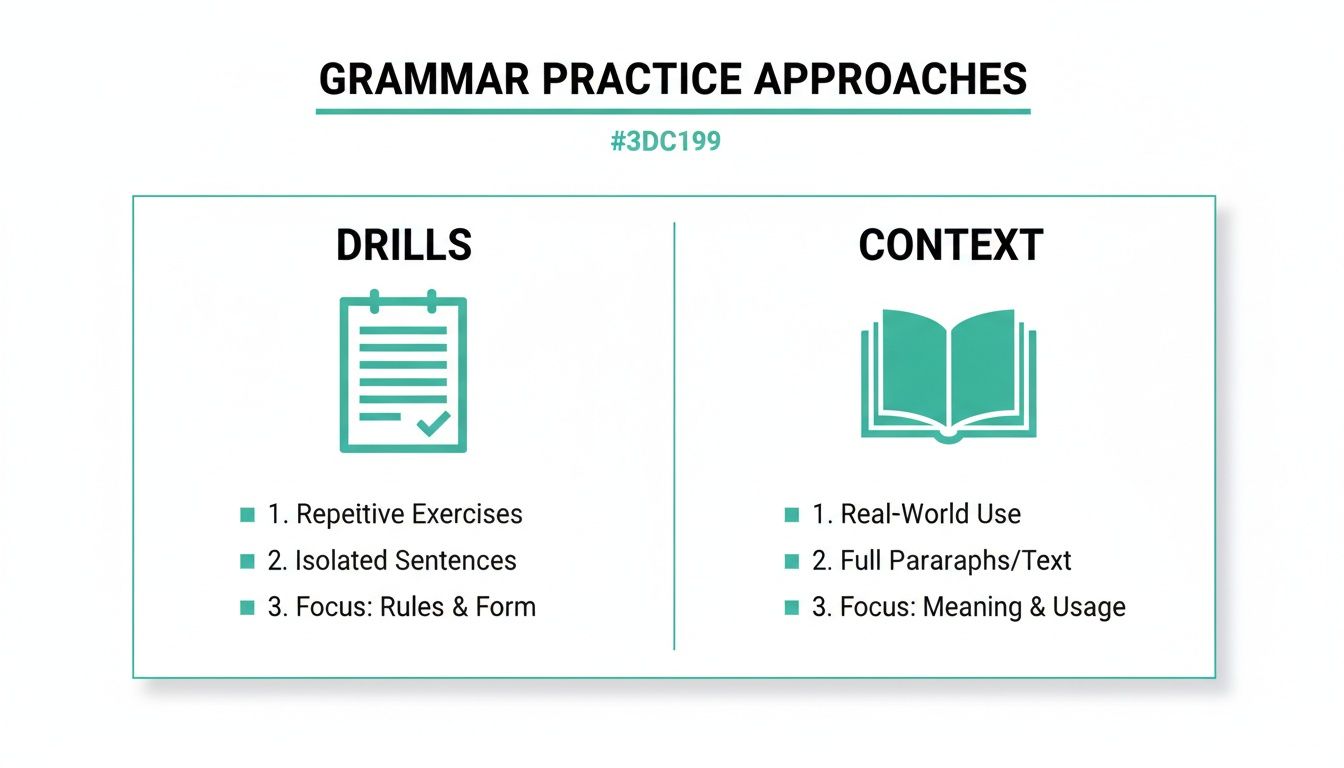
As you can see, the focus of contextual learning is on meaning and real-world application. This makes knowledge stick long term, unlike memorizing isolated rules that are quickly forgotten.
Shifting from Traditional Drills to Contextual Practice
Making the switch from rote memorization to meaningful practice is a significant strategic shift. The table below highlights the key differences between these two philosophies.
| Practice Method | Traditional Drill Approach | Contextual Practice Approach |
|---|---|---|
| Focus | Memorizing rules and definitions | Understanding meaning and function |
| Materials | Textbook exercises, isolated sentences | Authentic articles, stories, podcasts |
| Goal | Correctly labeling parts of speech | Internalizing natural language patterns |
| Outcome | Can pass a test, but struggles with use | Develops an intuitive feel for grammar |
| Motivation | Often feels like a chore | Engaging and interesting |
Ultimately, the contextual approach moves you from being a student of the language to a user of the language.
Why Nouns and Verbs Are Your Starting Point
When you begin practicing in context, it is helpful to narrow your focus. Start with the most fundamental components: nouns and verbs. Nouns are the most common part of speech in English. For example, a linguistic analysis of the Brown Corpus, a well-known collection of American English texts, found that nouns constitute nearly 20% of the words, making them the most frequent lexical category, with verbs following.
By focusing on the most frequent parts of speech, like nouns and verbs, you are practicing the foundational elements that form the backbone of nearly every sentence you read or hear.
This high frequency means every sentence is a goldmine for seeing nouns in action. Learning to spot them, along with the verbs that power the sentence, helps you quickly grasp the core message. It is a simple strategy that builds a solid foundation for recognizing all other parts of speech later.
Becoming a Grammar Detective in Your Daily Reading
Practicing parts of speech can feel tedious. A practical strategy is to reframe the activity from a test to a treasure hunt. The content you already read every day, such as news articles, blog posts, books, and even social media, is packed with perfect examples.
The key is to switch from being a passive reader to an active grammar detective. This involves consciously looking for the roles words play as you read. This is not about memorizing rules; it is about building recognition. When you actively spot words in their natural habitat, you start to internalize the patterns of the language. This method is incredibly powerful because it is built on real, authentic material, a core principle of comprehensible input. You can learn more about how engaging with real language helps you acquire grammar naturally in our detailed guide.
Your Simple Toolkit for Spotting Grammar
You do not need any fancy software to get started. All you need is a piece of text and a straightforward system. The goal is to make the different parts of speech visually pop out at you.
Here is a practical, low-tech method you can try with any article or a page from a book:
Highlight all the nouns in one color (e.g., yellow). Nouns are often the easiest to spot, since they name people, places, things, or ideas.
Circle every verb you find. These are the action words or states of being that drive the sentence.
Underline all the adjectives. Look for the words that describe the nouns you just highlighted.
This simple, hands-on activity forces your brain to slow down and analyze how sentences are constructed. It transforms reading from a passive habit into an engaging exercise that reinforces what you are learning with every page.
This screenshot from the Lenguia platform shows how you can interact with text by clicking on words to understand their meaning and function.
Platforms like this turn any text into an interactive learning tool, making the process of identifying parts of speech feel seamless and intuitive.
From Identification to Deeper Understanding
Once you get comfortable with the basic highlight, circle, and underline method, you can start adding more layers to your detective work. Now you can look for the "support team" of the sentence, like adverbs and prepositions.
The real breakthrough happens when you stop seeing grammar as a set of rules to memorize and start seeing it as a system of relationships between words. Active reading helps you decode those relationships.
For example, after you circle a verb, look for any adverbs nearby that describe how the action was done. Did the character walk quickly? Did the scientist speak confidently? That connection between the verb and adverb becomes clear when you see it in a real sentence that is telling a story.
This active approach builds a strong foundation, making it much easier to practice parts of speech in more structured exercises later on.
Engaging Your Brain with Targeted Grammar Exercises
Spotting parts of speech while you read is an excellent first step. The real learning occurs when you move from simply recognizing words to actively using them. This is where you can turn simple sentences into a creative playground for grammar, cementing the role each word type plays.
Forget boring drills. Think of this as getting your hands on the building blocks of language. When you start swapping words and rewriting sentences intentionally, you force your brain to think critically about how each piece affects the whole picture.
Create Your Own Sentence Puzzles
One of the most powerful strategies to practice parts of speech is to create your own "Mad Libs" style stories. That classic game is a powerhouse for learning because it forces you to see the specific job each word has. You can do it with any text you find.
Just grab a short paragraph from a book or an article you are reading. Go through and remove a few key nouns, verbs, and adjectives, leaving labeled blank spaces in their place.
- Example Sentence: The (adjective) dog (verb) across the (adjective) field to catch the (noun).
Now, try to fill in those blanks without looking at the original words. The results are often amusing, but they also instantly show you how changing a single part of speech can radically alter a sentence’s meaning. It is a fun, memorable way to solidify the function of nouns, verbs, and adjectives.
Master Meaning by Swapping Words
Another effective technique is sentence transformation. This is where you take a basic sentence and rewrite it multiple times, changing specific parts of speech to see how the meaning shifts. It is a focused exercise that builds flexibility and a deeper understanding of word choice.
Adjective and Adverb Swaps
Start with a simple descriptive sentence and see how many different versions you can create. This is a great way to appreciate the subtle power of modifiers.
Original: The large dog ran quickly.
Variation 1: The tiny dog ran slowly. (This flips the entire mental image.)
Variation 2: The anxious dog ran hesitantly. (Now you have added emotional context.)
Variation 3: The majestic dog ran effortlessly. (This version creates a totally different tone.)
Every one of these sentences is correct, but each tells a different story. This simple exercise trains your brain to see adjectives and adverbs not as boring labels but as powerful tools for shaping meaning. It is a targeted way to practice parts of speech that directly links grammar to real communication.
Turn Your Mistakes Into Your Best Teachers
Making mistakes can be frustrating. However, every error is a data point. Each time you mix up a part of speech, you receive a clear signpost pointing to exactly what you need to work on. Shifting your mindset to see mistakes as learning tools is one of the most powerful things you can do for your language journey.
This is not just about feeling better about errors. There is a pedagogical concept behind this called Assessment for Learning (AfL). The core idea is that ongoing checks, including your own self-correction, should guide your future learning, not just measure what you already know. Embracing this turns frustration into a clear strategy for progress.
Start a Grammar Error Log
To put this into practice, start a grammar error log. It can be a simple notebook or a document on your computer where you track the specific mistakes you make with parts of speech. This simple strategy is an incredibly effective way to uncover your personal grammar blind spots.
Your log does not have to be complicated. Just a few columns will do the trick.
The Original Sentence: Write down the sentence exactly as you first wrote or said it.
The Correction: Note the correct version.
The Error Type: Be specific. Was it an adjective/adverb mix-up? Wrong preposition? A verb tense issue?
A Quick Note: Briefly explain why it was wrong. For example, "Adverbs modify verbs, so I needed 'quickly' not 'quick'."
This simple process transforms a vague feeling of "I am bad at grammar" into a specific, actionable problem like, "I often confuse my adjectives and adverbs." That is a problem you can actually solve.
From Finding Patterns to Taking Action
After just a week or two, your error log will start to show you clear patterns. Maybe you consistently use "good" when you should be using "well," or perhaps prepositions like "in," "on," and "at" are particularly challenging. These patterns are your personalized roadmap for how to practice parts of speech effectively.
By focusing your energy on the specific, recurring mistakes you actually make, you stop wasting time on grammar concepts you have already mastered and accelerate your improvement in the areas that truly matter.
For instance, if you see many adjective errors, you can dedicate a week to focusing solely on them. You could try the sentence transformation exercises mentioned earlier, specifically swapping out different adjectives to see how they change a sentence's meaning.
This kind of targeted practice makes your study sessions radically more efficient. Recognizing and working with your mistakes is also a huge help when you find you understand a second language but can't speak it well, as it helps bridge the gap between passive knowledge and active use.
Master the Five-Minute Grammar Hunt
You do not need a desk, a quiet room, or a textbook to practice. Some of the best learning moments happen in the small pockets of time throughout your day. The "Five-Minute Grammar Hunt" is the perfect tool for this.
The idea is simple: grab any small piece of text around you and give yourself just five minutes to analyze it. It is a high-impact, low-commitment exercise you can do while waiting in line or during a commercial break.
The real power of this micro-practice is how it completely lowers the barrier to entry. It is tough to procrastinate on something that only takes five minutes, which makes it an incredibly effective way to build a daily habit that sticks.
Here are a few places you can do this effortlessly:
A News Headline: Headlines are packed with meaning. In just a few words, you can almost always spot a key noun, a strong verb, and maybe a punchy adjective. It is a perfect grammar snapshot.
A Social Media Post: Quickly scan a tweet or an Instagram caption. Can you find the nouns, verbs, and pronouns? The informal language is a great window into how grammar works in everyday communication.
An Email Subject Line: Before you even open a message, take two seconds to analyze the subject. Identify the core parts of speech. This simple action reinforces your recognition skills in a context you see dozens of times a day.
By sprinkling these quick "hunts" throughout your day, you make learning an automatic part of your routine. This kind of consistent, bite-sized exposure is exactly what your brain needs to internalize grammar patterns for good.
Answering Your Top Grammar Practice Questions
As you move from traditional grammar drills to a more natural, context-based approach, questions are likely to arise. It is a significant shift, but the payoff is substantial. Here are straightforward answers to common challenges learners face.
How Often Should I Practice?
Consistency beats intensity every time. Forget about cramming for hours on a weekend. You will see much better results from 15-20 minutes of focused, in-context practice each day.
This does not have to be a major production. It could be as simple as reading a news article and mentally tagging all the verbs you see. Or you might write a short journal entry and then review it specifically for how you used adjectives. These small, daily habits build a strong, intuitive sense for grammar over time.
Is It Necessary to Learn Every Single Grammar Term?
No, it is not essential for fluency. Knowing what a word does in a sentence is far more important than knowing its official grammatical label. Get a solid handle on the main categories, such as nouns, verbs, adjectives, and adverbs, and you will have the core building blocks of the language. More advanced concepts will become clearer as you get more exposure.
Think of it like learning to drive. You absolutely need to know the gas from the brake, but you do not need to name every part in the engine to get where you are going. Focus on function first.
Can I Practice Just by Listening?
Absolutely. Active listening is an incredibly powerful tool for internalizing grammar. Next time you listen to a podcast or audiobook, do not just let the words wash over you. Try to consciously notice the action words (verbs) or the descriptive language (adjectives).
You can even pause, repeat a sentence out loud, and try to identify its basic structure. This trains your ear to recognize grammatical patterns naturally, which is a massive part of sounding fluent. For a more intensive practice, find a transcript and read along, highlighting the parts of speech as you hear them.
What if I Keep Making the Same Mistakes?
This is completely normal. We all have tricky words or grammar points that are difficult to master, especially with elements like articles and prepositions that do not map neatly from one language to another.
The best strategy is to create a personal "error log." Do not just write down the mistake. Every time you get a correction, write down the entire correct sentence. Over time, you will build a personalized study guide full of real-world examples that target your specific weak spots. Reviewing these correct patterns is much more effective than trying to memorize abstract rules.
Ready to stop drilling and start absorbing grammar the natural way? Lenguia turns any content you love into a personalized lesson. With interactive texts, one-click flashcards, and an AI coach ready to answer your questions 24/7, you'll build an intuitive feel for grammar without ever looking at a boring worksheet again. Discover a smarter way to learn at Lenguia.