Master Spanish Clothing Vocabulary: An Essential Guide for Real Conversations
Ever found yourself in a shop in Spain, trying to describe the exact shirt you’re looking for? Or maybe you wanted to compliment a friend on their new pants but didn't have the right words.
This guide is designed to be your go-to toolkit for practical application. We'll break everything down from general categories to specific items.
Your Essential Spanish Clothing Vocabulary Guide
Fashion is a significant part of Spanish culture. Spain's major role in the global apparel market shows how intertwined fashion is with the language.
Practical Application: Get the words you’ll actually use in real life scenarios.
Clear Structure: Easily find what you're looking for with logical, easy to follow categories.
Grammar Focus: We’ll cover gender and number so you can use these words accurately.
Just to give you an idea of how big fashion is, the Spanish fashion industry's international sales hit a massive €25,911 million back in 2019. You can dive deeper into Spain's fashion economy in this report from FashionUnited.
Essential Vocabulary for Tops and Outerwear
Let's start building your Spanish clothing vocabulary from the top down. This section covers the essentials for shirts, blouses, sweaters, and jackets that you'll hear and use in everyday conversations.
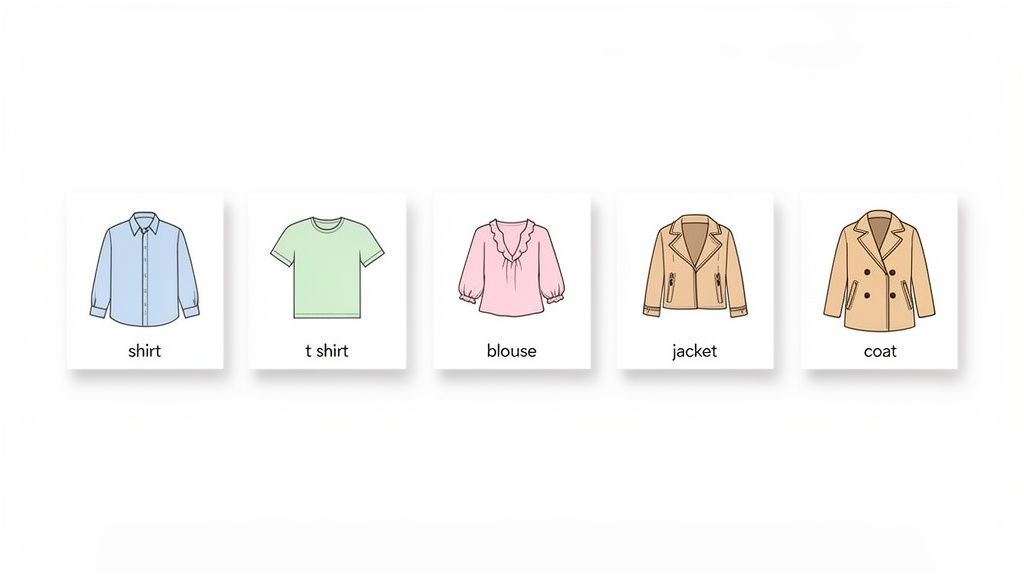
To make things easier, We've put together a quick reference table with the core terms for your wardrobe.
Quick Reference for Spanish Tops and Outerwear
This table summarizes the most common Spanish words for upper body clothing. A practical strategy is to pay close attention to the gender of each noun, as this will affect the articles and adjectives you use with them.
| English | Spanish (Singular) | Gender | Spanish (Plural) |
|---|---|---|---|
| Shirt (button up) | la camisa | Feminine | las camisas |
| T shirt | la camiseta | Feminine | las camisetas |
| Blouse | la blusa | Feminine | las blusas |
| Sweater/Jumper | el suéter | Masculine | los suéteres |
| Jacket | la chaqueta | Feminine | las chaquetas |
| Coat | el abrigo | Masculine | los abrigos |
Spanish Words for Pants, Skirts, and Bottoms
Now, let's move on to the words you'll need for clothing on your lower half. These are absolute wardrobe staples, so you'll find yourself using this vocabulary all the time.
A great example is el pantalón. While it's technically a singular, masculine noun (the pant), you'll almost always hear and use it in its plural form, los pantalones, to mean "pants" or "trousers." To talk specifically about jeans, you can say pantalones vaqueros or, especially in Spain, just shorten it to vaqueros. Skirts, or las faldas, are feminine.
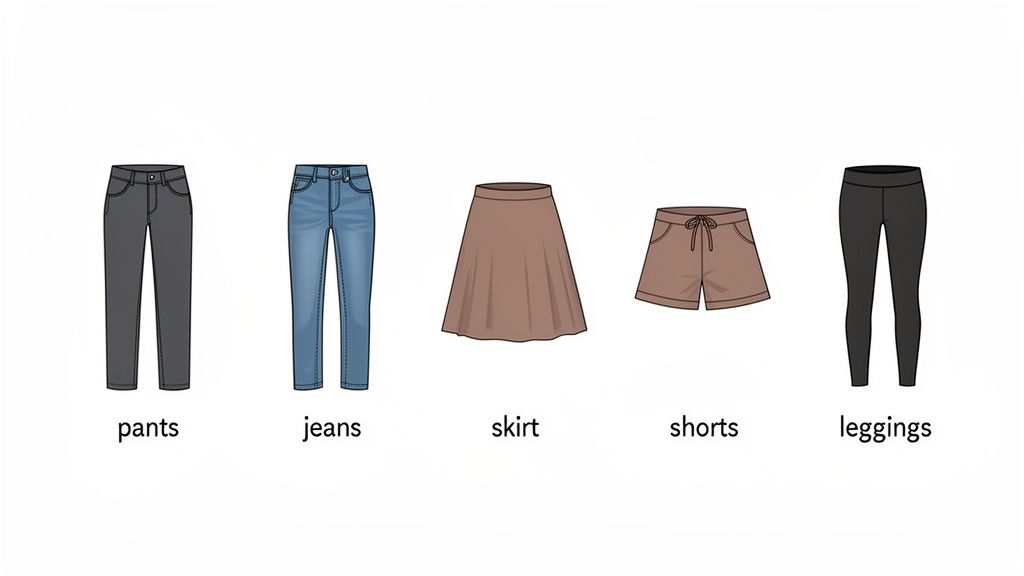
Here are a couple of these words in action:
Necesito comprar unos pantalones nuevos. (I need to buy new pants.)
Esa falda azul es muy bonita. (That blue skirt is very pretty.)
| English | Spanish (Singular) | Gender | Spanish (Plural) |
|---|---|---|---|
| Pants/Trousers | el pantalón | Masculine | los pantalones |
| Jeans | el vaquero / el jean | Masculine | los vaqueros / los jeans |
| Shorts | el pantalón corto | Masculine | los pantalones cortos |
| Skirt | la falda | Feminine | las faldas |
| Dress | el vestido | Masculine | los vestidos |
| Leggings | las mallas | Feminine | las mallas |
| Sweatpants | el pantalón de chándal | Masculine | los pantalones de chándal |
| Underwear | la ropa interior | Feminine | — |
| Boxers | el bóxer | Masculine | los bóxers |
| Briefs | el calzoncillo | Masculine | los calzoncillos |
| Panties | la braga | Feminine | las bragas |
| Belt | el cinturón | Masculine | los cinturones |
Navigating Spanish Vocabulary for Footwear
An outfit isn't truly complete without the right pair of shoes. This makes footwear an absolutely essential part of your Spanish clothing vocabulary. While the general word for shoes is los zapatos, Spanish gets much more specific, giving you a different word for just about every style you can think of.
On a casual day, you'll probably reach for a pair of zapatillas (sneakers). But if you're heading to a more formal event, you might need some zapatos de tacón (high heels).
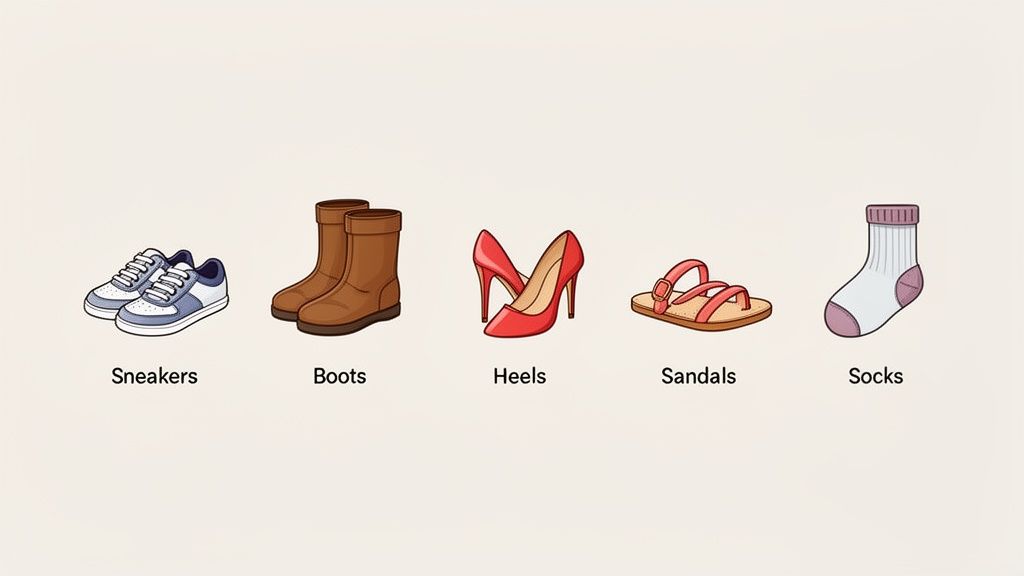
When the weather starts to get colder, you’ll definitely need a sturdy pair of botas (boots). And of course, you can't forget los calcetines (socks) since they're key for comfort no matter what shoes you're wearing.
Estas botas son muy cómodas para caminar. (These boots are very comfortable for walking.)
| English | Spanish (Singular) | Gender | Spanish (Plural) |
|---|---|---|---|
| Shoe | el zapato | Masculine | los zapatos |
| Sneaker/Trainer | la zapatilla | Feminine | las zapatillas |
| Boot | la bota | Feminine | las botas |
| Sandal | la sandalia | Feminine | las sandalias |
| High heel | el tacón | Masculine | los tacones |
| Flip-flop | la chancla | Feminine | las chanclas |
| Slipper | la zapatilla de casa | Feminine | las zapatillas de casa |
| Loafer | el mocasín | Masculine | los mocasines |
| Flat (shoe) | la bailarina | Feminine | las bailarinas |
| Ankle boot | el botín | Masculine | los botines |
| Hiking boot | la bota de montaña | Feminine | las botas de montaña |
| Sock | el calcetín | Masculine | los calcetines |
How to Talk About Accessories in Spanish
Accessories are what really pull an outfit together, giving it that final touch of personality and style. Knowing the right words for these items in Spanish is key to adding more detail and sounding more natural when you're describing what you're wearing or complimenting someone else.
For example, a hat isn't just a hat. It could be a sombrero (a traditional, wide brimmed hat) or a gorra (a cap). A scarf is a bufanda, a belt is a cinturón, and gloves are guantes. You could easily use these in a sentence like, "En invierno, siempre uso una bufanda y guantes" (In winter, I always wear a scarf and gloves).
Of course, knowing the words is just the first step. The real fun begins when you start putting them together. If you want some tips on making your accessories work for you, check out this great guide on how to accessorize an outfit.
Describing Clothes with Adjectives for Color and Fit
Okay, so you've got the nouns down. That's a huge step. But if you really want your Spanish to sound natural, the next layer is describing those clothes. This is where adjectives come in. In Spanish, they have one crucial rule: they have to agree in both gender and number with the noun they're describing.
What does that actually mean? Simply put, a feminine noun like una falda (a skirt) needs a feminine adjective, like roja (red). A masculine noun needs a masculine one.
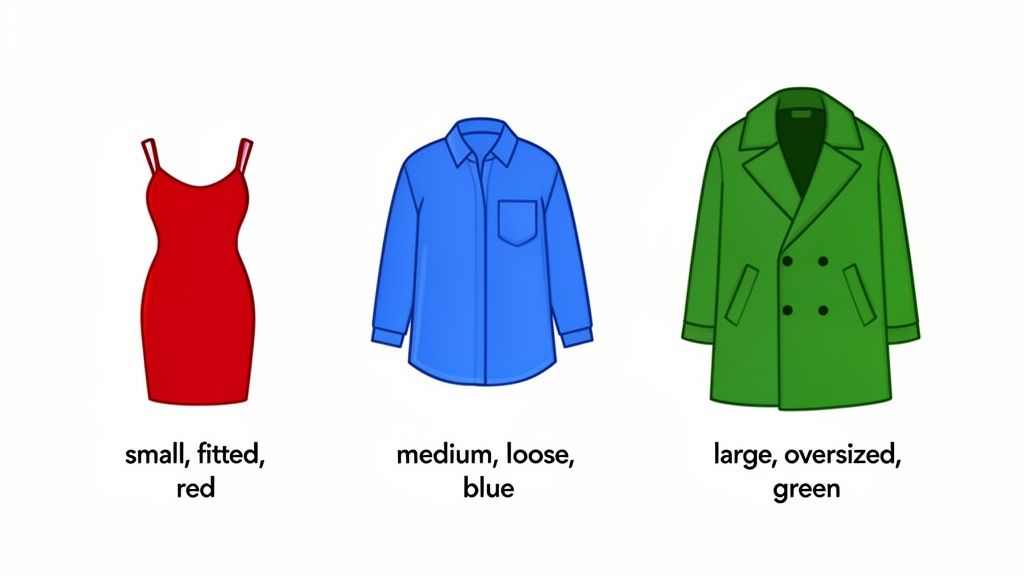
Let’s look at a quick example. You’d say un vestido rojo (a red dress), because vestido is masculine. But for a skirt, it becomes una falda roja, since falda is feminine. The same logic applies to plurals. One pair of pants is masculine (un pantalón azul), but multiple pairs become unos pantalones azules. Both the noun and the adjective get an 's'.
Getting the hang of this agreement is a total game changer for your Spanish clothing vocabulary. It’s one of those details that makes you sound less like a textbook and more like a real speaker. If you want to get more comfortable with this, it’s a good idea to practice parts of speech like nouns and adjectives to build a solid foundation.
Common Adjectives for Describing Clothes in Spanish
To get you started, here's a table with some of the most common adjectives you'll use when talking about clothes. I've broken them down by color and fit, showing both the masculine and feminine forms to make that agreement a little easier.
| Adjective Category | English | Spanish (Masculine) | Spanish (Feminine) |
|---|---|---|---|
| Color | red | rojo | roja |
| Color | blue | azul | azul |
| Color | green | verde | verde |
| Color | black | negro | negra |
| Color | white | blanco | blanca |
| Color | yellow | amarillo | amarilla |
| Color | gray | gris | gris |
| Fit | big | grande | grande |
| Fit | small | pequeño | pequeña |
| Fit | tight | ajustado | ajustada |
| Fit | loose | suelto / holgado | suelta / holgada |
| Fit | long | largo | larga |
| Fit | short | corto | corta |
Practical Spanish Phrases for Clothes Shopping
Alright, you've got the vocabulary down. That's a huge first step. But knowing the words for "shirt" or "pants" is one thing; actually using them in a real shop is where the magic happens. This is your chance to bring all that new Spanish clothing vocabulary to life.
When you walk into a store, you'll need a few key phrases to get the ball rolling and find what you're looking for.
For instance, you can kick things off by telling the shop assistant exactly what's on your mind. Just say, "Busco una chaqueta de cuero" (I'm looking for a leather jacket). Simple, direct, and it gets the conversation started.
Once you spot something you like, you'll probably want to ask a few questions. Here are the essentials:
¿Puedo probármelo/la? (Can I try it on?)
¿Tiene esto en otra talla/otro color? (Do you have this in another size/another color?)
¿Cuánto cuesta? (How much does it cost?)
How Do You Say “To Wear” in Spanish?
Spanish gives you a few different verbs for "to wear," each with its own flavor. The most common and versatile one is llevar. You can't go wrong with it. For example, "Llevo una chaqueta azul" (I am wearing a blue jacket).
You can also use usar (to use/wear), which works in most of the same situations as llevar. But if you're talking about the specific action of putting something on, you'll want the reflexive verb ponerse, as in "Me pongo los zapatos" (I put on my shoes).
Ready to see all this vocabulary in action and practice with stories you'll actually find interesting? Lenguia uses AI to create personalized reading and listening exercises from web articles, books, and more, helping you learn the way your brain is wired to. Start turning your interests into fluency at https://www.lenguia.com.