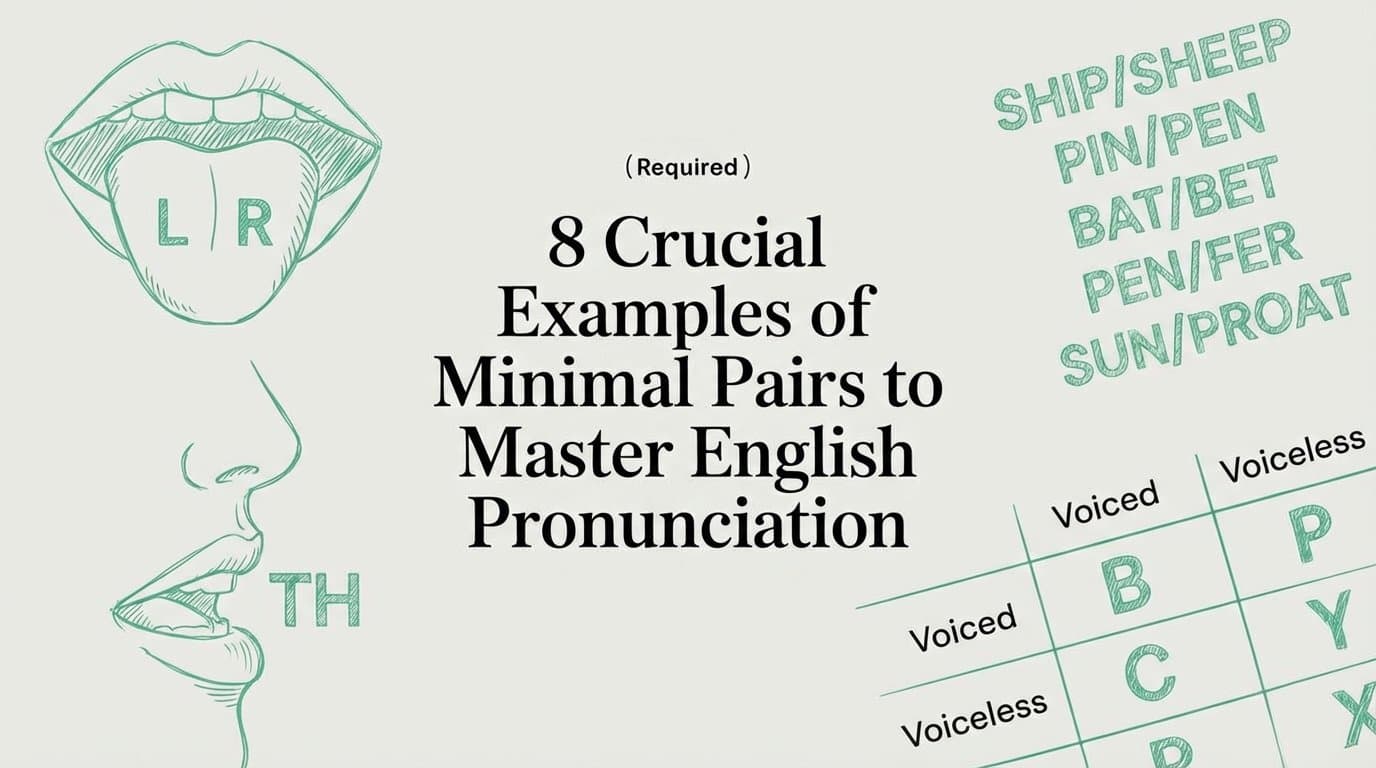
8 Crucial Examples of Minimal Pairs to Master English Pronunciation
Have you ever intended to say you want a 'sheet' of paper, only to ask for something entirely different? Or perhaps you've confused 'think' with 'sink' in a fast-paced conversation. These common, sometimes embarrassing, mix-ups highlight the critical importance of minimal pairs: words that are identical except for a single, subtle sound difference.
Mastering these distinctions is a cornerstone of achieving fluency. It’s not just about refining your accent; it's about sharpening your listening comprehension and boosting your speaking clarity. When you can confidently distinguish between 'pit' and 'bit' or 'lace' and 'race', you eliminate ambiguity and communicate your intended meaning with precision. This guide moves beyond simple definitions to provide a strategic breakdown of the most challenging examples of minimal pairs in English.
Let's conquer these tiny sound differences for a huge impact on your overall communication skills.
1. /p/ vs /b/ – 'Pit' vs 'Bit'
The contrast between the voiceless /p/ and the voiced /b/ is one of the most fundamental examples of minimal pairs for English learners. These sounds share the same place of articulation (bilabial, using both lips) and manner (plosive, a puff of air), but they differ in one critical aspect: voicing. The /p/ sound is voiceless, meaning the vocal cords do not vibrate, while the /b/ sound is voiced, requiring vocal cord vibration.
This distinction is crucial because a simple switch can create entirely different words and meanings. Mastering it significantly improves both pronunciation clarity and listening accuracy.
Phonetic Breakdown and Common Errors
'Pit' /pɪt/: The initial /p/ sound is produced with a sharp puff of air, a feature known as aspiration. You can feel this puff by placing your hand in front of your mouth when you say the word.
'Bit' /bɪt/: The initial /b/ sound has no such puff of air. The sound is softer, and the vibration of the vocal cords begins almost immediately.
A common error for learners whose native languages do not distinguish between voiced and voiceless stops is to produce both sounds without aspiration, making 'pit' sound like 'bit' to native English speakers. This can lead to frequent misunderstandings in conversation.
Practical Tip: The key to mastering this pair is not just lip movement but controlling the vibration in your throat and the release of air. Focus on the physical sensation of voicing. Place your fingers on your throat as you say "bbb" and then "ppp" to feel the difference.
Actionable Practice Strategies
Isolate and Exaggerate: Practice the initial sounds in isolation. Exaggerate the puff of air for /p/ and the throat vibration for /b/. Record yourself to confirm you can hear the difference.
Contextual Drills: Use sentences that force you to switch between the sounds. For example: "Pat put the big bat in the pit."
Active Listening: Pay close attention to these sounds when listening to native speakers. Sharpening your ear is half the battle, a skill that is vital to improving your listening comprehension.
Additional Examples:
Pat /pæt/ vs. Bat /bæt/
Ripe /raɪp/ vs. Tribe /traɪb/
Sip /sɪp/ vs. Sib /sɪb/
2. /l/ vs /r/ – 'Lace' vs 'Race'
The contrast between the lateral approximant /l/ and the alveolar approximant /r/ is one of the most challenging yet crucial examples of minimal pairs for many English learners. This is particularly true for speakers of languages like Japanese, Korean, and some Chinese dialects where these sounds are not distinct. Both are voiced and involve the tongue approaching the alveolar ridge (the spot behind your top teeth), but their manner of articulation is completely different.
Mastering this distinction is essential for clear communication, as confusing them can lead to significant misunderstandings, turning a 'light' into a 'right' or making a 'correction' sound like an 'collection'. Precise tongue placement is the key to producing these sounds correctly and being understood.
Phonetic Breakdown and Common Errors
'Lace' /leɪs/: To produce the /l/ sound, the tip of your tongue presses firmly against the alveolar ridge. Air flows around the sides of the tongue, which is why it's called a lateral sound.
'Race' /reɪs/: For the /r/ sound, the tip of the tongue is curled back slightly and raised toward the alveolar ridge but does not touch it. The body of the tongue is tensed, and the lips are often rounded.
The most common error is producing a sound that is somewhere between /l/ and /r/, or substituting one for the other entirely. This happens because learners haven't developed the muscle memory for the distinct tongue positions required for each sound.
Practical Tip: The core difference is contact versus no contact. For /l/, the tongue tip makes solid contact. For /r/, the tongue tip floats near the roof of the mouth without touching. Focus on feeling where your tongue is and what it's doing.
Actionable Practice Strategies
Visual and Physical Cues: Practice in front of a mirror. For /l/, your mouth can be more relaxed. For /r/, you should see your lips round slightly. Physically feel the tongue-tip contact for 'L' and the no-contact tension for 'R'.
Contextual Drills: Read sentences aloud that contain both sounds. For example: "The really long road leads right to the lake." Record yourself to check for clarity.
Active Listening through Input: Consistently listen to authentic materials. The more you hear the sounds used correctly in different contexts, the better your brain will become at distinguishing them. This builds your intuitive understanding of the language's sound system.
Additional Examples:
Light /laɪt/ vs. Right /raɪt/
Alive /əˈlaɪv/ vs. Arrive /əˈraɪv/
Glass /ɡlæs/ vs. Grass /ɡræs/
3. /ɪ/ vs /i:/ – 'Bit' vs 'Beat'
The distinction between the short, lax vowel /ɪ/ and the long, tense vowel /i:/ is one of the most challenging yet essential examples of minimal pairs for learners of English. These vowels differ in both length (duration) and tongue position (tenseness). The /ɪ/ sound is quick and made with a relaxed tongue, while the /i:/ sound is longer, and the tongue is held higher and more tensely in the mouth, almost as if smiling.
Mastering this difference is critical, as it affects some of the most common words in the English language. A slight change in vowel length can completely alter the meaning of a sentence, leading to frequent and sometimes confusing misunderstandings.
Phonetic Breakdown and Common Errors
'Bit' /bɪt/: The /ɪ/ vowel is short and relaxed. The mouth is relatively neutral, and the sound is produced quickly from the center of the mouth. Think of the vowel sound in "it" or "is".
'Beat' /bi:t/: The /i:/ vowel is long and tense. The corners of the mouth are pulled back slightly, as in a smile. The sound is held longer, like the vowel in "see" or "eat".
A primary error for many learners is producing both vowels with the same length and tenseness, often defaulting to a sound that is somewhere in between. This makes it difficult for native speakers to distinguish between words like 'sit' and 'seat' or 'fill' and 'feel'.
Practical Tip: Focus on the physical sensation of muscle tension in your cheeks and tongue. The /i:/ sound in 'beat' should feel like you are actively stretching your mouth into a slight smile, while the /ɪ/ in 'bit' should feel completely relaxed and neutral.
Actionable Practice Strategies
Isolate and Lengthen: Practice saying the long /i:/ vowel sound on its own ("eeeeee") and then contrast it with the short, clipped /ɪ/ sound. Consciously exaggerate the length difference.
Contextual Drills: Read sentences aloud that place both sounds in close proximity. For instance: "Did you feel you could fill the seat?" or "Will the wheel sit on this bit?"
Active Listening: Train your ear by listening for these vowel sounds in songs and podcasts. The rhythm and melody in music can make vowel lengths more obvious, a technique often used when you learn a language with songs.
Additional Examples:
Sit /sɪt/ vs. Seat /si:t/
Fill /fɪl/ vs. Feel /fi:l/
Lid /lɪd/ vs. Lead /li:d/
4. /θ/ vs /s/ – 'Think' vs 'Sink'
The distinction between the voiceless dental fricative /θ/ and the voiceless alveolar fricative /s/ is one of the most classic examples of minimal pairs and a frequent challenge for English learners. The /θ/ sound, common in words like 'think' and 'the', does not exist in many world languages. Its unique tongue placement, between the teeth, makes it a significant hurdle that often marks a non-native accent.
This contrast is critical for clear communication, as mispronouncing it can lead to confusion between common words. Mastering the physical production of /θ/ is a major step toward achieving native-like pronunciation and improving overall intelligibility.
Phonetic Breakdown and Common Errors
'Think' /θɪŋk/: To produce the /θ/ sound, the tip of your tongue must lightly touch the back of your upper front teeth or be placed slightly between your teeth. Air flows continuously between the tongue and teeth, creating a soft hissing sound.
'Sink' /sɪŋk/: For the /s/ sound, the tip of your tongue is behind the upper front teeth, near the alveolar ridge, but not touching them. Air is forced through a narrow channel along the center of the tongue, creating a sharp hissing sound.
The most common error is substituting /s/ for /θ/, making 'think' sound like 'sink'. Another frequent substitution is using a /t/ or /f/ sound, turning 'think' into 'tink' or 'fink'. These errors stem from the absence of the dental fricative in a learner’s native phonology.
Practical Tip: The key is physical awareness of your tongue's position. The /θ/ sound is gentle and requires the tongue to be forward, while the /s/ sound is sharper and produced with the tongue retracted slightly. Use a mirror to visually confirm your tongue is in the correct position.
Actionable Practice Strategies
Isolate and Feel the Airflow: Say "sss" and notice the focused, sharp stream of air. Then, place your tongue tip between your teeth and blow gently to create the "thhh" sound. The airflow for /θ/ is wider and softer.
Contextual Drills: Create and recite sentences that highlight the contrast. For example: "I think that ship will sink" or "He sought what he thought was thick ice."
Active Listening and Shadowing: Listen carefully to native speakers pronounce words with /θ/ and /s/. Pay close attention to high-frequency words like 'the', 'this', 'that', and 'with'. Practice shadowing, repeating what you hear immediately after you hear it.
Additional Examples:
Thank /θæŋk/ vs. Sank /sæŋk/
Thick /θɪk/ vs. Sick /sɪk/
Thought /θɔːt/ vs. Sought /sɔːt/
5. /æ/ vs /ɛ/ – 'Trap' vs 'Dress'
The vowel contrast between the low front /æ/ (as in 'trap') and the mid front /ɛ/ (as in 'dress') is a classic stumbling block for many English learners. These examples of minimal pairs highlight how a subtle change in jaw height and tongue position can completely alter a word's meaning. Both are front vowels, but /æ/ is produced with the jaw more open and the tongue lower than for /ɛ/.
For learners whose native languages have a smaller vowel inventory, these two sounds can seem almost identical. Mastering this distinction is a major step toward achieving a more native-like accent and avoiding common comprehension errors.
Phonetic Breakdown and Common Errors
'Trap' /træp/: To produce the /æ/ sound, your jaw should be low and your tongue flat and forward in your mouth. The corners of your lips might pull back slightly, as if in a tense smile. The sound is often described as bright and open.
'Dress' /drɛs/: For the /ɛ/ sound, your jaw is more relaxed and slightly higher than for /æ/. Your tongue is also in the front of your mouth but positioned in the middle, not low. The sound is shorter and less open than /æ/.
A frequent error is to merge these two sounds, often producing something closer to /ɛ/ for both words. This can make 'bad' sound like 'bed' or 'man' sound like 'men', leading to significant confusion for the listener.
Practical Tip: The primary physical difference is jaw position. Think of /æ/ as the "low" vowel and /ɛ/ as the "mid" vowel. Exaggerating the jaw drop for /æ/ is a key technique to create a clear distinction between the two sounds.
Actionable Practice Strategies
Mirror and Feel: Use a mirror to watch your jaw position. Say "trap" and consciously drop your jaw. Then say "dress" and notice how your jaw is much more closed. Focus on this physical sensation.
Contextual Drills: Practice sentences that contain both vowels to train your mouth to switch between them. For example: "The sad man set the black cat on his bed."
Active Listening: Use authentic content, like daily stories, to train your ear. Listen for the difference in words like 'man' vs. 'men' or 'that' vs. 'then'. This passive exposure helps your brain internalize the phonetic contrast.
Additional Examples:
Bad /bæd/ vs. Bed /bɛd/
Man /mæn/ vs. Men /mɛn/
Sat /sæt/ vs. Set /sɛt/
6. /v/ vs /w/ – 'Veil' vs 'Wail'
The contrast between the voiced labiodental fricative /v/ and the voiced labio-velar approximant /w/ is a classic challenge for many English learners. These two sounds are frequently confused, particularly by speakers of languages that lack one or both sounds, such as Japanese, Korean, and German. While both are voiced, their place and manner of articulation are entirely different, making this distinction a vital component of clear English pronunciation.
Mastering this minimal pair is essential for avoiding common misunderstandings, as swapping these sounds can drastically alter the intended meaning of a sentence. For instance, asking for "wine" versus a "vine" yields very different results. This pair is one of the key examples of minimal pairs that directly impacts everyday communication.
Phonetic Breakdown and Common Errors
'Veil' /veɪl/: The /v/ sound is a fricative. It is produced by gently pressing the top teeth against the lower lip and pushing air through the small opening, creating friction. You should feel a slight vibration on your lower lip.
'Wail' /weɪl/: The /w/ sound is an approximant. The lips are rounded and pushed forward, similar to the position for saying "oo," and the back of the tongue is raised toward the velum (the soft palate). The lips do not touch the teeth.
A common error is to substitute the sounds, pronouncing "very" as "wary" or vice versa. This often happens because learners have not developed the muscle memory for the precise lip and teeth placement required for the /v/ sound.
Practical Tip: The key is to focus on the physical contact point. The /v/ sound requires teeth-on-lip contact, creating friction. The /w/ sound has no contact; the lips are rounded and move away from the teeth. Over-articulating this difference is the first step to mastery.
Actionable Practice Strategies
Mirror Practice: Stand in front of a mirror and say "v-v-v," watching to ensure your top teeth are touching your bottom lip. Then, say "w-w-w," making sure your lips are rounded and not touching your teeth.
Contextual Drills: Create and repeat sentences that include both sounds to build fluency. For example: "We viewed the very wide valley."
Active Listening and Repetition: Use audio resources to hear the clear distinction between words like 'vine' and 'wine'. Listen to a native speaker, pause the audio, and repeat the word, trying to mimic the sound exactly.
Additional Examples:
Vine /vaɪn/ vs. Wine /waɪn/
Vest /vɛst/ vs. West /wɛst/
Verse /vɜːrs/ vs. Worse /wɜːrs/
7. /ʃ/ vs /tʃ/ – 'Sheet' vs 'Cheat'
The difference between the voiceless postalveolar fricative /ʃ/ and the voiceless postalveolar affricate /tʃ/ offers another key set of examples of minimal pairs. While both sounds are made with the tongue in a similar position just behind the alveolar ridge, their manner of articulation is distinct. The /ʃ/ sound is a continuous fricative, like a long "shhh," whereas the /tʃ/ sound is an affricate, which begins with a quick stop (/t/) and releases into a fricative (/ʃ/).
This distinction is crucial for clear communication, as confusing the two can easily lead to misunderstandings with common words like 'sheep' and 'cheap' or 'wish' and 'witch'. Mastering this pair enhances both speaking clarity and auditory discrimination.
Phonetic Breakdown and Common Errors
'Sheet' /ʃiːt/: The initial /ʃ/ sound is produced by forcing air continuously through a narrow channel formed by the tongue. The sound is smooth and can be held for a long time: "shhhhh."
'Cheat' /tʃiːt/: The initial /tʃ/ sound is sharp and abrupt. It starts with the tongue tip briefly touching the roof of the mouth to stop the airflow (like a /t/), then immediately releasing it into the /ʃ/ sound.
A frequent error for learners is to pronounce the /tʃ/ sound without the initial stop, making it sound like /ʃ/. For example, 'cheat' might sound like 'sheet'. This often happens if the learner's native language does not feature affricate sounds.
Practical Tip: Think of /tʃ/ as two sounds merged into one quick, sharp motion: a 't' followed by a 'sh'. To master it, practice saying "t-sh" slowly and then gradually speed up until it becomes a single, explosive "ch" sound.
Actionable Practice Strategies
Feel the Stop: Place the tip of your tongue on the ridge behind your upper teeth as if you're about to say "t." Practice releasing it sharply into the "sh" sound. The abrupt start is the main difference.
Contextual Drills: Use sentences that highlight the contrast. For instance: "Which cheap sheep did you choose for the show?"
Active Listening: Focus on identifying these sounds in native speech. Listen for the smooth, hissing quality of /ʃ/ versus the sharp, percussive quality of /tʃ/. Using a tool to isolate these sounds in authentic content can significantly speed up this process.
Additional Examples:
Show /ʃoʊ/ vs. Chow /tʃaʊ/
Sheep /ʃiːp/ vs. Cheap /tʃiːp/
Wish /wɪʃ/ vs. Witch /wɪtʃ/
8. /n/ vs /ŋ/ – 'Thin' vs 'Thing'
The distinction between the alveolar nasal /n/ and the velar nasal /ŋ/ is one of the most revealing examples of minimal pairs for identifying non-native speech patterns in English. Both are nasal consonants, meaning air escapes through the nose, but their place of articulation differs. The /n/ sound is made with the tongue tip touching the alveolar ridge (behind the teeth), while the /ŋ/ sound is made with the back of the tongue pressing against the soft palate (velum).
This difference is highly significant because the /ŋ/ sound, typically found in the "-ing" ending, is one of the most common sounds in the English language. Confusing it with /n/ can make speech sound unnatural and sometimes lead to misunderstandings.
Phonetic Breakdown and Common Errors
'Thin' /θɪn/: The word ends with a clear /n/ sound. Your tongue tip should firmly press against the ridge behind your upper front teeth, completely stopping airflow through the mouth.
'Thing' /θɪŋ/: The word ends with the /ŋ/ sound. The back of your tongue rises to meet the soft palate, while the tip of your tongue remains down, not touching anything. The sound is produced entirely in the back of the mouth and nose.
A frequent error is for learners to substitute /n/ for /ŋ/ at the end of words, making 'thing' sound like 'thin' or 'singing' sound like 'singin'. This is often referred to as "n-dropping" and can make a speaker's accent very noticeable.
Practical Tip: The core challenge is physical awareness of your tongue's position. You must learn to separate the movement of the tongue tip from the movement of the back of the tongue. The /ŋ/ sound never involves the tip of the tongue touching the front of your mouth.
Actionable Practice Strategies
Hold the Sound: Practice holding the final sound of a word like 'sung'. Say "sun-gggg" and feel where the back of your tongue makes contact. Then, do the same for "sun-nnnn" and notice how the contact point moves to the front of your mouth.
Contextual Drills: Create sentences that highlight the contrast. For example: "The thin king will sing a thing." Recording yourself saying this will immediately reveal any confusion between the two sounds.
Active Listening: Focus specifically on "-ing" endings when listening to native speakers in podcasts or movies. Train your ear to recognize the distinct, deeper resonance of the /ŋ/ sound compared to the sharper /n/.
Additional Examples:
Win /wɪn/ vs. Wing /wɪŋ/
Ban /bæn/ vs. Bang /bæŋ/
Sun /sʌn/ vs. Sung /sʌŋ/
8 Minimal Pair Contrasts
| Minimal pair | 🔄 Complexity (implementation) | ⚡ Resource requirements | ⭐ Expected outcomes | 📊 Ideal use cases | 💡 Key advantages / Tips |
|---|---|---|---|---|---|
| /p/ vs /b/ — "Pit" vs "Bit" | Low — single voicing difference | Low — short drills, flashcards | ⭐⭐⭐ — quick perceptual gains | Beginner discrimination, high-frequency vocab | 💡 Use short minimal-pair drills + recordings; pair with contextual flashcards |
| /l/ vs /r/ — "Lace" vs "Race" | High — distinct tongue placement | High — prolonged kinesthetic practice | ⭐⭐⭐ — large accent/comprehension impact | Accent reduction, intermediate learners from East Asian L1s | 💡 Use targeted AI feedback + repeated contextual exposure |
| /ɪ/ vs /i:/ — "Bit" vs "Beat" | Medium — duration & tenseness subtlety | Medium — slowed audio, repetition | ⭐⭐⭐ — improves listening of common words | Listening accuracy, morphology contrasts (tense/meaning) | 💡 Compare slowed native models; emphasize duration in SRS |
| /θ/ vs /s/ — "Think" vs "Sink" | Medium-high — new tongue placement for many | Medium-high — focused articulation practice | ⭐⭐⭐ — strong intelligibility improvement | Function words, pronunciation for confident speech | 💡 Isolate function words in podcasts; practice tongue-between-teeth placement |
| /æ/ vs /ɛ/ — "Trap" vs "Dress" | Medium — subtle vowel height change | Medium — perception training, spaced reps | ⭐⭐ — useful but often context-recoverable | Listening accuracy, CVC word sets, intermediate learners | 💡 Use jaw-height cues and contextual SRS from graded texts |
| /v/ vs /w/ — "Veil" vs "Wail" | Medium-high — different manners/place of articulation | Medium-high — lip/teeth tactile practice | ⭐⭐⭐ — noticeable accent reduction | Learners from L1s lacking /v/ or /w/ contrasts | 💡 Practice tactile cues (lip/teeth); extract pairs from interest-based content |
| /ʃ/ vs /tʃ/ — "Sheet" vs "Cheat" | Medium — manner (fricative vs affricate) timing | Medium — controlled airflow drills | ⭐⭐⭐ — rapid perceptual and production gains | Common vocabulary, listening & speaking drills | 💡 Train stop+fricative timing; use filtered story words for practice |
| /n/ vs /ŋ/ — "Thin" vs "Thing" | Medium — place of articulation shift | Low-medium — high exposure via -ing forms | ⭐⭐⭐ — high utility (frequent morpheme) | -ing morphology, perceived fluency, everyday speech | 💡 Highlight -ing words in readings; focus on velar tongue placement and SRS |
Putting It All Together: From Practice to Automatic Pronunciation
Moving through this extensive list of examples of minimal pairs, you have done more than just observe subtle sound differences. You have equipped yourself with a strategic framework for tackling one of the most persistent challenges in language acquisition: mastering phonemic distinctions that do not exist in your native language. The journey from consciously distinguishing 'bit' /bɪt/ from 'beat' /biːt/ to producing these sounds automatically is built on targeted, consistent practice.
The core insight is that rote memorization of word lists is inefficient. True progress comes from integrating this phonetic awareness into your daily language consumption. The goal is to retrain your brain to not only hear the difference between 'thin' /θɪn/ and 'thing' /θɪŋ/, but to instinctively predict which sound belongs in a given context. By encountering these sounds in authentic sentences, stories, and conversations, you connect them to meaning, which solidifies learning far more effectively than isolated drills.
Your Actionable Path to Clearer Pronunciation
To transition from knowledge to skill, you must move from passive recognition to active production. To truly achieve automatic pronunciation, it's essential to incorporate effective active learning strategies into your practice routine. Here is a replicable method to apply today:
Identify Your Top Two Challenges: Review the minimal pairs covered, such as /l/ vs /r/ or /v/ vs /w/. Which two cause you the most difficulty? Focus exclusively on these for the next two weeks. Trying to fix everything at once leads to burnout.
Become an Active Listener: As you listen to podcasts, watch shows, or talk with native speakers, specifically hunt for your target sounds. Don't just let the audio wash over you. When you hear a word containing one of the sounds, pause and repeat it. Shadowing, or repeating what you hear in real time, is an excellent technique here.
Use a "Look-Up and Record" Method: When you encounter a word with a challenging sound, look up its phonetic transcription. Use a tool like Forvo to hear it pronounced by multiple native speakers. Then, record yourself saying the word and compare it to the native examples. This immediate feedback loop is critical for self-correction.
Ready to turn these examples into real-world skill? Lenguia is designed to let you create interactive flashcards from any text, get feedback on your writing, and learn with content you truly enjoy. Start your journey to more confident speech with Lenguia today.