How to Improve Listening Comprehension: 6 Practical Tips
Cracking the code to better listening comprehension boils down to a straightforward formula: consistent practice with material you can mostly understand, combined with active engagement techniques and a daily routine you can actually stick to. This guide provides the practical strategies and routines to move beyond just hearing noises to truly processing meaning.
From Hearing to Understanding
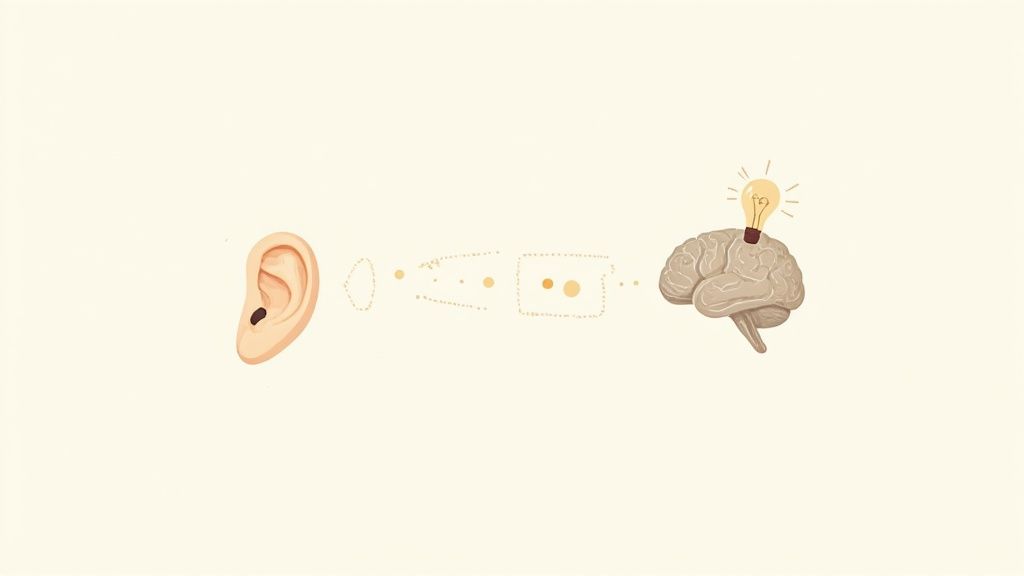
For most language learners, listening is the toughest skill to master. It’s also the most critical for real-world communication. Many get stuck in a frustrating loop, passively hearing words but never quite grasping the full message.
This barrier usually exists because there's a disconnect between recognizing individual words and processing them at conversational speed. Your brain has to do more than just translate; it needs to predict, interpret tone, and fill in the blanks on the fly.
Ever felt like you can understand a second language but can't speak it? That's a classic sign of this gap between your passive knowledge and active processing skills. Targeted listening practice is the strategy that closes that gap.
Why Strong Listening Matters
Powerful listening skills have a real, measurable impact on success in both school and work. It's about cutting down on misunderstandings, building confidence, and communicating more effectively.
Listening comprehension is a huge hurdle for learners worldwide. Many English learners report it's their most difficult skill. This isn't just a minor inconvenience; it has tangible consequences.
The real goal is to shrink the delay between hearing a word and knowing what it means. Good practice builds the neural pathways to make this process feel instant, just like it does in your native language.
Core Principles for Better Listening
To transform your listening ability, ground your efforts in a few key principles. These are the pillars that support any effective strategy.
Before diving into specific techniques, here's a quick look at the foundational principles that make them work.
| Principle | What It Means | Why It's Critical |
|---|---|---|
| Comprehensible Input | Use materials where you understand 95% of the content. The remaining 5% is your learning zone. | Keeps you motivated and ensures you're building on existing knowledge, not just getting frustrated. |
| Active Engagement | Don't just let audio wash over you. Interact with it by summarizing, transcribing, or shadowing. | Forces your brain to process deeply, turning passive hearing into active learning. |
| Consistency Over Intensity | Short, daily sessions (15-20 minutes) beat long, infrequent ones every time. | Builds a sustainable habit and leverages the power of spaced repetition for long-term retention. |
Think of this guide as your starting point for putting these principles into action. With the right strategies, you can finally move from passively hearing to actively understanding, unlocking a whole new level of fluency.
Find Your Starting Point and Set Clear Goals

Before you can build a solid plan, you need an honest assessment of where you are right now. Jumping into advanced podcasts when you’re still getting the hang of the basics is a recipe for frustration. A clear starting point helps you pick the right materials and, just as importantly, celebrate real progress.
Think of it like using a map. You wouldn't just start driving in a random direction; you'd first figure out your current location. This isn't about getting a perfect score on a formal test. It’s about understanding your functional ability in real-world scenarios.
How to Diagnose Your Current Listening Level
A simple way to gauge your level is to test your understanding with different kinds of audio. This quick self-diagnostic check gives you a practical baseline and helps you see the gap between what you think you understand and what you actually process.
Try this simple experiment:
Controlled Audio: Listen to a 2-minute clip from a slow news broadcast or a podcast made for learners. Could you grasp the main topic and key details without subtitles?
Native-Speed Audio: Now, listen to a 2-minute clip from a native-level podcast or a casual talk show conversation. How much did you catch? Was it just a few words, or could you follow the general flow?
The difference in your comprehension is incredibly revealing. If you understood most of the controlled audio but felt lost with the native-speed content, you might be at a low-intermediate level (like A2 or B1). If both were manageable, you're likely in the upper-intermediate to advanced range (B2 to C2).
A key part of improving listening comprehension is moving from vague aspirations like "get better" to concrete, actionable targets. Your self-diagnosis provides the data you need to set goals that are both ambitious and achievable.
This simple test gives you a far more useful metric than a generic label. It highlights your specific challenges—whether they're speed, vocabulary, or complex sentence structures.
From Vague Wishes to Specific Targets
Once you have a rough idea of your current level, set meaningful goals. The problem with a goal like "I want to improve my listening" is that it’s impossible to measure. You'll never know if you've actually achieved it, which kills motivation.
Effective goals are specific, measurable, and time-bound. They give you a clear finish line, turning practice from a chore into a focused mission.
Instead of a fuzzy goal, create a precise one. Here are some examples that transform a vague wish into a powerful objective:
Beginner (A2): "In 30 days, I will understand 80% of a 3-minute slow-paced news report on a familiar topic without using a transcript."
Intermediate (B1): "Within six weeks, I will be able to follow the main plot points of a 10-minute episode of a specific animated series with target-language subtitles only."
Advanced (B2/C1): "By the end of the quarter, I will listen to a 20-minute native-speed podcast on a professional topic and be able to write a 3-sentence summary of the main arguments."
These goals work because they define exactly what success looks like, what material you'll use, and when you expect to achieve it. This structure provides a clear roadmap, allowing you to track your progress and adjust your strategies as you go.
Use Comprehensible Input to Build Your Foundation
One of the fastest ways to kill motivation is jumping straight into native-level content. Trying to follow a fast-paced movie or a dense political podcast when you're still finding your footing is like trying to lift a weight that's too heavy—it leads to frustration, not growth.
The key is finding that sweet spot. That's where comprehensible input comes in.
The idea is simple but incredibly powerful: focus on listening to material where you understand most of what's being said. Think of it as hitting a 95% comprehension rate. That other 5% is where the magic happens. You use the context of what you do understand to figure out the new bits, all without feeling totally lost.
This approach keeps you in the game because you’re constantly succeeding. Instead of straining to catch a single familiar word in a sea of noise, you’re building on a solid foundation of understanding. To really dig into this concept, check out our guide on what comprehensible input is and why it works.
Why Your Reading Is Often Better Than Your Listening
Ever notice how you can breeze through an article but then struggle to follow a conversation about the exact same topic? It’s a common experience, and it's not your fault. For most of us, this gap is a direct result of how we were taught languages in school.
Traditional education tends to hammer on reading and writing, often leaving listening skills behind. A study from the OECD covering 15 European school systems uncovered a surprising trend: the gap between reading and listening skills actually gets wider the more years of formal English instruction a student has.
This tells us that classroom methods often inadvertently make us much stronger readers than listeners, creating that frustrating imbalance so many of us feel. You can read more about how educational approaches can widen the reading-listening skill gap on oecd.org.
This is exactly why a dedicated listening strategy is so important. You need to actively work to bring your listening up to par with your reading, and using the right level of input is the most effective way to close that gap.
Finding Your Perfect Listening Materials
The goal here is to find audio and video that feels challenging but not impossible. The right material makes you lean in, curious. The wrong material just makes you want to hit stop.
Here's a playbook for finding resources that match your current level.
Beginner (A2/B1):
Your priorities are crystal clear: slow, deliberate speech and strong visual context. You need content that supports your understanding, not fights against it.
Animated Series: Shows made for younger audiences are gold. The language is simpler, the plots are easy to follow, and the on-screen action gives you a ton of clues.
Graded Readers with Audio: These are books written specifically for language learners. Many come with audio, letting you connect the sounds you hear with the words on the page.
Learner-Focused Podcasts: Hunt for podcasts designed for learners of your target language. They almost always feature slow, clear speech and focus on the most common vocabulary.
Intermediate (B1/B2):
At this stage, you can start dipping your toes into more authentic content, but you still need to be picky. Look for clear speakers and topics you're already familiar with.
YouTube Channels on Your Hobbies: Find creators talking about stuff you already know a lot about, like cooking, gaming, or cars. Your existing knowledge acts as a scaffold, helping you decode new words and phrases.
Documentaries: Narrators in documentaries often speak very clearly and deliberately, which makes them much easier to follow than a chaotic, multi-person conversation in a TV drama.
Podcasts on Familiar Topics: Search for podcasts related to your job or personal interests. The specialized vocabulary will be a good challenge, but the familiar context will keep you from getting overwhelmed.
The ultimate test for comprehensible input is simple: how does it make you feel? You should be engaged and curious, not stressed and discouraged. If you can follow the main storyline without needing a transcript, you're on the right track.
By carefully choosing materials that stick to the principles of comprehensible input, you turn listening practice from a painful chore into an enjoyable—and seriously effective—habit. This is how you build the solid foundation you'll need to one day tackle any native-level content with complete confidence.
Master Active Listening Techniques
Once you’ve found material at your level, it’s time to engage with it. Passive listening—like having a podcast on in the background—is better than nothing, but it won't push you forward.
To level up your listening comprehension, you must transform hearing into a focused, active exercise. This is where the real learning happens. It’s about using specific strategies that force your brain to pay close attention, catch details, and make connections.
These techniques are your toolkit for dissecting the language. They train your ear to pick up on the subtle sounds, rhythms, and structures that you would otherwise miss.
Adopt the Focused Listening Method
One of the most effective strategies is Focused Listening. This means listening to the same short audio clip (1-3 minutes) multiple times, but with a different goal each time. It turns a single piece of content into a multi-layered lesson.
Instead of trying to "understand everything" at once—which is a recipe for overwhelm—you break the task down into smaller, more manageable goals. This kind of structured repetition is incredibly powerful for building deep, lasting comprehension.
Here’s a practical routine for a Focused Listening session:
Listen for the Gist: On your first pass, forget the details. Your only goal is to answer the question, "What is the main idea here?" Just try to get a general sense of the topic and what the speaker is trying to say.
Listen for Specifics: Now, listen again. This time, zero in on specific bits of information—names, numbers, dates, or key vocabulary. Jot down a few words you recognize.
Listen for Structure: On the third pass, shift your focus to the language itself. Pay attention to grammar, how sentences are built, or the use of connecting words. This helps you understand how the speaker is building their argument or telling their story.
This process trains your brain to listen on different levels, moving you from a surface-level understanding to a much deeper grasp of both the content and the language used to deliver it.
Sharpen Your Skills with Shadowing
Another incredibly powerful technique is Shadowing. The exercise is simple: listen to audio and repeat what the speaker says, in real-time, just a split second behind them. It sounds easy, but it’s a demanding workout for your brain.
Shadowing forces you to sync up your listening, processing, and speaking skills all at once. The goal isn't perfect mimicry; it's about training your brain to process spoken language much faster.
This technique is a direct attack on the common problem of mental translation. By forcing you to produce the sounds almost instantly, it shortens the delay between hearing and understanding. This boosts your processing speed and has the added benefit of improving your pronunciation.
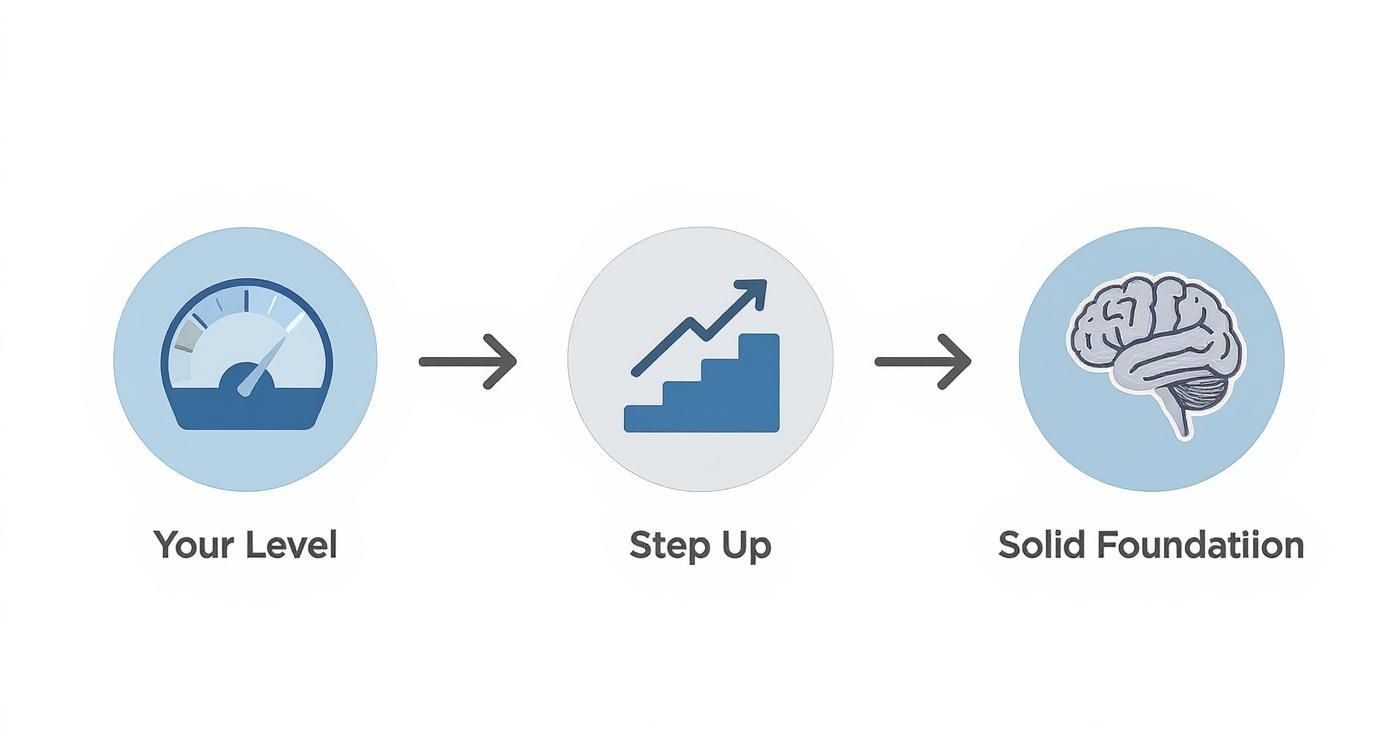
As the diagram shows, starting with material at your level and taking a small step up is what builds the solid foundation you need. It’s this foundation that makes active listening exercises like these so effective.
Use Dictation to Train Your Ear for Detail
Dictation, or transcription, is a classic for a reason: it works. The process is straightforward. You listen to a short segment of audio, write down exactly what you hear, and then compare your version to the official transcript.
This practice is like putting your listening skills under a microscope. It immediately reveals the specific words, sounds, or grammatical endings that you're consistently missing.
Dictation closes the gap between what you think you hear and what is actually being said. It's a direct diagnostic tool that pinpoints your exact weaknesses with unparalleled accuracy.
By integrating these active listening techniques into your routine, you move beyond simply hearing the language. You start to actively engage with it, break it down, and truly understand its mechanics. This intentional effort is the key to unlocking your full listening potential.
Build a Consistent Daily Practice Routine

Active listening techniques are powerful, but they only work if you use them consistently. Real improvement doesn't come from a few intense cramming sessions. It's built through small, repeatable actions that become second nature.
The goal is to build a sustainable habit, not to rely on fleeting bursts of motivation. By weaving listening practice into your life so seamlessly it feels automatic, you sidestep burnout and guarantee steady, incremental progress every single day.
The Power of Habit Stacking
One of the most effective ways to build a new habit is to piggyback it onto an existing one. This psychological trick, called habit stacking, links your listening practice to something you already do on autopilot.
The formula is simple: "After I [CURRENT HABIT], I will [NEW LISTENING HABIT]." This completely removes the friction of deciding when and where you’re going to practice.
Here’s what this looks like in practice:
Morning Coffee Routine: "After I press 'start' on my coffee maker, I will listen to a five-minute news podcast in my target language."
Daily Commute: "When I get in the car for my commute, I will immediately start a chapter of my foreign language audiobook."
Evening Wind-Down: "Before I brush my teeth at night, I will do one listening exercise from my language app."
This strategy uses the momentum of established routines, making it far more likely your new practice will stick. You're not building a new habit from scratch; you’re just adding a tiny step to a path your brain already knows well.
The secret to consistency isn't finding more willpower; it's designing a system that makes practice the default option. Habit stacking is that system.
Customizable Practice Plans
Your daily routine needs to fit your life, not the other way around. A rigid, one-size-fits-all plan is designed to fail. The smart approach is to create a flexible blueprint that works for you, even on your craziest days.
Have a few go-to routines ready to deploy based on the time and energy you have.
The 15-Minute Daily Drill
Think of this as a focused, high-intensity workout for your brain. It's perfect for a lunch break or a quiet moment before the day gets hectic.
Warm-Up (3 minutes): Listen to a short, easy audio clip you've heard before. This gets your brain switched into the right language mode.
Active Listening (10 minutes): Use the Focused Listening method on a new 2-3 minute audio clip. Listen once for the main idea, a second time for specific details, and a third time to notice sentence structure.
Review (2 minutes): Quickly jot down 3-5 new words or phrases you picked up.
The Commute Power-Up
Turn dead travel time into productive practice. This routine is about high-volume listening to build familiarity and endurance.
Podcasts: Pick a podcast on a topic you're genuinely into. Don't stress about catching every single word; just focus on following the overall flow of the conversation.
Audiobooks: Listening to a story you already know in your native language can be an awesome way to absorb vocabulary through context. You know the plot, so you can focus on the language.
Music: Pay active attention to the lyrics of songs in your target language. Look them up later and see how much you actually understood.
There are tons of platforms with great content for this. For instance, you can dive into graded audio resources like the Spanish stories on Lenguia.com to find material that’s right for your level, making your commute both fun and genuinely useful.
Creating these small, consistent touchpoints with the language is what forges the neural pathways for effortless understanding. It’s the daily grind, not the occasional marathon session, that will truly transform your listening comprehension.
To make things even more practical, here's a sample schedule you can adapt. The goal is to mix up your activities to keep things fresh and target different sub-skills throughout the week.
Sample Weekly Listening Practice Schedule
| Day | Activity (15-30 mins) | Focus Skill |
|---|---|---|
| Monday | Focused Listening on a 3-min news clip. Transcribe 2-3 sentences. | Detail-oriented comprehension |
| Tuesday | Podcast on a familiar topic during commute. | Gist & conversational flow |
| Wednesday | Shadowing practice with a short dialogue or monologue. | Pronunciation & rhythm |
| Thursday | Listen to 3 songs, then read and translate the lyrics. | Vocabulary in context |
| Friday | Watch a short video or cartoon with target-language subtitles. | Visual context & colloquialisms |
| Saturday | Dictation exercise: listen to a sentence and write it down. | Aural-to-written accuracy |
| Sunday | Relaxed listening: enjoy an audiobook chapter or a longer podcast episode without pressure. | Listening endurance |
This isn't a rigid prescription, but a template to show you how a balanced week might look. Feel free to swap days or activities based on your energy levels and interests. The most important thing is showing up, day after day.
Track Your Progress and Break Through Plateaus
You can practice for hours, but how do you really know if you're getting better? If you’re not tracking your progress, you're flying blind. You can't see how far you've come, and you won't know what to do when you inevitably feel stuck.
The good news is you don't need some complex analytics dashboard to see your gains. The process can be simple, and it's one of the most rewarding parts of the journey. It’s the proof that keeps you going.
Simple Ways to See How Far You've Come
One of the best ways to measure your progress is to go back in time. Find an audio clip that felt impossible a month or two ago—maybe a fast-paced podcast or a tricky news report. Now, listen to it again.
Chances are, you'll be shocked at how much more you understand. What once sounded like a wall of noise has likely started to separate into distinct words and clearer ideas. This isn't just a feeling; it’s tangible proof that your daily efforts are adding up.
Another great technique is tracking how much you understand without subtitles.
Pick a short video series you enjoy.
Watch the first episode with subtitles on, and notice how much you rely on them.
After a few weeks of consistent listening practice, watch a new episode, but this time, try it without the subtitles first.
You can always re-watch with them on to see what you missed, but you'll probably notice you're catching more and more on your own. Seeing that reliance drop is a huge win.
It's not about perfection; it's about progress. Realizing you can now catch 60% of a conversation you only understood 30% of before is a massive victory. That’s what keeps your motivation fired up.
How to Smash Through a Learning Plateau
Sooner or later, every single language learner hits a plateau. You know the feeling—you're putting in the hours, but it feels like you're not getting any better. Don't panic. This is a completely normal part of the process.
When your progress stalls, it's just a signal that your brain has gotten comfortable with your current routine. It needs a new challenge. The solution isn't to practice harder, but to practice differently.
Here are a few proven strategies to break out of a rut:
Mix Up Your Materials: If you've only been listening to news podcasts, switch things up. Try some casual interviews or an audiobook. Throwing different formats, topics, and levels of formality at your brain forces it to adapt.
Hunt Down a New Accent: Just because you can understand a speaker from Madrid doesn't mean you'll get someone from Buenos Aires. Actively seek out speakers from different regions. This trains your ear for new pronunciations, rhythms, and slang.
Level Up Your Technique: Systematically try a more challenging active listening method. If you’ve just been doing basic transcription, it’s time to try real-time shadowing. It’ll push your processing speed to the next level.
Finally, make sure the new vocabulary you're learning actually sticks. When you come across new words in your listening practice, add them to a Spaced Repetition System (SRS), like the one built right into Lenguia. An SRS is designed to show you a flashcard right at the moment you’re about to forget a word, which makes your vocabulary practice way more efficient. This locks in your gains and builds a stronger foundation for everything you listen to next.
Common Questions About Improving Listening
As you start putting these strategies into practice, you're bound to run into a few common questions. We all do. Getting these cleared up early can be the difference between pushing through a tough spot and getting discouraged. Let's tackle some of the biggest hurdles learners face.
Should I Use Subtitles
Short answer: Yes, but you have to be smart about it.
Using subtitles in your native language is a trap. It feels helpful, but you're really just turning listening practice into reading practice. On the other hand, subtitles in your target language are a fantastic tool, especially when you're starting out.
They create a bridge, connecting the sounds you hear with the words on the screen. The key is to see them as training wheels, not a permanent solution. Your goal is to eventually take them off as your ear gets stronger.
A great way to do this is with the "three-pass" method. Watch a short clip first with target-language subtitles. Then, watch it again without them. Finally, a third time with them back on to catch anything you missed. This turns subtitles from a passive crutch into an active learning strategy.
What Is the Best Speed to Listen To
The sweet spot is a speed that feels slightly challenging but not completely overwhelming. This is the heart of comprehensible input. Blasting audio at full speed when you're not ready just creates frustration and makes your brain tune out.
Most media players and platforms like YouTube have playback speed controls. Don't be shy about slowing things down to 0.75x speed. It gives your brain just enough extra time to process what you're hearing without making the audio sound like a robot. Once that feels easy, nudge it back up to normal speed.
What If I Feel Completely Lost
First off, it happens to everyone. The absolute worst thing you can do is panic. When you're in a conversation or listening to an audio clip and feel totally lost, your first job is to refocus on what you can understand, no matter how small.
Anchor on Key Words: Can you catch just one or two familiar words? Sometimes, that’s enough to get the gist of the topic.
Focus on Tone and Context: Is the speaker happy, angry, or asking a question? You can get a surprising amount of information from the emotion and situation, even if you miss the specific words.
Request Clarification: In a real conversation, it’s completely fine to say, "Could you please repeat that?" or "Sorry, I didn't catch that." Learning how to manage a conversation is a skill in itself.
Feeling lost isn't a sign that you're failing. It’s a sign that you're pushing your boundaries. Every single time you work your way through one of these moments, your listening skills get a little bit stronger.
Ready to turn these strategies into a seamless, daily habit? Lenguia is built on the power of comprehensible input, delivering level-appropriate stories and lets you turn your media into content that you can understand to make practice feel effortless. Explore how Lenguia can transform your listening skills today.