Your Ultimate Guide to Slang in Spanish
Learning Spanish slang is how you graduate from textbook phrases to sounding like you actually belong in the conversation. It’s the difference between knowing the words and understanding the culture.
Why Learning Spanish Slang Unlocks True Fluency
Most of us start out focused on grammar rules and formal vocabulary. That’s a great foundation. But then you hit a wall: real conversations don't sound anything like your lessons. People use shortcuts, inside jokes, and colorful expressions you will never find in a textbook.
Connect on a Deeper Level
When you use a bit of local slang correctly, something magic happens. It shows you have put in the effort to see the culture from the inside. You are not just a tourist reciting phrases, you are someone who is genuinely trying to connect.
This one small shift can completely change your interactions. Instead of being seen as a guiri (a common Spanish slang term for a foreigner), people see you as someone who is actually engaged with their way of life.
Understand Modern Spanish Media
Good luck trying to understand the latest reggaeton hit, a viral TikTok trend, or a popular Netflix show without knowing any slang. Modern Spanish media is packed with it. If you do not have a handle on these informal terms, you're missing huge chunks of the conversation and the cultural punchlines that make the content great.
Learning slang helps you:
Follow the plot of a TV show without hitting pause every two minutes to look something up.
Actually get the lyrics to a song and what the artist is trying to say.
Engage with social media from Spanish-speaking creators and feel like you are in on the joke.
This whole process is a perfect example of how comprehensible input helps you acquire a language without even trying.
In the end, learning slang is not about memorizing a bunch of new words. It's about opening the door to authentic conversations, cultural fluency, and a much more dynamic and enjoyable way to learn Spanish.
The Great Divide: Spain vs. Latin American Slang
First things first: there is no such thing as one universal “Spanish.” This is the most important lesson, and probably the hardest, for anyone diving into the world of slang. Thinking you can use a word you learned from a Madrid-based TV show in a cafe in Buenos Aires is a recipe for blank stares.
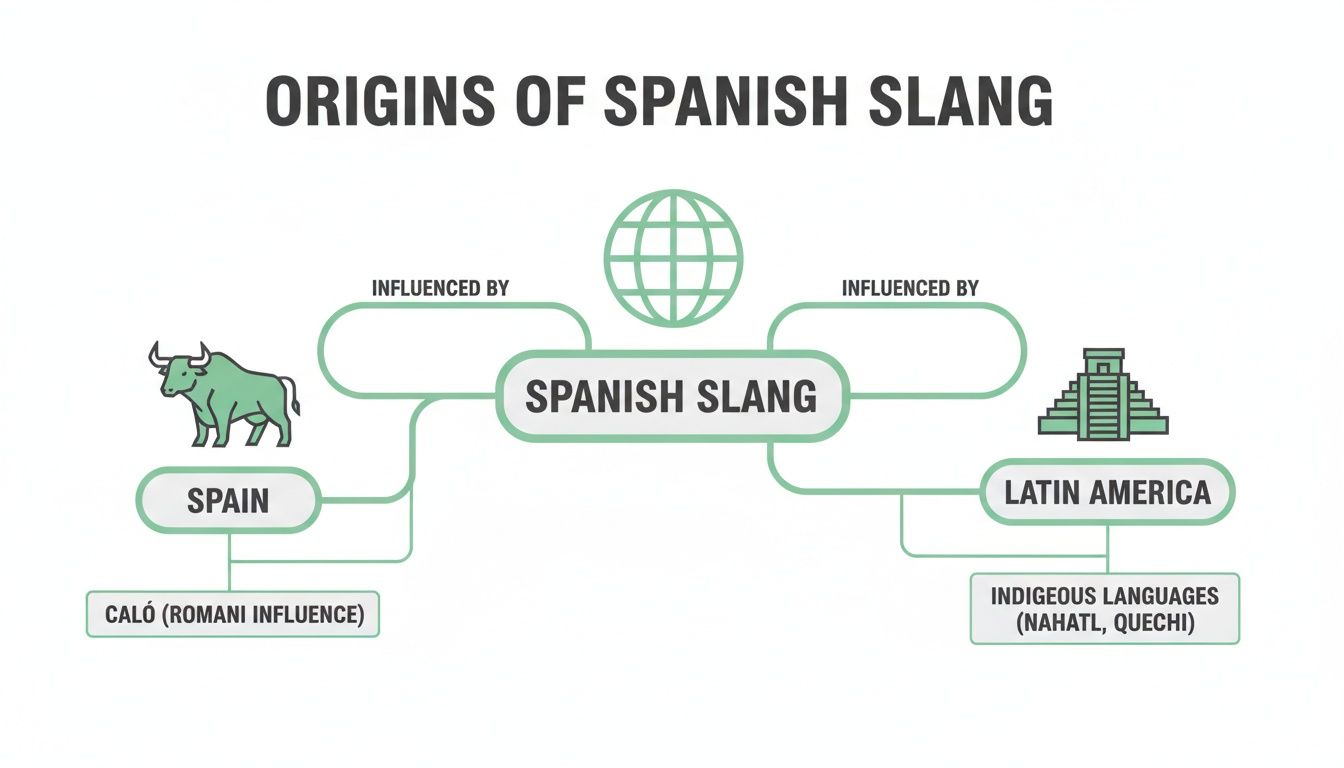
Just like you would not expect a Londoner to use the word "y'all" or someone from Texas to talk about going to the "loo," Spanish slang is deeply, fiercely regional. The language in Spain and the language in each country in Latin America has been doing their own thing for centuries. That separation has created two incredibly rich but distinct worlds of informal speech.
Key Vocabulary and Pronunciation Differences
The differences are not subtle. We are talking about basic, everyday words that you'll hear constantly. For example, a car is a 'coche' in Spain. Say that in most of Latin America, and they'll know what you mean, but they will almost always say 'carro' instead. A computer is an 'ordenador' in Spain, but it's a 'computadora' everywhere else in the Spanish-speaking world.
Pronunciation is another dead giveaway. The famous Spanish "lisp" where 'c' (before e/i) and 'z' are pronounced like the 'th' in "think" is a hallmark of most of Spain. This feature, known as 'distinción', is completely absent in Latin America, where those letters are pronounced just like an 's' (a phenomenon called 'seseo').
Here is a quick rundown of some massive variations you can't ignore:
You (plural, informal): In Spain, you'll hear 'vosotros' used constantly to mean "you all." Step foot anywhere in Latin America, and it vanishes. Everyone, from friends to strangers, uses 'ustedes'.
A Bus: Is it a 'bus'? Or an 'autobús'? Maybe. But in Colombia, it's often a 'buseta,' and in parts of Mexico, you'd be waiting for a 'camión' (which, confusingly, also means "truck").
Cool: This one word has a thousand faces. Something can be 'guay', 'mola', 'chido', 'padre', 'chévere', 'bacano' or about 100 more variations depending where you are.
Essential Slang You Will Hear in Spain
Step off the plane in Spain, and you'll quickly discover that the Spanish spoken on the street is a whole different beast from what you learned in class. To really tune into the local rhythm and blend in, you need a handle on the essential slang that colors every single conversation.
Common Slang in Spain at a Glance
Before we dive deep, here's a quick look at some of the key terms you'll hear all over Spain. Think of this as your cheat sheet for sounding like a local.
| Slang Term | Literal Meaning | Common Slang Meaning | Example Sentence |
|---|---|---|---|
| Guay | (none) | Cool, awesome, great | ¡Qué guay tu camiseta! (Your t-shirt is so cool!) |
| Molar | To be a molar (tooth) | To be cool, to really like | Esa película me mola un montón. (I really like that movie.) |
| Vale | It is valid/worth | Okay, alright, got it, deal | ¿Quedamos a las ocho? — Sí, vale. (We're meeting at 8? — Yep, okay.) |
| Tío / Tía | Uncle / Aunt | Dude, guy / Girl, gal | ¿Viste a ese tío? (Did you see that guy?) |
| Flipar | To flip out | To be amazed, shocked, to love something | Vas a flipar con esta noticia. (You're going to freak out over this news.) |
Everyday Essentials: Guay and Vale
Guay is the ultimate, all-purpose word for "cool," "great," or "awesome." It is incredibly flexible and just works in pretty much any positive context. You'll hear things like, "¡Qué guay tu camiseta!" ("Your t-shirt is so cool!"). It's friendly, incredibly common, and used by everyone.
And then there's vale. This might just be the single most useful word in the entire Spanish language. It means "okay," "alright," "deal," or "got it." You'll use it to agree, to show you understand, and even to wrap up a phone call.
A classic exchange sounds like this:
"¿Quedamos a las ocho?" (We're meeting at eight?)
"Sí, vale." (Yep, okay.)
A practical tip: Master vale first. It’s a conversational lubricant that signals you're tuned in, making your Spanish sound instantly less like you're reading from a textbook.
Talking About People: Tío and Tía
In English, you've got "dude," "man," or "gal." Spain's answer to this is tío (for a guy) and tía (for a girl). Yes, they literally mean "uncle" and "aunt," but in everyday slang, they're used to refer to anyone, friend or stranger.
You might say, "¿Viste a ese tío?" ("Did you see that guy?") or tell a friend, "¡Qué tía más maja!" ("What a nice girl!"). It is the default, informal way to refer to someone. Using it correctly is a dead giveaway that you've been listening to how real Spaniards actually talk.
Expressing Surprise and Amazement with Flipar
When something is genuinely mind-blowing, shocking, or just unbelievable, the word you're searching for is flipar. It's a powerhouse verb that captures a whole spectrum of strong reactions, from wide-eyed wonder to complete disbelief.
You can use it in a few different ways:
To be amazed: "Vas a flipar con esta noticia." (You're going to freak out/be amazed by this news.)
To love something: "Me flipa la música de Rosalía." (I'm crazy about Rosalía's music.)
To be shocked: "Flipé cuando me dijo que se mudaba." (I was shocked when he told me he was moving.)
A Slang Tour of Latin America
If Spanish from Spain is like learning the local lingo of London, then Latin American Spanish is like trying to master the slang of New York, Texas, and California all at once. The sheer size and diversity of the continent have created an incredible tapestry of unique, colorful, and hyper-regional expressions.
Mexican Slang Essentials
Mexican Spanish is one of the most recognizable and influential dialects out there, partly because its media presence is just massive. The slang is playful, direct, and absolutely essential for understanding daily life.
Güey (or Wey): This is the undisputed king of Mexican slang. It is the go-to equivalent of "dude," "man," or "bro," and you will hear it constantly among friends. For example, "¿Qué onda, güey?" ("What's up, dude?"). But be careful, its tone can shift dramatically depending on the context, from super friendly to slightly insulting.
¿Qué onda?: While you can always ask ¿qué tal?, using ¿qué onda? is a much more informal and authentically Mexican way to say "What's up?" or "What's going on?". It just sounds right.
No mames: You will see this one everywhere, especially online. It roughly translates to "no way," "you're kidding," or a more forceful "don't mess with me." It's incredibly versatile for expressing shock, disbelief, or frustration. You might hear, "¿No mames, en serio te dijo eso?" ("No way, did he really tell you that?").
Colombian Slang and Its Vibe
Colombian Spanish is often praised for its clarity, but don't let that fool you. Its slang is full of warmth and unique expressions that add a friendly, positive energy to conversations.
Chévere / Bacano: Both of these are popular ways to say "cool," "great," or "awesome." They are used to describe anything from a good movie to a fun party. For example, "Esa fiesta estuvo muy chévere" ("That party was really cool").
Parce / Parcero: Similar to Mexico's güey, parce is the go-to word for "dude," "mate," or "bro" in Colombia. It is a staple of informal conversation between friends, as in, "¿Quiubo, parce?" ("What's up, dude?").
Dar papaya: This is a uniquely Colombian expression that means "to make yourself an easy target." It is a warning against being careless with your belongings or actions. The classic advice is, "No des papaya" or "Don't give them an opportunity to take advantage of you."
Argentinian Slang and its Italian Flair
Argentinian Spanish, particularly from the Buenos Aires region, has a distinct sing-song intonation heavily influenced by Italian immigration. The slang, known as lunfardo, is just as unique.
Che: This is the quintessential Argentinian slang term, used to get someone's attention. It is like saying "hey," "man," or "pal." You'll hear it constantly: "¡Che, vení para acá!" ("Hey, come over here!").
Boludo/a: Now this is a tricky one. Among close friends, it is a very common and affectionate term similar to "dude" or even a lighthearted "dummy." But with strangers or in a tense situation, it can be a serious insult. Context is everything here.
Quilombo: Literally meaning "brothel," this word is widely used to describe a mess, a disaster, or a chaotic situation. If a project goes wrong, someone might exclaim, "¡Qué quilombo!" ("What a mess!").
Of course, slang also pops up when talking about common topics like money. To get a better sense of these regional variations, check out our guide on slang words for money in Spanish. From Mexico to Argentina, understanding these local terms is a massive step toward sounding less like a tourist and more like someone who truly gets the culture.
Common Slang Mistakes You Need to Avoid
Ignoring the Context
This is, without a doubt, the biggest mistake learners make: using informal language in a formal setting. Slang is for your friends at a bar, not for a job interview or a chat with your professor. Calling an older person or your boss tío ("dude") is not going to win you any points; it will just come across as disrespectful.
This idea is called register, and it's simply about matching your language to the social situation. Before a slang word leaves your lips, just run through a quick mental checklist:
Am I talking to a friend or a total stranger?
Is this a chill hangout or a professional environment?
What is my relationship with this person?
A practical strategy is to listen more than you speak at first. Notice what words other people are using in a specific situation before you try to use slang yourself. When in doubt, it is much better to sound a little too formal than to be unintentionally rude.
Mixing Up Your Regions
As we've seen, Spanish slang is intensely regional. Tossing out a Mexican güey in Argentina will earn you a blank stare, just like using the Argentinian che in Spain will immediately flag you as an outsider. It is a dead giveaway that you have not quite tuned into the local frequency.
This is not just about sounding authentic. It's about avoiding massive misunderstandings. Some words are perfectly innocent in one country and deeply offensive in another.
A classic example of this is the verb coger. In Spain, it's an everyday word that just means "to take" or "to grab." You'll hear coger un taxi ("to take a taxi") all the time. But in most of Latin America, coger is a vulgar slang term for having sex. You can imagine how using it in the wrong place could turn a simple request into a cringeworthy moment.
How to Practice Spanish Slang Effectively
Just knowing a list of slang words isn't the real goal, is it? The real win is dropping the perfect term into a conversation and having it land just right. To get there, you need to go beyond flashcards and develop a natural, intuitive feel for the language.
A useful strategy is to treat slang acquisition like learning any other skill. You need observation, practice, and feedback. Your "game footage" is the everyday media coming straight from Spanish-speaking countries.
Immerse Yourself in Authentic Media
The absolute best way to learn how real people talk is to listen to them. A lot. My advice? Pick a country or region you're genuinely curious about, say, Mexico or Spain, and just dive headfirst into their media.
Podcasts and Music: Find popular podcasts or artists from your target country. Listening on repeat is a game-changer for picking up the natural rhythm, tone, and context of slang. If you need some ideas on where to start, you might like our guide on how to learn Spanish with songs.
TV Shows and Movies: Streaming platforms are a goldmine for this. Start by watching shows with Spanish subtitles to connect the sounds you hear with the written words. Later, turn them off to really test your listening skills.
Social Media Influencers: Jump on TikTok or Instagram and follow creators from that country. Their short, casual videos are packed with the most up-to-the-minute slang, giving you a real-time window into how the language is evolving on the streets.
Ready to move beyond textbooks and learn Spanish the way it's actually spoken? Lenguia uses engaging stories and podcasts based on your interests to immerse you in authentic language. Transform any content into a personalized lesson and build fluency naturally, without the boring drills. Start your journey to real-world fluency with Lenguia today.