How to improve reading fluency: Boost skills with practical strategies
To improve reading fluency in a new language, practice consistently with the right materials, use specific exercises like repeated reading, and track your progress. True fluency is not just about speed; it is a blend of accuracy, speed, and natural expression. Mastering these three elements unlocks a much deeper level of understanding. This guide will show you practical strategies to get there.
What Is Reading Fluency and Why It Matters
Many language learners believe fluency means reading faster, but it is much more than that. True fluency is about reading with precision, a natural rhythm, and, most importantly, understanding what you are reading.
The Bridge Between Words and Meaning
The goal is to make the act of reading so automatic that all your mental energy can focus on grasping the message behind the words. This is not just a theory.
An FFT Education Datalab analysis of over 110,000 students in their Reading Assessment Programme found a strong link between oral reading fluency and reading comprehension. The takeaway is clear: as decoding becomes effortless, your brain is free to focus on meaning. For language learners, this is the most direct path to truly understanding what you read. You can learn more about this idea by exploring what is comprehensible input.
Fluency is the essential bridge that connects decoding words to understanding ideas. Without it, reading remains a mechanical chore rather than a meaningful experience.
Before we discuss the "how," here is a quick breakdown of the three pillars of fluency. Understanding these components helps you target your practice where it is needed most.
The Three Pillars of Reading Fluency
| Component | What It Means | How to Practice It |
|---|---|---|
| Accuracy | Reading words correctly without mistakes or self-corrections. | Use graded readers at your level, preview tricky vocabulary before you start, and practice with audio to hear correct pronunciation. |
| Speed (Rate) | Reading at a natural, conversational pace, not too fast, not too slow. | Try timed readings where you track your words per minute (WPM). The goal is still steady reading improvement, not rushing. |
| Prosody (Expression) | Reading with natural rhythm, intonation, and phrasing, like you would when speaking. | Practice shadowing (reading along with an audiobook) and recording yourself to hear how you sound. |
Mastering all three components is what separates clunky, word-by-word reading from smooth, confident comprehension.
Building an Effective Fluency Practice
A successful plan includes:
Consistent Practice: Short, daily sessions are far more powerful than cramming for hours once a week.
Targeted Exercises: Do not just read aimlessly. Use specific drills like Repeated Reading and Shadowing to build automatic word recognition.
Level-Appropriate Materials: You need texts that are slightly challenging but not so hard they leave you frustrated. This is key to staying motivated.
By weaving these elements into your routine, you create a system that does more than increase your reading speed. It fundamentally changes your ability to connect with and understand new ideas in your target language.
Finding Your Starting Point and Setting Clear Goals
Before you can improve your reading fluency, you must know your current level. Goals like "I want to read better" are too vague. They are impossible to track, and when you cannot see progress, it is easy to get discouraged and quit.
A data-driven approach makes everything tangible. It shows you exactly where you are starting and lets you see your improvements, which is a huge motivator.
The best way to get this baseline is by measuring your Words Correct Per Minute (WCPM). This is a simple but powerful metric that gives you a clear snapshot of your current fluency. It is not about chasing a high score or comparing yourself to others; it is about establishing a personal benchmark you can build on.
How to Calculate Your WCPM
You can calculate this in just a few minutes. All you need is a timer, a pen, and a short piece of text that feels comfortable for your current level, something where you already know most of the words.
Here’s how to run a quick one-minute reading test:
Find a suitable text: Pick a passage of about 200 to 300 words. The key is to choose something you can read without getting stuck on every sentence.
Set a one-minute timer: Get ready to read the passage out loud at a natural, comfortable pace. Do not rush; the goal is accuracy at a normal pace.
Read aloud: Start the timer and begin reading. As you go, make a mark on paper for any word you mispronounce, skip, or have to correct.
Mark your spot: When the timer stops, mark the last word you read.
Calculate your score: First, count the total number of words you read in that minute. Then, count the number of errors you marked.
Now for the final step: subtract the number of errors from the total words read. That result is your starting WCPM score.
WCPM Formula: (Total Words Read in 1 Minute) - (Number of Errors) = Your WCPM Score
This number is now your personal benchmark. It is a tool to guide your journey to better reading fluency.
Setting Specific and Measurable Goals
With your baseline WCPM, you can finally set specific, motivating targets. This simple shift transforms your practice from a chore into a focused mission. Instead of just hoping to get better, you will know exactly what you are working toward.
Consider setting goals like these:
Increase my WCPM by 15 points in the next six weeks. This is a clear, time-bound objective that gives your practice purpose.
Read a 500-word article without needing to look up more than three words. This goal focuses on building your vocabulary in the context of fluent reading.
Read a short story aloud and feel confident in my pronunciation and rhythm. This is a qualitative goal that targets the expressive side of fluency, known as prosody.
When you set these clear targets, you create a roadmap for your own success. You can re-test your WCPM every few weeks to see your progress in hard numbers, which provides the encouragement you need to keep pushing forward. This focused approach is the key to making steady, noticeable gains.
Core Techniques for Your Daily Fluency Practice
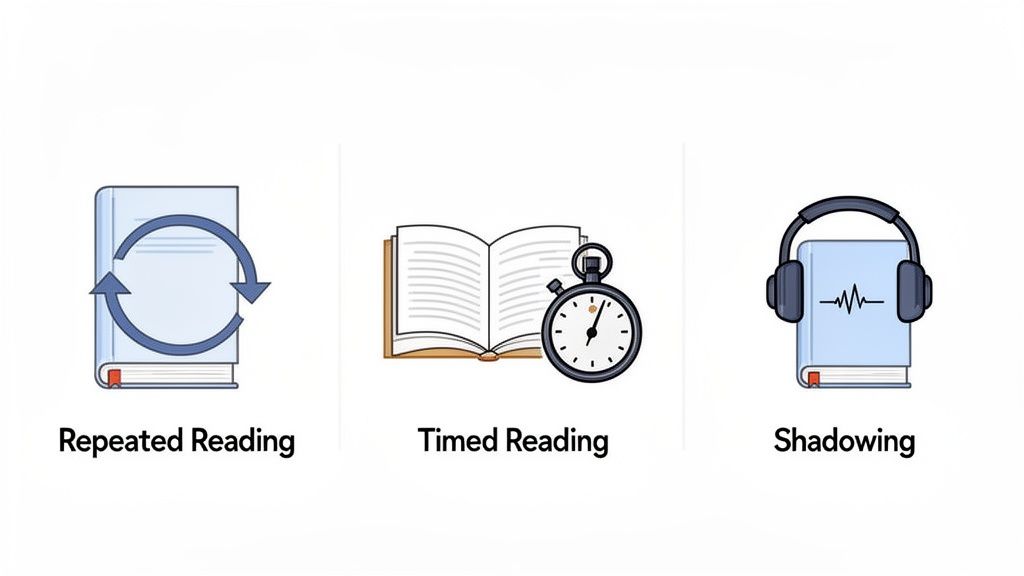
You have your baseline and some solid goals. Now it is time to build a daily practice habit that works. These are targeted, proven exercises designed to train your brain for speed, accuracy, and natural rhythm.
Think of these three techniques as the foundation of your fluency routine. Each one tackles a different piece of the puzzle. When you use them together, you create a balanced practice that addresses speed, expression, and instant word recognition.
Master Passages with Repeated Reading
This is one of the most effective ways to build automaticity. The idea behind Repeated Reading is simple: you read a short, engaging text aloud multiple times until you can do it smoothly, without stumbling. It is not about memorizing the text; it is about training your brain to see words and phrases and instantly recognize them.
This process is like a musician practicing a difficult piece of music. They do not just play it through once. They drill tricky bars over and over until the notes flow effortlessly. Repeated Reading does the same for your brain and voice.
For this to work, stick to short passages of 100 to 250 words. Reading a passage aloud three or four times is usually the sweet spot where you will feel a real difference in your confidence and flow. The key is to use material you find interesting, like the short stories in our guide to Spanish graded readers, to keep the process engaging.
Even 10-15 minutes a day of this focused practice can significantly improve your progress.
Add a Challenge with Timed Reading
Timed Reading adds a bit of friendly pressure to your routine. Here is how it works: you read a new passage for a set time, usually one minute, and keep track of how many words you read. The point is not to rush through the text, but to push yourself to maintain a steady, focused pace.
This technique is fantastic for building your reading rate. Over time, you will see your Words Correct Per Minute (WCPM) score climb, which is incredibly motivating. It also helps you get comfortable with maintaining comprehension under a bit of pressure, a useful skill for real-world reading.
By measuring your progress, you turn an abstract goal like "getting better" into a tangible result you can see week after week. This builds momentum and motivation.
Perfect Your Rhythm with Shadowing
Shadowing is a great technique for mastering prosody, the natural music, rhythm, and intonation of a language. It involves reading a text aloud while listening to a native speaker read the exact same thing. Your goal is to "shadow" their voice as closely as possible, copying their pace, pitch, and pauses.
This exercise is powerful because it bridges the gap between seeing words and hearing how they should sound.
Getting started with shadowing is easy:
Find a text with audio. A graded reader with an included recording or a podcast with a transcript is perfect.
Listen first. Play the audio once to get a feel for the speaker's rhythm and flow.
Read along. Now, play it again and read the text aloud at the same time. Try to match their voice in real-time. It may feel strange at first, but stick with it.
Connecting Fluency with True Comprehension
Reading smoothly is a huge achievement, but it is only half the battle. If you can read a page out loud perfectly but have no idea what you just said, you are not truly reading.
The real goal is to link smooth, effortless reading with a deep, genuine understanding of the text. When your brain stops struggling to decode every single word, it finally has the mental space to think about what the text actually means. This shift from decoding to understanding is the most important leap you will make.
The Power of Comprehensible Input
How do you build this critical connection? The key is working with what linguists call Comprehensible Input. This means picking reading material where you already know about 95% to 98% of the words. It is the perfect sweet spot: challenging enough to introduce new ideas, but not so hard that it becomes a frustrating slog.
Staying in this zone creates a powerful positive feedback loop. Your fluency improves, which makes comprehension easier, which in turn motivates you to read more. It is a cycle of success.
A World Bank's report on the global literacy crisis that reviewed over 120 studies confirmed that fluency is a foundational skill that frees up mental energy for comprehension. Other research on fluency routines showed that just 10 minutes of daily practice significantly boosts not only speed and accuracy but also comprehension scores. The link is direct and undeniable.
Practical Strategies to Boost Understanding
You can actively strengthen the bond between fluency and comprehension with a few simple but powerful habits. Instead of just letting your eyes glaze over the words, these techniques force you to engage with the material on a deeper level.
Here are a couple of practical tips you can start using today:
Preview Your Vocabulary: Before jumping into a new chapter or article, scan for unfamiliar words. Jot them down or create quick flashcards. Knowing these tricky words beforehand prevents them from breaking your reading flow. It lets you focus completely on the meaning.
Pause and Ask Questions: Get into the habit of stopping after each paragraph to ask yourself a simple question, such as, "What was the main point of that?" or "Who did what there?" This quick moment of active recall forces your brain to process the information, not just skim it.
By actively checking for understanding as you go, you are training your brain to see reading as a meaning-making activity, not just a word-recognition exercise.
This kind of active engagement is a cornerstone of effective learning. If you are looking for more ways to deepen your understanding, check out our complete guide on how to improve reading comprehension skills. Combining these comprehension checks with your fluency practice will speed up your progress and make reading a more rewarding experience.
To make it even clearer, here is what a balanced week could look like in a simple table format. You can use this as a starting point and tweak it to better fit your own schedule and goals.
Sample Weekly Fluency Practice Schedule
| Day | Focus Activity (15-20 mins) | Recommended Material |
|---|---|---|
| Monday | Repeated Reading | Short article or graded reader excerpt (150-200 words) |
| Tuesday | Shadowing | Podcast or audio article with a transcript |
| Wednesday | Repeated Reading | A different short article or excerpt from the same story |
| Thursday | Shadowing | Another segment from your chosen audio material |
| Friday | Timed Reading | A new, unseen passage of similar difficulty |
| Saturday | Extensive Reading | A graded reader, blog post, or book of your choice |
| Sunday | Vocabulary Review | SRS flashcards (Anki, etc.) with words from the week |
Remember, this is just a template. The best plan is the one you can stick to consistently. Feel free to swap days or activities around to keep things interesting and aligned with your energy levels.
Let's tackle some of the questions that often come up when people start working on their reading fluency. Getting these sorted out early helps you set the right expectations and avoid discouragement.
How Long Does It Take to See Improvement?
The honest answer is: it all comes down to consistency. You will not become a fluent reader overnight, but if you stick to a daily routine, you will see progress faster than you might think.
You will probably notice small wins within the first couple of weeks, such as reading a familiar paragraph a little more smoothly. More significant gains, like a real jump in your Words Correct Per Minute (WCPM) or feeling confident picking up a new book, usually show up after a month or two of dedicated practice. The key is consistent, focused effort, not long, sporadic sessions.
Is Reading Fluency the Same as Comprehension?
It is easy to confuse these two, but they are different skills that are completely intertwined.
Think of it this way: reading fluency is the bridge that leads to deep comprehension. Fluency is the mechanical side of things, reading the words on the page accurately and with a natural rhythm. Comprehension is about understanding the meaning behind those words.
If you are struggling with fluency, your brain is working so hard to decode the text that it has no energy left to process the message. By building that automaticity, you free up mental bandwidth to focus on what the text is actually saying.
Fluency turns reading from a slow, mechanical chore into a smooth, meaning-making experience. Without a solid foundation in fluency, true comprehension will always feel just out of reach.
Can I Get Better Just by Reading a Lot?
Reading a lot is amazing for building vocabulary and getting more exposure to the language. But on its own, it is often not enough to break through a fluency plateau. In fact, just reading more without targeted practice can sometimes reinforce slow or inaccurate habits.
This is where specific, targeted exercises are a game-changer. Activities like Repeated Reading and Shadowing force you to work on the mechanics of accuracy, speed, and prosody in a way that just reading for pleasure does not. Think of these drills as accelerators that build the automaticity you need for truly smooth reading.
Should I Read Aloud or Silently?
The best approach is to do both. Each method has its own unique benefits, and a balanced practice routine should include a mix of the two.
Reading Aloud: This is crucial for developing prosody, the natural rhythm and intonation of the language. It also forces you to catch pronunciation mistakes and builds a stronger link between the written word and how it sounds.
Silent Reading: This is what you will do most of the time in the real world. It is fantastic for building reading speed, stamina, and your ability to process information quickly.
A good rule of thumb is to use reading aloud for your targeted drills and save silent reading for when you are just enjoying a book or article.
Ready to stop struggling and start understanding? Lenguia provides daily, level-appropriate stories with audio to make your fluency practice effective and engaging. Transform any text and even entire books into a learning experience and track your progress with smart tools. Start your journey to fluency with Lenguia today.