A Practical Guide to Graded Spanish Readers for Fluency
Graded Spanish readers are books specifically designed for language learners. They use a controlled range of vocabulary and grammar that matches different stages of learning, from total beginner to advanced.
They are powerful because they deliver comprehensible input, a key concept in language acquisition. This means you absorb the language naturally through context instead of trying to memorize rules and vocabulary lists.
Understanding Graded Spanish Readers
Imagine learning the piano. You wouldn’t start with a complex concerto on day one. That would be frustrating. Instead, you would begin with simple scales and tunes, slowly building your skills.
Graded Spanish readers apply the same logic to learning a language. These are not just children's books, they are stories engineered to provide a smooth, satisfying path toward fluency.
The effectiveness lies in how they methodically introduce new words and sentence structures. Each book is designed to be just challenging enough to keep you engaged, but not so hard that you need a dictionary for every other sentence. This careful leveling is what makes them so effective.
The Power of Comprehensible Input
The success of graded readers is based on a fundamental concept in language learning: comprehensible input. The theory is simple: we acquire language best when we understand what we read or hear. You learn by engaging with content that is just slightly beyond your current skill level.
Comprehensible input is the bridge between what you already know and what you are ready to learn. It allows your brain to figure out the meaning of new words and grammar from the surrounding story, making the process feel natural and intuitive.
Instead of getting stuck on unfamiliar words, you can follow the plot, enjoy the story, and pick up the language almost without realizing it. This turns reading from a chore into an enjoyable activity. For a deeper dive into this concept, check out our guide on what is comprehensible input.
This approach boosts your confidence and keeps you motivated. Every time you finish a book, it reinforces that you can do this and makes you excited to start the next one.
How Graded Readers Build Fluency
How does reading these stories lead to fluency? It works in a few key ways:
Vocabulary Acquisition: You encounter new words repeatedly in different understandable situations. This helps you internalize their meaning without drilling flashcards.
Grammar Recognition: You start to recognize grammatical patterns naturally, just as you did with your first language. Verb conjugations and sentence structures begin to "feel right" through exposure, not from studying dense rulebooks.
Increased Reading Speed: The more you read material at the right level, the faster and more easily you will understand it. This prepares you for tackling more complex, authentic material written for native speakers.
How to Find Your Perfect Reading Level
Choosing the right graded reader is the most important part of making this strategy work. A book that is too hard will cause frustration. A book that is too easy will not lead to growth. The goal is to find the "sweet spot" where you can follow the story but still encounter enough new words to learn.
This is about building momentum with reading you enjoy, not grinding through a textbook. At the right level, you get lost in the story and absorb Spanish naturally. It turns learning into an activity you look forward to.
This process is a foundational step toward fluency. It is how you get the comprehensible input your brain needs to acquire the language.
Match Your Level with CEFR Standards
Most graded Spanish readers are aligned with the Common European Framework of Reference for Languages (CEFR). This is the international standard for language ability. This alignment makes it easy to match your current skills to the right books. If you have taken a class or a test, you probably know your CEFR level.
The table below breaks down what to expect at each level, from a complete beginner (A1) to advanced (C1). It provides a general vocabulary count and the main grammar concepts you will encounter, helping you choose books with confidence.
Matching Graded Reader Levels with CEFR Standards
Use this table to align your current CEFR level with the right graded reader, so you can find books with the appropriate vocabulary and grammar complexity.
| CEFR Level | Typical Vocabulary Range | Key Grammar Concepts |
|---|---|---|
| A1 Beginner | 200–500 words | Present tense (ser, estar, tener), basic nouns, adjectives, and greetings. |
| A2 High Beginner | 500–1,000 words | Simple past tenses (preterite vs. imperfect), direct/indirect object pronouns. |
| B1 Intermediate | 1,000–2,000 words | Subjunctive mood, conditional tense, and more complex sentence structures. |
| B2 Upper Int. | 2,000–3,000 words | Advanced subjunctive uses, passive voice, and nuanced idiomatic expressions. |
| C1 Advanced | 3,000+ words | Complex compound sentences, literary tenses, and sophisticated vocabulary. |
This framework removes the guesswork. If you are an A2 learner, you can select a book and know it will help you practice past tenses without introducing B1-level subjunctive grammar before you are ready.
Use the Simple Five Finger Rule
What if you do not know your CEFR level? There is a simple, practical test called the five-finger rule. It is a quick check to see if a reader is a good fit.
Here is how it works:
Open the book to any random page of text.
Start reading the page.
Hold up one finger for every word you do not understand.
Stop when you finish the page or when you have held up five fingers.
If you finish the page with only one or two fingers up, the book is probably a great choice. Three or four fingers means it will be a challenge, but manageable. If you reach five fingers before finishing the page, the book is likely too difficult for now. Set it aside and come back to it later.
The Sweet Spot for Learning
The ideal book is one where you understand 95% of the words on the page. This ensures you can follow the story's flow and infer the meaning of unknown words from context, which is the core principle of comprehensible input.
Finding this balance is key. It makes reading feel productive and fun, helping you build vocabulary and confidence without constant dictionary lookups. Your main goal is to read, enjoy yourself, and let the language sink in.
A Step-by-Step Strategy for Effective Reading
To get the most value from a graded reader, you need a solid routine. Simply letting your eyes drift across the page is not enough for serious language acquisition. A structured approach turns passive reading into an active, powerful learning exercise that makes new words and grammar stick.
Phase 1: Pre-Reading Warm-Up
Before reading the first sentence, take a minute or two to warm up your brain. This pre-reading phase prepares your mind for the Spanish you are about to see, making it easier to process what is coming.
Think of it like stretching before a workout. You are activating the right mental muscles for a better session.
Just a few quick actions are all it takes:
Examine the Cover: Look at the title and any pictures. What do you think the story is about based on these clues? Make a quick guess.
Read the Summary: If there is a blurb on the back or a short introduction, read it. This provides context.
Make Predictions: Ask yourself a few questions, in Spanish if you can. Something simple like, “¿Quién es el personaje principal?” (Who is the main character?) or “¿Qué va a pasar?” (What is going to happen?).
This process primes your brain by activating vocabulary you already know. You are giving your mind a rough map of the terrain ahead, which makes the actual reading journey much smoother.
Phase 2: Active Reading Immersion
Now it is time to start reading. The main goal here is not to understand every single word perfectly. It is to read for the general meaning and get lost in the story. This is where the magic of comprehensible input happens.
Your biggest challenge will be to resist the urge to stop and look up every unfamiliar word. Doing so breaks the flow, shatters your immersion, and shifts your brain from understanding a story to translating a list of words.
The core of active reading is learning to use context clues to figure things out. When you encounter a word you do not know, read the whole sentence. Then read the sentence before and after it. Often, the surrounding text provides enough clues to make a good guess.
This is a critical skill for developing true reading fluency. You are training your brain to think in Spanish and handle uncertainty, just as you do in your native language. If a word seems essential and you are completely stuck, highlight it and move on. You can return to it later. For more on this, check out our guide on how to improve reading comprehension skills.
Phase 3: Post-Reading Reinforcement
Once you finish a chapter or your planned reading session, it is time for the final phase: making it stick. This post-reading review cements new vocabulary and grammar, moving it from your short-term memory into long-term storage.
Skipping this step is like having a great workout and then forgetting to eat protein. You did the hard work but missed the final ingredient for real growth.
Here is a simple but powerful routine to wrap up:
Summarize the Chapter: Try to explain what you just read out loud, in your own words, in Spanish. If speaking feels too difficult, write down a few sentences. This forces you to actively recall and use the language.
Review Highlighted Words: Now, go back to the few key words you highlighted. This is the time to look them up. Because you already understand the context, the definitions will make more sense and be more memorable.
Create Connections: For each new word, try to think of how you could use it in a different sentence. This small step builds stronger neural pathways and helps make the new vocabulary truly yours.
This three-part strategy transforms every session with a graded reader into a complete learning cycle, ensuring you make consistent, measurable progress.
Supercharge Your Learning by Integrating Audio
Reading is a fantastic way to build your Spanish vocabulary and grammar, but it only works one set of skills. To speed up your journey to fluency, mixing audio with your graded Spanish readers is a game-changer. It bridges the gap between seeing the language on a page and understanding it in a real conversation.
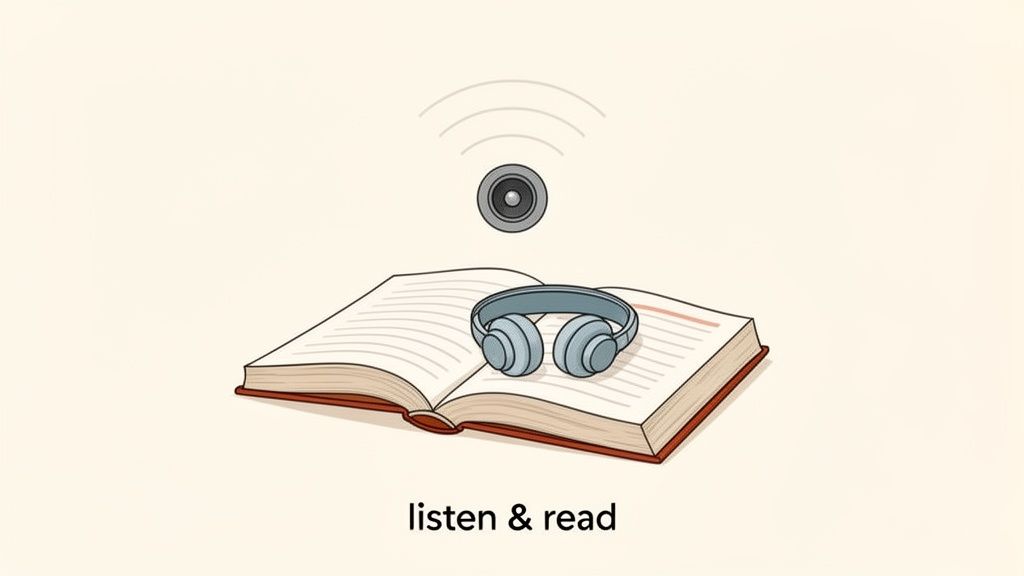
Many graded readers now come with audio files. Listening while you read trains your ear, cements pronunciation, and helps you internalize the natural rhythm of spoken Spanish. This simple trick turns a single book into a multi-skill tool, building both your reading and listening skills at the same time.
Practical Techniques for Audio Integration
Getting started is easy. The key is to experiment with a few different methods and see what works for you. Each technique targets a slightly different skill, so mixing them up can provide a well-rounded practice session.
Here are three effective strategies you can try:
Listen First, Then Read: Play a chapter's audio without looking at the book. Do not stress about catching every word; just try to get the gist of the story. This trains your ear to find keywords and context clues at a natural pace. Afterward, read the same chapter to fill in the blanks and see how much you understood.
Read First, Then Listen: First, read a chapter silently. Once you have a solid handle on what is happening, listen to the audio recording. This approach reinforces what you have just read, connecting written words to their spoken sounds and helping you lock in the correct pronunciation.
Read and Listen Simultaneously: This is the most popular method, where you follow along in the book as the audio plays. It is a great way to link spelling with sound and boost your reading speed. You will start recognizing words instantly instead of sounding them out in your head.
The Power of Shadowing for Fluency
Once you are comfortable with the basics, you can try an effective method called shadowing. Shadowing is speaking along with the audio narrator, trying to mimic their speed, rhythm, and intonation as closely as possible.
It might feel awkward at first, but it is one of the best ways to improve your own speaking fluency. It forces you to actively produce the language, not just passively consume it. For a deeper dive into why active listening is so crucial, you can explore our detailed guide on how to improve listening comprehension.
Shadowing essentially rewires your brain and mouth to produce Spanish sounds more naturally. You are not just learning the words; you are learning the music of the language, which is crucial for sounding more like a native speaker.
Beyond Traditional Readers with AI Learning Tools
The core ideas behind graded Spanish readers are solid. But blending that proven foundation with today's technology can create a more dynamic, personal, and engaging path to fluency. AI-powered tools are taking the concept of comprehensible input to a new level.
Think of platforms like Lenguia as your personal content engine. Instead of being limited to a pre-written library, you get a practically endless stream of reading material that is matched not only to your level but also to your interests. It is the difference between a static library and a living ecosystem that grows with you.
Endless Content Tailored to You
One of the biggest hurdles with traditional graded readers is finding enough material you want to read at your level. You might finish a great A2-level mystery and find there are no more like it. AI can eliminate this problem.
Lenguia can generate new stories for you daily about things you are genuinely curious about, whether that is tech, history, travel, or cooking. This personalization is a huge motivator. When you are excited to see what happens next in a story, you stop "studying" and just start reading.
This shift from generic stories to personalized content dramatically increases engagement. It ensures that every reading session is not just a language exercise but a genuinely enjoyable experience, which is the key to building a sustainable, long-term learning habit.
This approach makes sure you are getting the comprehensible input you need without ever running out of fresh, interesting material. The AI adjusts the complexity as you progress, keeping you in that sweet spot where you feel challenged but not overwhelmed.
Turning the Whole Internet into a Graded Reader
Beyond creating new stories, some advanced platforms can take content from across the web and turn it into a personal learning tool. Imagine finding a fascinating news article in Spanish that is just above your level. With Lenguia, you can simplify it to your reading level instantly.
This single feature opens up a limitless library. You are no longer stuck with books written for learners. Instead, you can dive into authentic materials on any subject, making them understandable and interactive.
Here is a glimpse of how it typically works:
Article Simplification: You paste a link to a news story or blog post, and the AI rewrites it using vocabulary and grammar you can follow.
Transcription: It can pull a transcript from a podcast and turn it into a clickable, interactive text with instant translations and definitions.
Interactive Features: Every word becomes a chance to learn. Click on any term to see its meaning, hear its pronunciation, and perhaps add it to a smart flashcard deck.
Common Questions About Graded Spanish Readers
As you start using graded readers, some practical questions will likely arise. Answering these can mean the difference between building a sustainable reading habit and a frustrating false start. Let’s tackle some of the most common ones.
Getting these answers straight helps you fine-tune your strategy. It ensures you are not just reading, but reading in a way that truly builds momentum toward your fluency goals.
How Many Readers Should I Read for Progress?
There is no magic number of books that unlocks fluency. The real key is consistency, not sheer volume.
Reading one chapter of a graded reader every day is far more powerful than binge-reading a full book over a single weekend once a month.
The goal is to make reading in Spanish a natural part of your daily routine. Aim for 15 to 30 minutes of focused reading each day.
A short, enjoyable daily session keeps your brain engaged with Spanish without causing burnout. This allows new words and grammar to move from short-term to long-term memory. Over time, you will be amazed at how much you have absorbed.
What if I'm Between Two Levels?
It is completely normal to feel stuck between two levels. Perhaps A2 books feel too simple, but B1 books are a frustrating struggle. In this situation, the best strategy is almost always to choose the easier level.
This may sound counterintuitive. While challenge is important, building confidence and momentum is more critical for the long haul.
Reading a slightly easier book allows you to:
Read faster and more smoothly, which improves your reading fluency and makes the experience more enjoyable.
Solidify what you already know, ensuring you have truly mastered the vocabulary and grammar at that level before moving on.
Build confidence. Finishing a book without constantly needing a dictionary feels like a real win and motivates you to keep going.
Choosing the harder book often leads to frustration, slow progress, and a higher chance of giving up. Once you can breeze through the easier level comfortably, you will be much better prepared to tackle the next stage.
Can I Skip a Level if It Feels Too Easy?
Sometimes you might face the opposite problem. You pick up a book at your "supposed" level and find it incredibly easy. The temptation to jump ahead is strong, but it is wise to be cautious.
Skipping a level can create hidden gaps in your knowledge. Each graded reader level is designed to systematically introduce and reinforce specific vocabulary and grammar. Even if a book feels easy, it is likely exposing you to those elements in different contexts, helping you internalize them completely.
Instead of skipping the level entirely, try this:
Read a few more books at your current level. See if other authors or stories present more of a challenge within the same vocabulary limits.
Increase your reading speed. Use the "easy" books as an opportunity to practice reading more quickly and smoothly, a valuable skill in itself.
Integrate the audio. If there is an audiobook, listen to it to challenge your listening skills with material you already understand in writing.
Mastering each stage ensures you have a rock-solid foundation. Rushing ahead might feel like progress in the short term, but it can lead to bigger comprehension problems later when those foundational gaps are exposed by more complex texts.
Are Graded Readers Only for Beginners?
Absolutely not. While graded readers are a fantastic tool for beginners, their value extends well into the intermediate and even advanced stages. Many learners mistakenly believe they should ditch readers as soon as they can handle "real" articles or books, but this overlooks a key benefit.
For intermediate and advanced learners, graded Spanish readers serve a different but equally important purpose. They are perfect for consolidating skills and building fluency without the cognitive overload that can come from native-level content.
Here is how they help at higher levels:
B1/B2 Learners: Readers at this stage help you internalize complex grammar like the subjunctive mood and conditional tenses in a natural context. They provide the repetition needed for these tricky concepts to become second nature.
C1 Learners: Even at an advanced level, graded readers can be a great way to read extensively and enjoyably, expanding your vocabulary with less common words while maintaining your reading speed and confidence.
Think of them as a reliable training tool. As you get fitter, you might lift heavier weights, but the fundamental exercises that built your strength in the first place still have value. Graded readers provide that essential, level-appropriate practice that keeps your Spanish sharp, no matter how far you have come.
Ready to move beyond traditional readers and experience a limitless supply of personalized Spanish content? Transform any article, podcast or book into an interactive lesson and build fluency with content you truly love. Start your journey at https://www.lenguia.com.